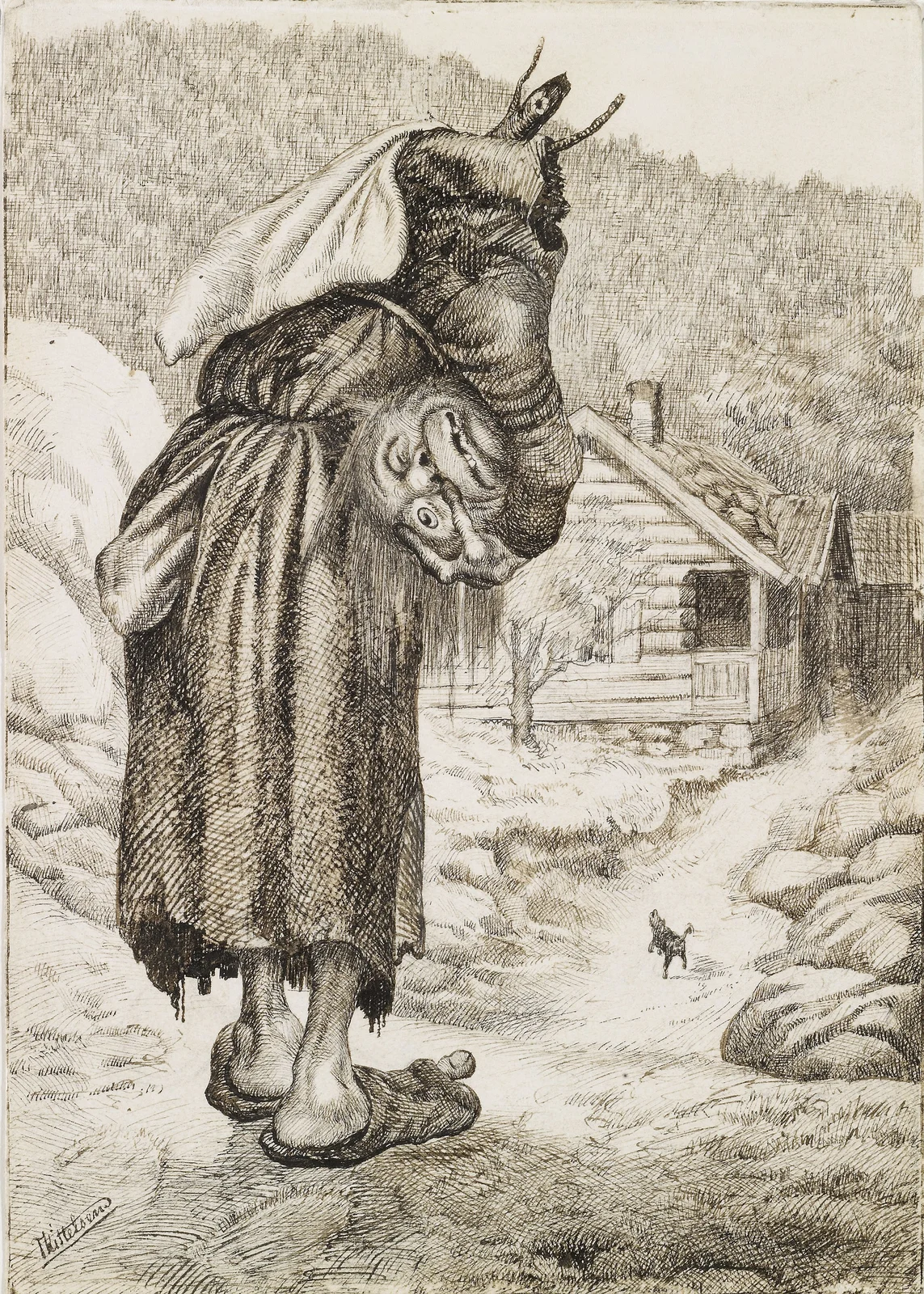
Kittelsen’s towering hag carries her detached head beneath one arm and a large sack on her back while approaching a cottage; a small barking dog stands on the path.
Kittelsen’s illustration to Smørbukk (Buttercup) depicts the approaching hag with her head beneath her arm and a sack on her back. The museum dates the drawing to1883.
Overview
Buttercup's mother's dog warns of a huge witch approaching with her head under her arm and a sack on her back. The boy hides beneath a kneading trough, but silver cutlery draws him out. Claiming stiffness, the witch asks him to enter her bag and fetch the gift himself, then carries him away. Twice he escapes while she sleeps and replaces himself with a heavy object.
On the third attempt she goes directly home and orders her daughter to prepare the boy as food while she visits church. Buttercup reverses their plans and escapes to the roof, eventually killing the returning household and taking its treasure. The head-under-arm appearance is repeatedly explicit; the narrative does not explain how the hag speaks or functions in that state. Her churchgoing also complicates a simple equation between monstrous bodies and an entirely separate world.
Origins & earliest records
Buttercup belongs to the Norwegian collected corpus translated by Dasent in Popular Tales from the Norse, first published in 1859. Its electronic witness retains a second-edition notice. The witch is unnamed, so this profile uses an openly descriptive title tied to her victim and visible attribute, without claiming an independently attested native creature name.
Records & interpretation
The story repeats the witch's head-under-arm appearance across three visits and supplies the sack, silver gifts and household feast as recognisable episode details. The evidence is literary and narrative, not medical or zoological. It supports this particular child-eating antagonist; it does not demonstrate that Norwegian witches generally carried detachable heads or visited churches.
In the literature
“with her head under her arm”
Tale XVIII, Buttercup; First dog warning about the approaching hag · George Webbe Dasent
The warning describes this particular hag’s detachable-head appearance.
Selected bibliography
Documented works and useful reading. This is not a list of every appearance.
- 01
Buttercup (Popular Tales from the Norse)
Inspected named tale XVIII. Electronic witness includes a notice to the second edition; its exact print date is unresolved.
- 02
Popular Tales from the Norse — Buttercup
Dasent historical English translation of Asbjørnsen and Moe. Hosted PG8933 text includes a Second Edition notice but does not establish the exact selected print edition date or printed pagination. The 1859 first English publication is context, not an asserted date for this selected witness. Exact observed HTML tale anchors and narrative episodes provide locators.
Family, evolution & connections
Buttercup’s head-carrying hag and her daughter
XVIII, Buttercup only.
Scroll sideways to see all branches. With a keyboard, focus the tree and use the arrow keys.
- Unnamed daughter
Explicit family relationships in the named translated tale. The story explicitly identifies her daughter and separately her husband. It does not explicitly identify the husband as the daughter’s father, so that paternal link is omitted.
The hag’s unnamed daughter in Buttercup
The hag orders her daughter to cook Buttercup while she attends church. Buttercup instead kills the daughter. The hag also has a husband, but the tale does not explicitly make him the daughter’s father.
Located primary passages
Specific passages supporting details in this entry, grouped by their published witness.
Popular Tales from the Norse — Buttercup
Dasent historical English translation of Asbjørnsen and Moe. Hosted PG8933 text includes a Second Edition notice but does not establish the exact selected print edition date or printed pagination. The 1859 first English publication is context, not an asserted date for this selected witness. Exact observed HTML tale anchors and narrative episodes provide locators.
- The dog warns of a hag carrying her head under her arm. A silver knife tempts Buttercup into her sack; while she sleeps he cuts his way out and substitutes a fir-tree root.
Tale XVIII, Buttercup; First visit; silver knife and root substitution
- A silver spoon prompts a second capture, escaped by leaving a stone that breaks the boiling pot. On the third visit a silver fork tempts him and the hag carries him straight home without stopping.
Tale XVIII, Buttercup; Second and third visits; stone escape and capture
- Left for the daughter to kill while the household goes to church, Buttercup tricks and kills her. He cooks her in his place and sets her head in bed, then kills the returning household with the saved root and stone from the roof, taking its wealth home.
Tale XVIII, Buttercup; Hag’s daughter, roof trap and return home
Complete named tale read. No invented print pages, exact selected edition date, earliest attestation or general rule for all members of a creature class is inferred.
References
Sources supporting this profile. Linked pages have their own scope and editorial standards.
- Primary textPopular Tales from the Norse — Buttercup (tale XVIII)Research access: 2026-10-05
Image credits
Historical story illustrationKittelsen’s towering hag carries her detached head beneath one arm and a large sack on her back while approaching a cottage; a small barking dog stands on the path.
Kittelsen’s illustration to Smørbukk (Buttercup) depicts the approaching hag with her head beneath her arm and a sack on her back. The museum dates the drawing to1883.