Man o’ the Hill (The Old Dame and Her Hen)
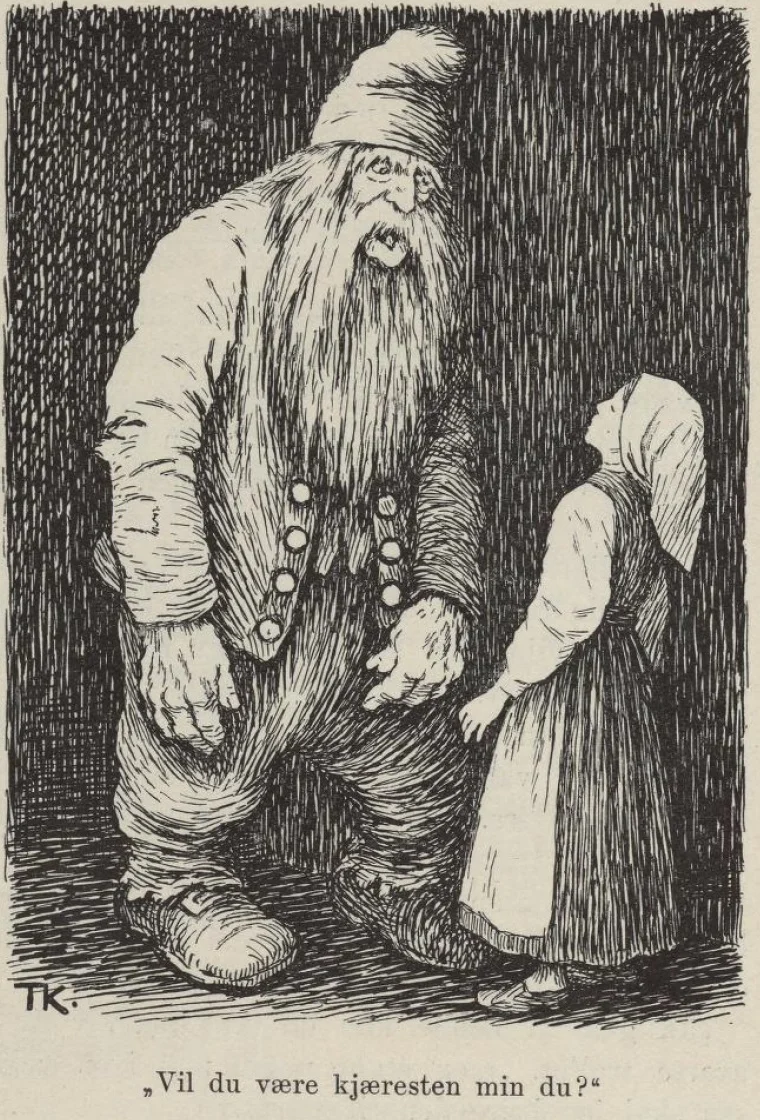
Directly inspected: large bearded hill-dweller addresses young woman; printed proposal caption. Exact named Hona tripper i Berget illustration in Barne-eventyr1915p22 by Theodor Kittelsen(1857–1914), matching this tale antagonist.
Overview
A missing hen draws three sisters, one after another, into a rocky cleft and through a trapdoor into richly furnished underground rooms. The resident, called Man o' the Hill and ogre in Dasent's translation, demands each girl's affection. He kills the two who refuse. Their youngest sister discovers their bodies and pretends to accept him, gaining enough freedom to observe his household.
When he kills a visiting goat and then restores it with ointment, she learns how to revive her sisters. He unknowingly carries each home in a sack, mistaking their warnings for her supposedly distant sight. She finally leaves a straw dummy and escapes herself. A gunshot frightens the pursuer because he thinks it is thunder; he bursts on returning at sunrise. His riches, restorative substance and vulnerabilities belong to this individual tale.
Origins & earliest records
The Old Dame and Her Hen is one of the Norwegian tales collected by Asbjørnsen and Moe and translated by Dasent in his English collection of 1859. The inspected later-edition electronic text uses several English labels for the same hill-dweller. Those translation terms do not establish a separate native species or a first oral date.
Records & interpretation
The primary story supplies underground rooms, fatal rejection of marriage, restorative ointment and deception through transported sacks. It also expressly distinguishes the gunshot from the thunder imagined by the ogre. These are textual witnesses to a wonder-tale antagonist and escape plot, not physical evidence of underground inhabitants or a verified method for reviving the dead.
In the literature
“the sun rose and the Man o’ the Hill burst.”
Tale III, The Old Dame and Her Hen; Final pursuit and retreat · George Webbe Dasent
The final sentence connects the monster’s bursting with sunrise during his retreat.
Selected bibliography
Documented works and useful reading. This is not a list of every appearance.
- 01
The Old Dame and Her Hen (Popular Tales from the Norse)
Inspected named tale III. Electronic witness includes a notice to the second edition; its exact print date is unresolved.
- 02
Popular Tales from the Norse — The Old Dame and Her Hen
Dasent historical English translation of Asbjørnsen and Moe. Hosted PG8933 text includes a Second Edition notice but does not establish the exact selected print edition date or printed pagination. The 1859 first English publication is context, not an asserted date for this selected witness. Exact observed HTML tale anchors and narrative episodes provide locators.
Family & connections
A source-supported family tree or inspiration record has not yet been compiled for this profile. Related reading below indicates a connection in subject matter, not a proven lineage or creative influence.
Located primary passages
Specific passages supporting details in this entry, grouped by their published witness.
Popular Tales from the Norse — The Old Dame and Her Hen
Dasent historical English translation of Asbjørnsen and Moe. Hosted PG8933 text includes a Second Edition notice but does not establish the exact selected print edition date or printed pagination. The 1859 first English publication is context, not an asserted date for this selected witness. Exact observed HTML tale anchors and narrative episodes provide locators.
- A hidden trap beneath the hill admits the sisters to the Man o’ the Hill’s house. He kills the first two after they refuse him; the youngest discovers their bodies and feigns agreement.
Tale III, The Old Dame and Her Hen; Missing hen and three successive daughters
- After seeing him restore a beheaded goat with ointment, the youngest sister revives her sisters in the same way and sends them home concealed in sacks with food and treasure.
Tale III, The Old Dame and Her Hen; Revived goat, flask and rescued sisters
- She leaves a clothed straw figure while escaping home. A sharpshooter’s gunfire frightens the pursuing Man o’ the Hill, who runs back toward his hill and bursts at sunrise.
Tale III, The Old Dame and Her Hen; Straw substitute, flight, gunfire and sunrise
Complete named tale read. No invented print pages, exact selected edition date, earliest attestation or general rule for all members of a creature class is inferred.
References
Sources supporting this profile. Linked pages have their own scope and editorial standards.
- Primary textPopular Tales from the Norse — The Old Dame and Her Hen (tale III)Research access: 2026-10-05
Image credits
Historical illustrationMan o’ the Hill (The Old Dame and Her Hen)
Directly inspected: large bearded hill-dweller addresses young woman; printed proposal caption. Exact named Hona tripper i Berget illustration in Barne-eventyr1915p22 by Theodor Kittelsen(1857–1914), matching this tale antagonist.