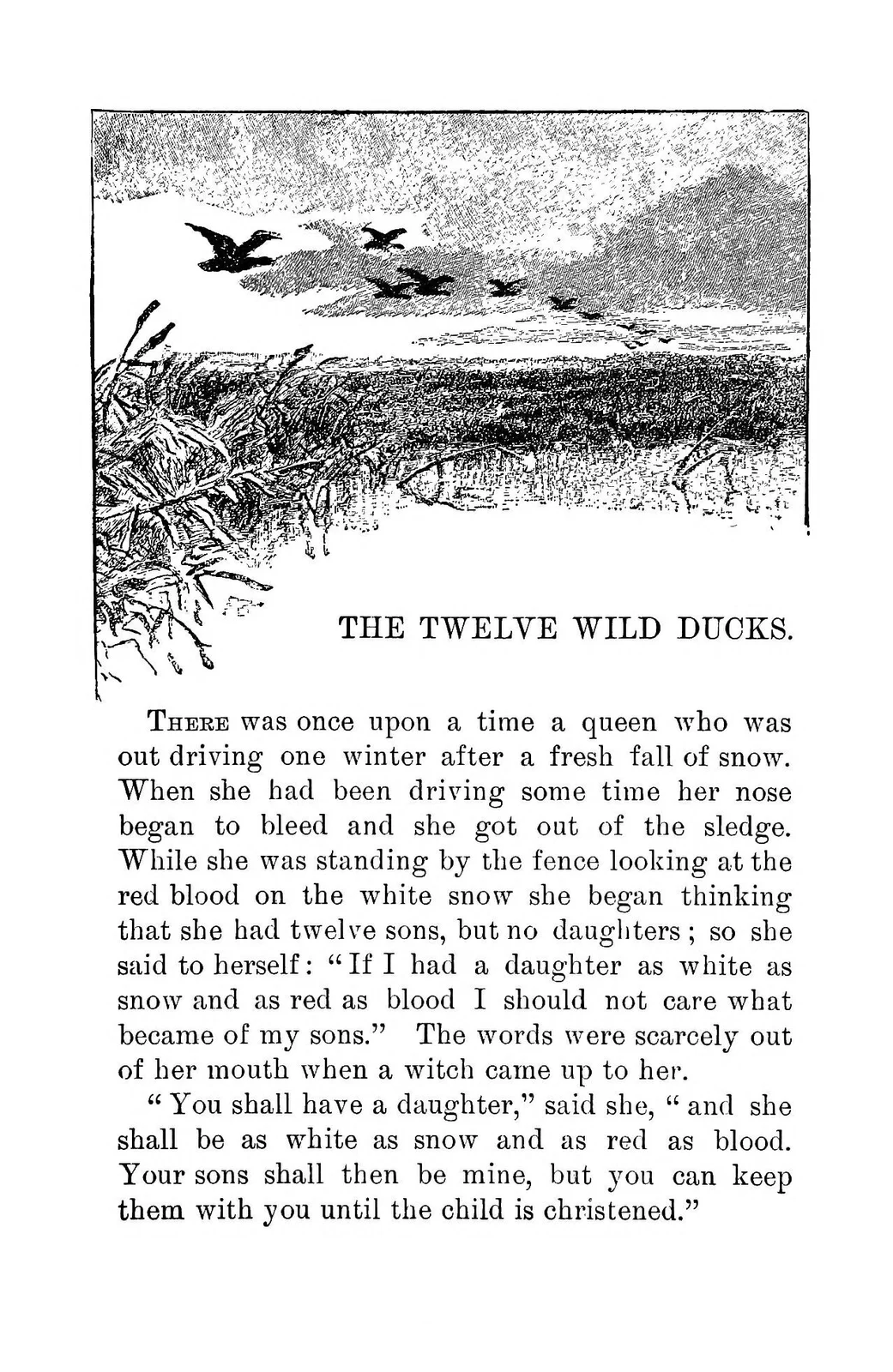
The Twelve Wild Ducks: illustrated flock above a marsh
A flock of wild ducks introduces the named tale about twelve enchanted brothers in Braekstad’s translation. The heading connects this marsh scene to their story; it does not establish a zoological species or individually distinguish every brother.
Overview
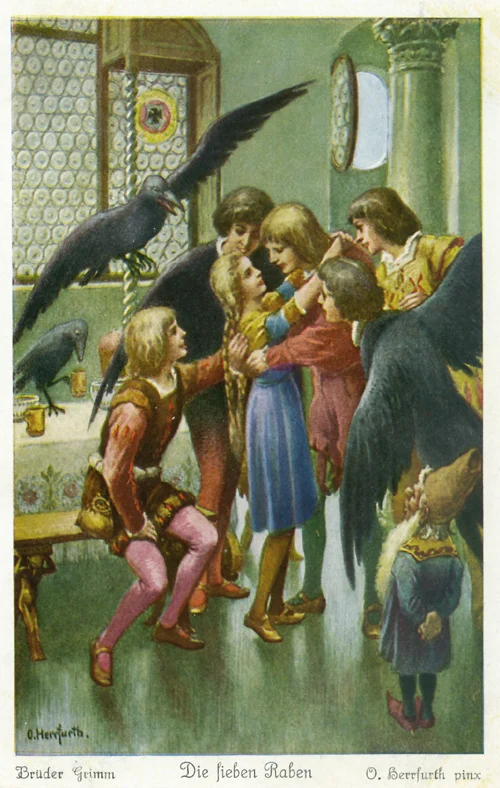
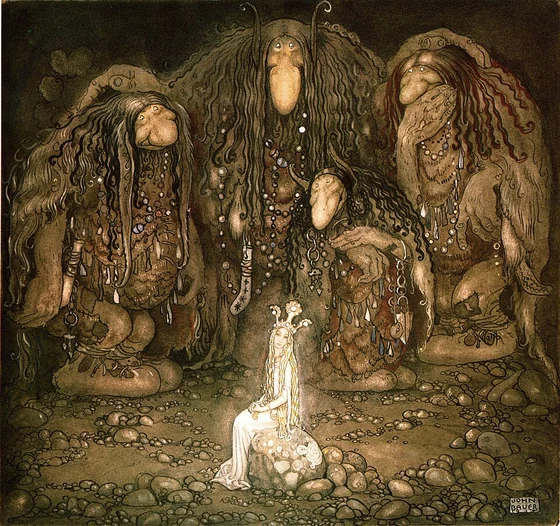
A queen's longing for a daughter leads to a bargain with an old troll witch: her twelve sons will belong to the witch after the girl's christening. The sons become wild ducks and leave the palace. Their grown sister discovers what happened and searches for them. In a woodland house, twelve beds, chairs and silver spoons reveal their household; crossing its threshold at night restores their human appearance.
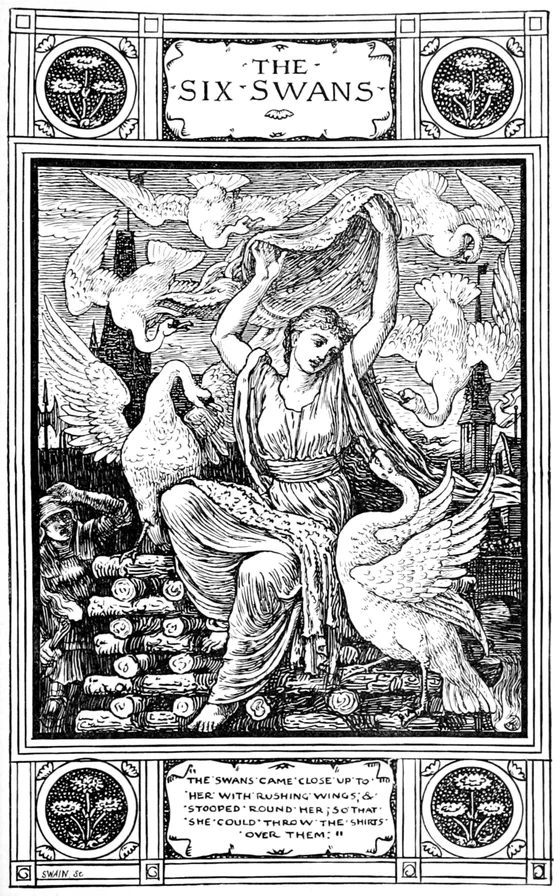
The youngest brother persuades the others that their sister should not bear the blame for their mother's bargain. To free them, she must make twelve sets of clothing from thistle down without speaking, laughing or weeping. False accusations nearly bring her execution, but the ducks arrive and receive the finished clothes. The youngest brother's shirt lacks one arm, leaving him with a wing. This Norwegian tale is distinct from Grimm's raven and swan sibling narratives.
Origins & earliest records
Asbjørnsen and Moe collected the Norwegian tale subsequently translated by Dasent as The Twelve Wild Ducks. His collection first appeared in English in 1859; this inspected electronic witness carries a second-edition notice without a securely dated print title page. The date therefore concerns literary transmission, not the origin of the brothers' transformation motif.
Records & interpretation
The primary narrative distinguishes daytime ducks, nighttime human brothers and the incomplete release marked by a remaining wing. Silver spoons and the sister's thistle clothing are concrete recognition and rescue devices. These details document a collected wonder tale, not duck biology. Similar sibling transformations elsewhere do not establish that separate tales concern the same individuals.
In the literature
“the youngest prince had a wild duck’s wing instead of his left arm”
Tale VIII, The Twelve Wild Ducks; Clothing thrown onto the ducks at the pyre · George Webbe Dasent
The incomplete left sleeve leaves one brother only partly restored.
Selected bibliography
Documented works and useful reading. This is not a list of every appearance.
- 01
The Twelve Wild Ducks (Popular Tales from the Norse)
Inspected named tale VIII. Electronic witness includes a notice to the second edition; its exact print date is unresolved.
- 02
Popular Tales from the Norse — The Twelve Wild Ducks
Dasent historical English translation of Asbjørnsen and Moe. Hosted PG8933 text includes a Second Edition notice but does not establish the exact selected print edition date or printed pagination. The 1859 first English publication is context, not an asserted date for this selected witness. Exact observed HTML tale anchors and narrative episodes provide locators.
Family, evolution & connections
The queen’s transformed sons and daughter
VIII, The Twelve Wild Ducks only.
Scroll sideways to see all branches. With a keyboard, focus the tree and use the arrow keys.
- Unnamed queen
- Snow-white and Rosy-red (one daughter)
Explicit family relationships in the named translated tale. The daughter’s double name denotes one girl, not the two Grimm sisters. No unnamed father is supplied. Transformations are narrative events, not biological evolution.
Snow-white and Rosy-red (Dasent’s single daughter)
In this tale, the queen’s twelve sons become wild ducks when their younger sister is christened. Snow-white and Rosy-red is one girl’s name, not the two sisters of the differently titled Grimm story.
Located primary passages
Specific passages supporting details in this entry, grouped by their published witness.
Popular Tales from the Norse — The Twelve Wild Ducks
Dasent historical English translation of Asbjørnsen and Moe. Hosted PG8933 text includes a Second Edition notice but does not establish the exact selected print edition date or printed pagination. The 1859 first English publication is context, not an asserted date for this selected witness. Exact observed HTML tale anchors and narrative episodes provide locators.
- A Troll grants the queen a wished-for daughter in exchange for her twelve sons. At the girl’s christening they become wild ducks; later their sister finds their house and sees them as princes at night.
Tale VIII, The Twelve Wild Ducks; Queen’s wish, Troll’s condition and christening
- The brothers require their sister to make twelve sets of thistle-down clothes without speaking, laughing or weeping. She continues after marrying a king while his mother steals her children and accuses her of eating them.
Tale VIII, The Twelve Wild Ducks; Thistle-down garments, silence and persecution
- She throws the clothes over the arriving ducks and they become princes, except the youngest retains one wing where his sleeve is unfinished. She can finally speak, the missing children are recovered and the persecuting queen is punished.
Tale VIII, The Twelve Wild Ducks; Rescue at the pyre, incomplete sleeve and children’s restoration
Complete named tale read. No invented print pages, exact selected edition date, earliest attestation or general rule for all members of a creature class is inferred.
References
Sources supporting this profile. Linked pages have their own scope and editorial standards.
- Primary textPopular Tales from the Norse — The Twelve Wild Ducks (tale VIII)Research access: 2026-10-05
Image credits
Historical illustrationThe Twelve Wild Ducks: illustrated flock above a marsh
A flock of wild ducks introduces the named tale about twelve enchanted brothers in Braekstad’s translation. The heading connects this marsh scene to their story; it does not establish a zoological species or individually distinguish every brother.