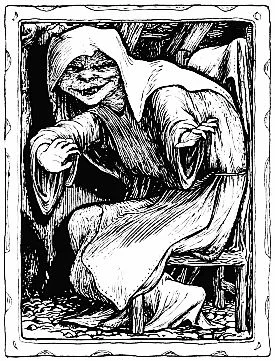
Batten: Mary Kerwan in her aged human appearance
Paddy O’Kelly and the Weasel illustration shows the old woman in the hut; adjacent narrative identifies the weasel’s human appearance as Mary Kerwan. John Dickson Batten (1860–1932) credited by title page. Selected title-page edition 1895.
Overview
Paddy shelters in a house near Tuam and watches a weasel repeatedly carry guineas to the hearth. He takes the accumulated money and uses some to buy a horse. The animal pursues him and attacks his new possessions; eventually he finds the horse, cows and calves dead. Following the weasel with a dog leads him to a lakeside hut where an old woman first denies knowing it, then acknowledges the stolen gold and identifies herself as Mary Kerwan.
She says she has collected gold for five centuries after a grave offence in youth, whose nature she does not specify. Within the tale she seeks religious assistance and offers Paddy another hidden treasure, naming the black dog that emerges from it as her son. The later cellar companion likewise identifies her as his mother. Mary predicts that she has only a month left, and the son eventually announces her death. Paddy follows the arrangement and receives further supernatural wealth. Her animal form should not be treated as an ordinary predatory weasel report, while the account’s religious framework remains attributed to the narrative rather than offered as practical instruction or a judgement of a real woman.
Origins & earliest records
Jacobs’s selected 1895 More Celtic Fairy Tales cites Hyde’s Beside the Fire, pages 73–91. The complete adapted story supplies Mary’s name, claimed age and maternal relationship. The five-century claim is internal testimony, not an independently dated life or oral origin.
Records & interpretation
The weasel’s pursuit, human disclosure and supernatural treasure are textual evidence. No actual animal transformation or historical identity has been verified. The religious request belongs to the story’s moral framework, and her unnamed youthful offence remains unspecified.
In the literature
“my gold that I was gathering for five hundred years throughout the hills and hollows of the world”
Paddy O'Kelly and the Weasel; p.49, the hag explains her accumulated treasure
Paddy steals the weasel’s accumulated guineas. She pursues him, attacks his new horse and kills livestock in his byre. Tracking her with a dog leads to a sick old woman who bargains when the dog attacks. She explains the gold was gathered over five hundred years and names herself Mary Kerwan.
Selected bibliography
Documented works and useful reading. This is not a list of every appearance.
- 01
More Celtic Fairy Tales: Paddy O’Kelly and the Weasel
Full selected episode and relevant editorial source note inspected; cited earlier collections remain attributed, not falsely claimed as newly read.
- 02
More Celtic Fairy Tales — Paddy O'Kelly and the Weasel
Joseph Jacobs, More Celtic Fairy Tales, New York: G.P.Putnam’s Sons; London:D.Nutt,1895, selected title page verified. Compiler acknowledges simplification and insertion of parallel incidents; each relevant source note supplies transmission claims. Historical English text, modern transcription; original illustration rights separate.
Family, evolution & connections
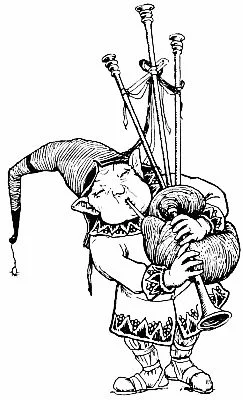
Mary Kerwan and her piper son in Jacobs’s retelling
The cellar piper’s mother is identified through Paddy’s conversation and the later death announcement.
Scroll sideways to see all branches. With a keyboard, focus the tree and use the arrow keys.
Explicit family statements in the named Jacobs retelling. Mary also calls the black dog her son. The episode supplies no narrated dog-to-piper transformation; that scene is not invented here. This is a tale-specific family, not a species genealogy.
Donal the Fairy Piper
Paddy refers to the piper’s mother’s secret; Donal later announces her death, and Paddy burns Mary’s hut as she instructed.
Black dog released from beneath the flag
Mary expressly calls the black dog her son. No dog-to-piper transformation scene is narrated, so this reference does not supply one.
Located primary passages
Specific passages supporting details in this entry, grouped by their published witness.
More Celtic Fairy Tales — Paddy O'Kelly and the Weasel
Joseph Jacobs, More Celtic Fairy Tales, New York: G.P.Putnam’s Sons; London:D.Nutt,1895, selected title page verified. Compiler acknowledges simplification and insertion of parallel incidents; each relevant source note supplies transmission claims. Historical English text, modern transcription; original illustration rights separate.
- Paddy steals the weasel’s accumulated guineas. She pursues him, attacks his new horse and kills livestock in his byre. Tracking her with a dog leads to a sick old woman who bargains when the dog attacks. She explains the gold was gathered over five hundred years and names herself Mary Kerwan.
Paddy O'Kelly and the Weasel; pp.46–49, gold theft, retaliation and hag identification
- Mary connects her suffering to a youthful crime and asks for masses, directing Paddy to buried treasure. She explicitly calls the black dog emerging from the pot her son and directs Paddy to purchase the first house, where her son will be in the cellar. The text gives directions, not a separate narrated confirmation that the masses were paid.
Paddy O'Kelly and the Weasel; pp.49–50, treasure bargain and named son
- The cellar piper announces his mother’s death; Paddy finds the hag dead and burns the hut as instructed. The piper gives him an inexhaustible purse, calls the weasel the origin of his wealth and departs permanently. No return to ordinary weasel life is narrated.
Paddy O'Kelly and the Weasel; p.56, death and final acknowledgment
Complete named tale independently read. Named source paragraphs and preface checked; extensive comparative Lir commentary was only partly read and its conclusions are not adopted. No verse, prayers or ritual formulas reproduced. Earlier editions and manuscripts remain indirect.
Primary source witness
Joseph Jacobs, More Celtic Fairy Tales, New York: G.P.Putnam’s Sons; London:D.Nutt,1895, selected title page verified. Compiler acknowledges simplification and insertion of parallel incidents; each relevant source note supplies transmission claims. Historical English text, modern transcription; original illustration rights separate.
- Jacobs credits Douglas Hyde’s Beside the Fire pp73–91. This verifies the compiler’s stated source; Hyde’s underlying edition and the unnamed grandmother at the tale’s conclusion have not been independently verified in this pass.
Verifies the compiler’s stated source, not the uninspected cited edition or asserted earliest manuscript.
References
Sources supporting this profile. Linked pages have their own scope and editorial standards.
- Primary textJacobs, More Celtic Fairy Tales: Paddy O’Kelly and the Weasel and source noteResearch access: 2026-10-05
Image credits
Historical illustrationBatten: Mary Kerwan in her aged human appearance
Paddy O’Kelly and the Weasel illustration shows the old woman in the hut; adjacent narrative identifies the weasel’s human appearance as Mary Kerwan. John Dickson Batten (1860–1932) credited by title page. Selected title-page edition 1895.