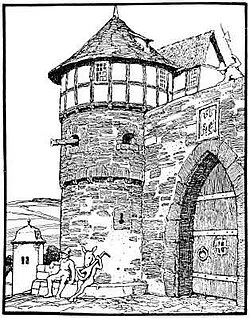
Donkey Prince plays his lute at the castle gate, Otto Ubbelohde,1909
Actual donkey-shaped figure stands with stringed instrument at castle gate; exact musical entry scene. Earlier accepted human release scene retained separately.
Overview
A childless royal couple receives a son who appears as a little donkey. His mother rejects him, but his father insists that he remain the heir. Growing tall-eared and cheerful, he persists in learning the lute despite a teacher's doubts about his limbs. Seeing his reflection distressingly reminds him of his body, and he travels with a loyal companion to another king's court.
His music gains entry, and his confidence wins a place beside the king and princess rather than with the servants. After marriage he removes his donkey skin in private and appears as a handsome young man, replacing it before dawn. A hidden servant reports this, prompting the king to burn the skin. The prince fears he must flee but is invited to stay and inherit. The tale names no witch who imposed the appearance.
Origins & earliest records
The Donkey is Grimm's numbered tale144, Das Eselein, selected through Margaret Hunt's English Household Tales of1884. The printed story joins donkey-shaped birth with a removable skin after marriage, without explaining the transition's mechanism. This is a specific literary attestation; it should not be treated as the first occurrence of all animal-bridegroom narratives or an observed royal biography.
Records & interpretation
The source directly records the donkey heir's musical training, status claims, private human appearance and burned skin. It does not call the form a costume worn for deception, nor explain an original curse. These details establish the narrative's concealed identity and release. They are textual evidence, not medical evidence of animal-shaped births or zoological evidence about donkeys playing instruments.
Additional images
 View larger
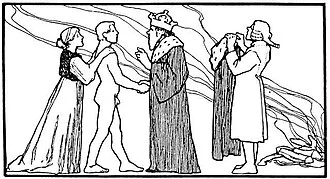
 Donkey Prince in released human form beside bride and king, Otto Ubbelohde,1909
Actual human prince faces his bride and king; discarded donkey skin lies at right. Human release scene, not donkey anatomy.
In the literature
“he suddenly threw off his ass’s skin”
Tale 144, The Donkey; The bridal chamber before the hidden servant · Margaret Hunt
The youth’s animal covering can be removed and is resumed the next morning.
Selected bibliography
Documented works and useful reading. This is not a list of every appearance.
- 01
Household Tales, tale 144: The Donkey
Specific numbered primary tale inspected. English translation terms and literary transmission remain distinct from oral origin.
- 02
Household Tales — The Donkey
Margaret Hunt historical English translation (1884); Project Gutenberg5314. Exact numbered tale and observed HTML anchor used; no inferred printed page or earliest oral date.
Family, evolution & connections
The donkey-shaped prince’s parents
Only the named numbered tale in Hunt’s 1884 Grimm translation.
Scroll sideways to see all branches. With a keyboard, focus the tree and use the arrow keys.
- Unnamed king and queen (joint parent pair)
Explicit parentage and birth order in the primary narrative. The second king later becomes a father-in-law and is not substituted for the prince’s own father. Animal form is a literary condition, not zoological hybridity.
The king and queen in The Donkey
The queen gives birth to a donkey-shaped child, and the king accepts him as his son and heir. These are explicit narrative parents; no animal father is supplied.
The daughter of the second king in The Donkey
The donkey-shaped prince marries the daughter of the king whose court receives him. That king is his father-in-law, while his own father belongs to the earlier royal household.
Hans the Hedgehog
Both tales use the burning of an animal skin in the husband’s bedchamber to end his extraordinary form. Hans’s burning is arranged by himself, whereas the donkey prince’s father-in-law acts after surveillance. This compares the recorded plots without asserting direct borrowing.
Located primary passages
Specific passages supporting details in this entry, grouped by their published witness.
Household Tales, tale 144: The Donkey
Margaret Hunt historical English translation (1884); Project Gutenberg5314. Exact numbered tale and observed HTML anchor used; no inferred printed page or earliest oral date.
- A queen bears a donkey; the king preserves him as heir despite her wish to destroy him. He perseveres until he masters the lute, travels to another court and insists on a noble place at table before winning its princess.
Tale 144, The Donkey; Royal birth, musical training and foreign court
- In the bridal room the donkey removes his skin and becomes a royal youth, then resumes it in the morning. A hidden servant reports this; the king burns the discarded skin and persuades the anxious youth to remain, granting the kingdom. The origin of his form is unexplained.
Tale 144, The Donkey; Removable skin and the king’s intervention
Complete named tale read. Original narrative curse causes and modern species identities are not inferred; prose only, no song or ritual-formula excerpts.
References
Sources supporting this profile. Linked pages have their own scope and editorial standards.
- Primary textHunt's Household Tales — 144 The DonkeyResearch access: 2026-10-05
Image credits
Historical illustrationDonkey Prince plays his lute at the castle gate, Otto Ubbelohde,1909
Actual donkey-shaped figure stands with stringed instrument at castle gate; exact musical entry scene. Earlier accepted human release scene retained separately.
Further credits appear with each additional image.