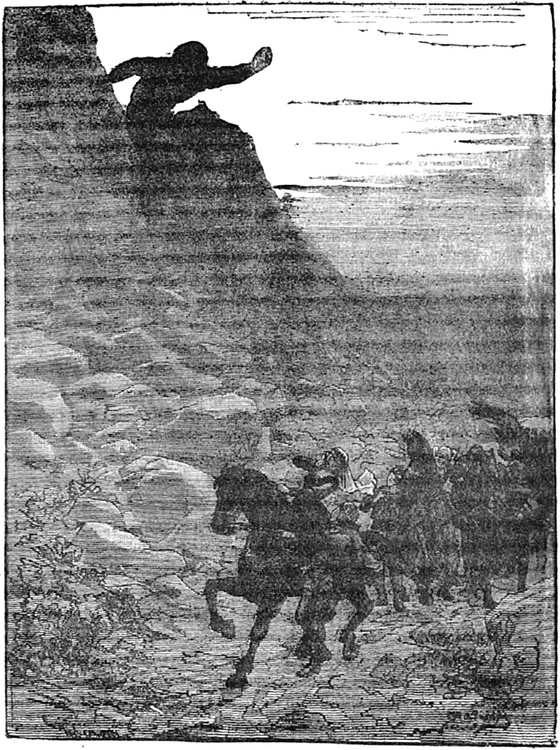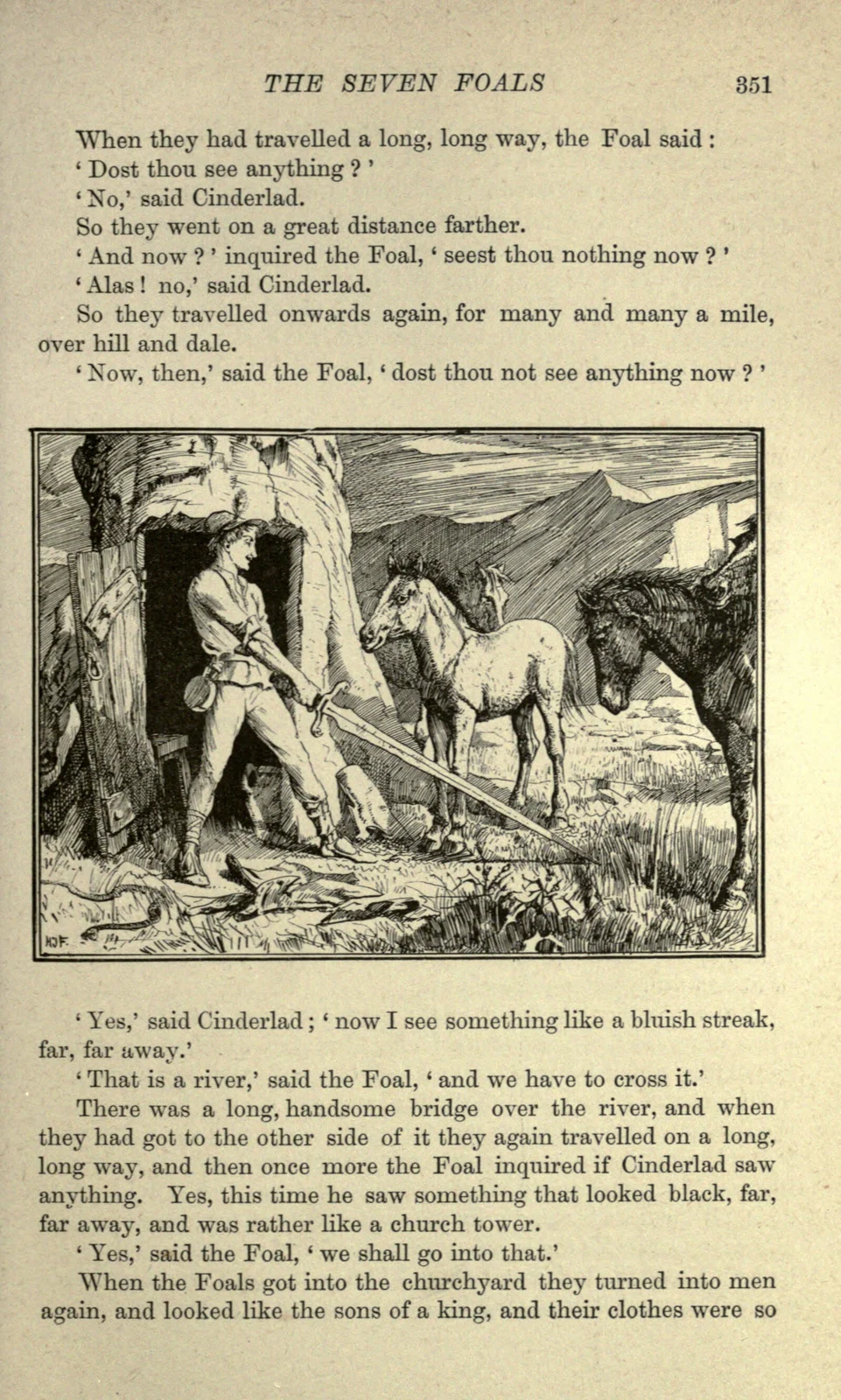
The enchanted foals show their watcher the great sword, H. J. Ford, 1890
The foals gather around their watcher as he raises the great sword from the hidden room. This belongs to Lang’s 1890 Seven Foals adaptation; the nearby text follows their journey toward the church and temporary restoration as royal brothers.
Overview
A king offers his daughter and half his kingdom to anyone who can follow his seven foals all day and correctly report what they eat and drink. Two brothers fail after an old spinning woman lulls them into idleness. Boots resists her invitation and holds a foal's tail. The youngest animal then speaks, offers him a ride and leads the group along its extraordinary route.
At a hidden room, the foals reveal a sword and explain that they are the princess's brothers, transformed by a troll. They become princes in a churchyard, enter the church to receive bread, wine and a blessing, then resume animal form outside. Boots brings proof of their food and drink to the king. At his wedding, he follows their prescribed release and restores all seven permanently. Their Christian destination belongs to this particular collected version.
Origins & earliest records
The Seven Foals appears in Asbjørnsen and Moe's Norwegian tale collection and Dasent's English translation, first published in 1859. The selected electronic text includes a second-edition notice but leaves its precise print date unresolved. Its account of a church visit is evidence of this transmitted version, not a reliable date for the motif's oral beginnings.
Records & interpretation
The narrative explicitly states that an unnamed troll transformed seven royal brothers and describes their temporary human return at a church. Speech, unusual travel and the final release distinguish these foals from ordinary horses. Bread and wine are plot evidence within a Christianised wonder tale; they do not establish an observed practice of animal transformation.
In the literature
“an ugly Troll has thrown this shape over us.”
Tale XLIII, The Seven Foals; Youngest foal’s explanation of the enchantment · George Webbe Dasent
The speaking animal identifies the cause of the seven brothers’ transformation.
Selected bibliography
Documented works and useful reading. This is not a list of every appearance.
- 01
The Seven Foals (Popular Tales from the Norse)
Inspected named tale XLIII. Electronic witness includes a notice to the second edition; its exact print date is unresolved.
- 02
Popular Tales from the Norse — The Seven Foals
Dasent historical English translation of Asbjørnsen and Moe. Hosted PG8933 text includes a Second Edition notice but does not establish the exact selected print edition date or printed pagination. The 1859 first English publication is context, not an asserted date for this selected witness. Exact observed HTML tale anchors and narrative episodes provide locators.
Family, evolution & connections
The king’s seven transformed sons and daughter
XLIII, The Seven Foals only.
Scroll sideways to see all branches. With a keyboard, focus the tree and use the arrow keys.
- Unnamed king
- Unnamed princess, their sister
Explicit family relationships in the named translated tale. The princes explicitly call the princess their sister; the king subsequently calls them his sons. The queen or other parent is not named. Boots is the princess’s bridegroom, not one of the brothers.
The unnamed princess in The Seven Foals
The seven foals explicitly identify themselves as the princess’s brothers. After their restoration, the king calls them his sons. Their horse form is an imposed enchantment, not the origin of a horse species.
Located primary passages
Specific passages supporting details in this entry, grouped by their published witness.
Popular Tales from the Norse — The Seven Foals
Dasent historical English translation of Asbjørnsen and Moe. Hosted PG8933 text includes a Second Edition notice but does not establish the exact selected print edition date or printed pagination. The 1859 first English publication is context, not an asserted date for this selected witness. Exact observed HTML tale anchors and narrative episodes provide locators.
- The king offers his daughter and half the kingdom for correctly reporting the foals’ diet. The first two brothers are distracted by a hag and fail; Boots refuses her delay and rides a foal.
Tale XLIII, The Seven Foals; Watching task and older brothers deceived
- The speaking foal explains that a Troll has transformed seven brothers of the princess and tells Boots how a sword can release them. The foals become princes in a churchyard and take bread and wine in church before returning to animal form outside.
Tale XLIII, The Seven Foals; Sword instructions and churchyard transformation
- Boots reports the church food correctly and wins the marriage. On the wedding day he obeys the instructions to behead all seven foals and set each head by its body’s tail, restoring the princes.
Tale XLIII, The Seven Foals; Correct report, wedding and removal of seven heads
Complete named tale read. No invented print pages, exact selected edition date, earliest attestation or general rule for all members of a creature class is inferred.
References
Sources supporting this profile. Linked pages have their own scope and editorial standards.
- Primary textPopular Tales from the Norse — The Seven Foals (tale XLIII)Research access: 2026-10-05
Image credits
Historical illustrationThe enchanted foals show their watcher the great sword, H. J. Ford, 1890
The foals gather around their watcher as he raises the great sword from the hidden room. This belongs to Lang’s 1890 Seven Foals adaptation; the nearby text follows their journey toward the church and temporary restoration as royal brothers.