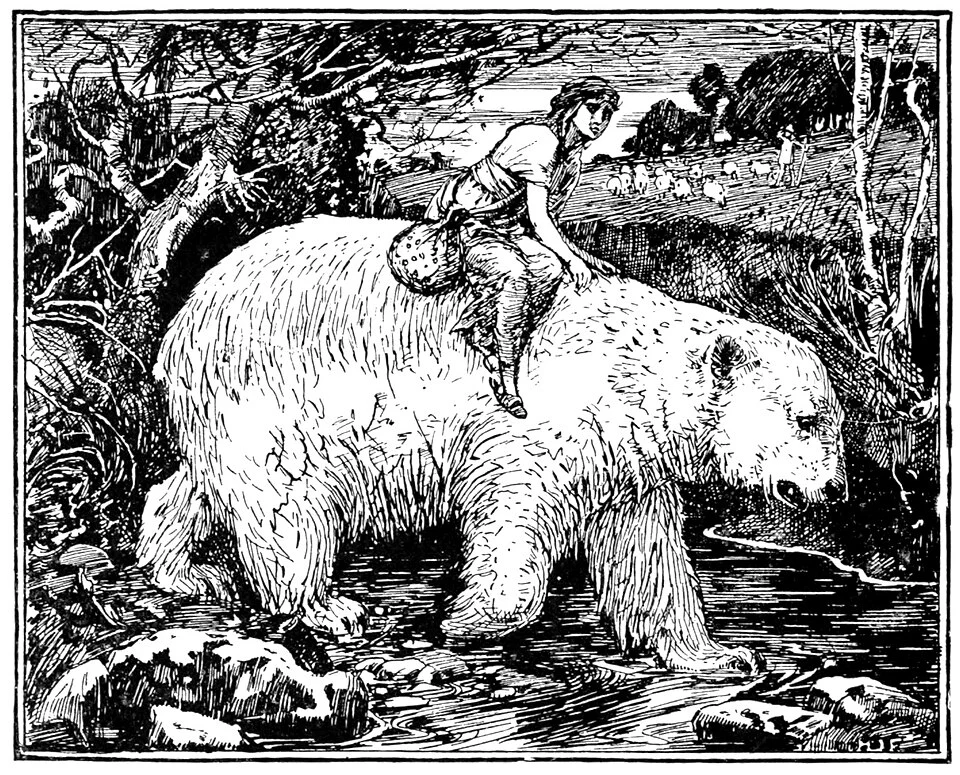
Enchanted White Bear carries the girl, Henry Justice Ford,1889
Actual bear transport scene individually inspected. HJF signature visible lower right establishes Henry Justice Ford, not Andrew Lang who edited the collection. Exact enchanted bear adaptation, distinct from the ordinary bear at Dovrefell.
Overview
The speaking white bear offers to enrich a poor household in exchange for its youngest daughter. After initial refusal, she agrees and rides his shaggy back to a golden and silver-lit castle inside a hill. A silver bell supplies whatever she needs. At night he sheds his animal shape and lies beside her, but leaves before daylight so she cannot see his human appearance.
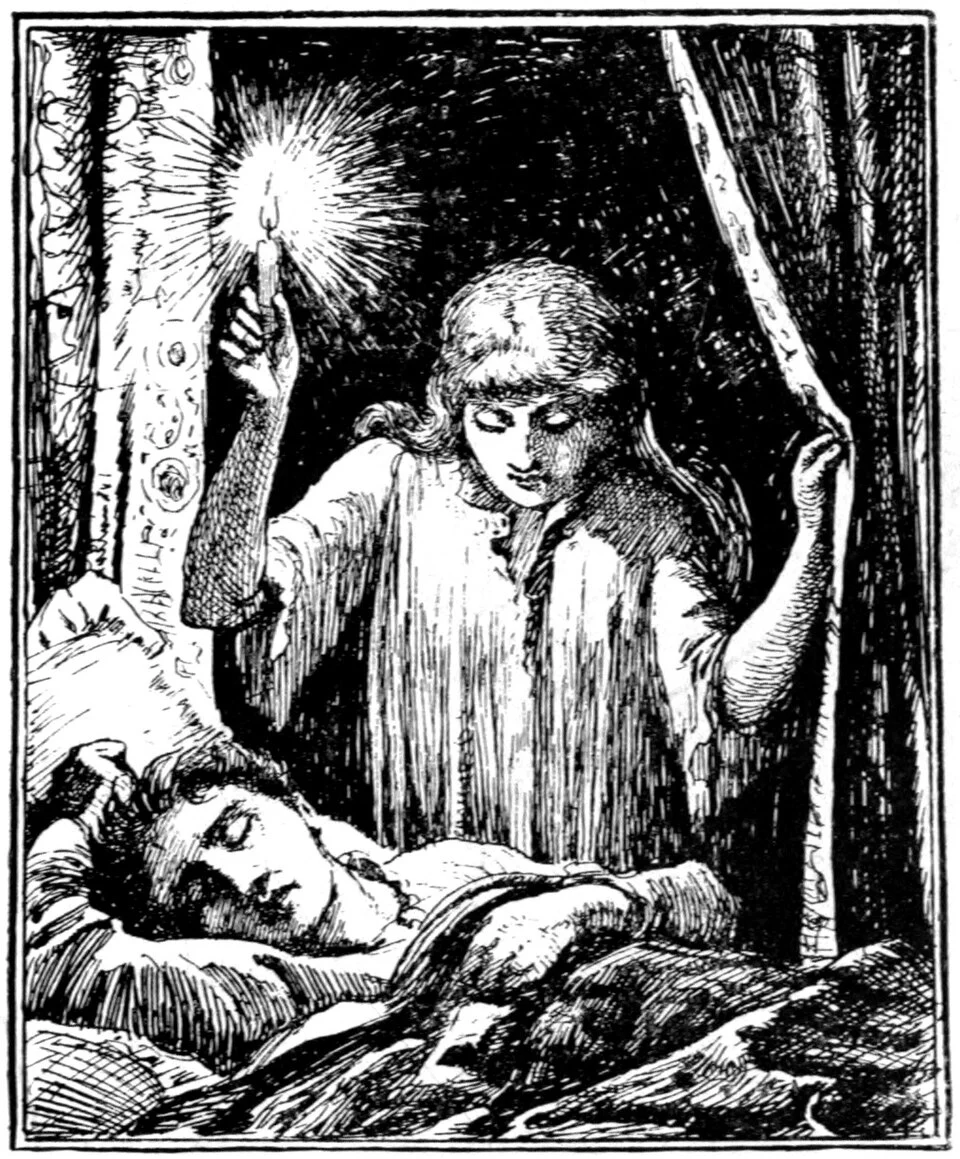
During a visit home, her mother urges her to light a candle. She sees a beautiful prince, but drops three hot drops of tallow on his shirt and wakes him. He explains that holding out for the prescribed year would have released him from his stepmother's spell; now he must marry a long-nosed princess in a remote castle. His companion reaches him with the winds' help, exchanging golden gifts for three visits. A sleeping drink prevents him hearing her until neighbouring captives warn him and he secretly discards it. She then wins the shirt-washing test: the tallow stains worsen under the trolls' washing but disappear when she dips the shirt in water.
Origins & earliest records
This particular white bear prince belongs to the Norwegian tale collected by Asbjørnsen and Moe and translated by Dasent, whose English collection first appeared in 1859. The selected electronic witness incorporates a second-edition notice but does not establish its print year. Animal-bridegroom parallels elsewhere are comparisons, not evidence that their protagonists are the same being.
Records & interpretation
The source explicitly distinguishes the prince's daytime bear form from his nighttime human body and names his stepmother as the enchanter. Candle tallow and the final washing trial connect discovery with release. This is a recorded wonder-tale transformation, not zoological evidence about white bears. The bear in The Cat on the Dovrefell is a separate ordinary animal.
Additional images
 View larger
 Enchanted White Bear prince in human form, candle inspection,1889
Actual candle-bearing girl beside sleeping human prince inspected. Depicts this enchanted individual in human form, not bear anatomy. Book illustrator credits verified in contemporary publisher list; individual plate artist not securely attributed.
In the literature
“I am a White Bear by day, and a Man by night”
Tale IV, East O’ the Sun and West O’ the Moon; Prince’s explanation after the tallow wakes him · George Webbe Dasent
He states the daily alternation imposed by his stepmother’s enchantment.
Selected bibliography
Documented works and useful reading. This is not a list of every appearance.
- 01
East O’ the Sun and West O’ the Moon (Popular Tales from the Norse)
Inspected named tale IV. Electronic witness includes a notice to the second edition; its exact print date is unresolved.
- 02
Popular Tales from the Norse — East O’ the Sun and West O’ the Moon
Dasent historical English translation of Asbjørnsen and Moe; hosted PG8933 includes a Second Edition notice, but its exact selected print edition date and printed pages are unresolved. 1859 is the first English collection context only. Exact observed chapter anchors and episode locators used.
Family, evolution & connections
The prince’s unnamed enchanting stepmother
The prince identifies a stepmother as the person who made him a bear by day and a man by night. The tale does not name his birth mother or explain her fate; stepmother must not be relabelled as biological mother.
Located primary passages
Specific passages supporting details in this entry, grouped by their published witness.
Popular Tales from the Norse — East O’ the Sun and West O’ the Moon
Dasent historical English translation of Asbjørnsen and Moe; hosted PG8933 includes a Second Edition notice, but its exact selected print edition date and printed pages are unresolved. 1859 is the first English collection context only. Exact observed chapter anchors and episode locators used.
- A white bear promises wealth to a poor household in return for its youngest daughter. He carries her to a lavish home inside a hill and sheds the animal form at night, always leaving before daylight.
- Prompted by her mother, the girl lights a candle and discovers a handsome prince. Three tallow drops wake him; he explains his stepmother’s day-bear/night-man curse would have ended after one year, but now he must return to marry a long-nosed princess.
Tale IV, East O’ the Sun and West O’ the Moon; Candle, tallow and stepmother’s enchantment
- The girl seeks him with gifts from three old women and transport by the winds. Gifts buy nights with him, though two are defeated by a sleeping drink. Reunited on the third, they arrange a washing test; she alone removes the tallow, the Troll household bursts and the pair release captives and depart.
Tale IV, East O’ the Sun and West O’ the Moon; Quest, purchased nights and shirt-washing test
Complete named tale read. Exact selected print date, page numbers and earliest attestations are not inferred.
References
Sources supporting this profile. Linked pages have their own scope and editorial standards.
- Primary textPopular Tales from the Norse — East O’ the Sun and West O’ the Moon (tale IV)Research access: 2026-10-05
Image credits
Historical illustrationEnchanted White Bear carries the girl, Henry Justice Ford,1889
Actual bear transport scene individually inspected. HJF signature visible lower right establishes Henry Justice Ford, not Andrew Lang who edited the collection. Exact enchanted bear adaptation, distinct from the ordinary bear at Dovrefell.
Further credits appear with each additional image.