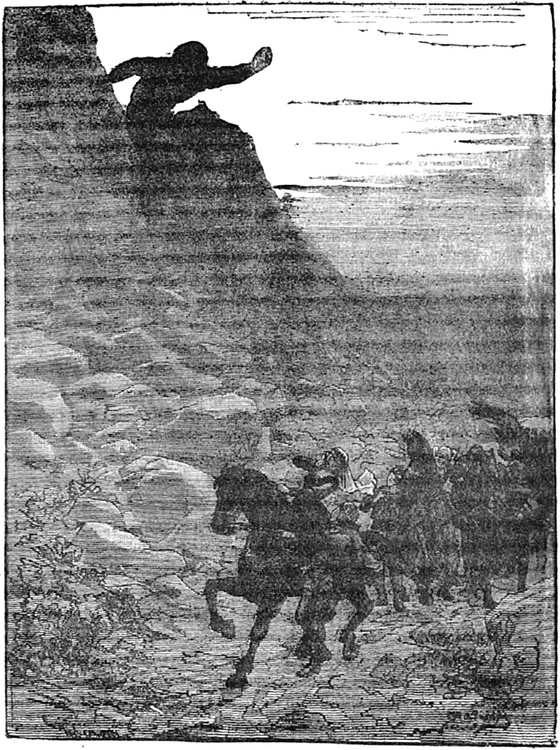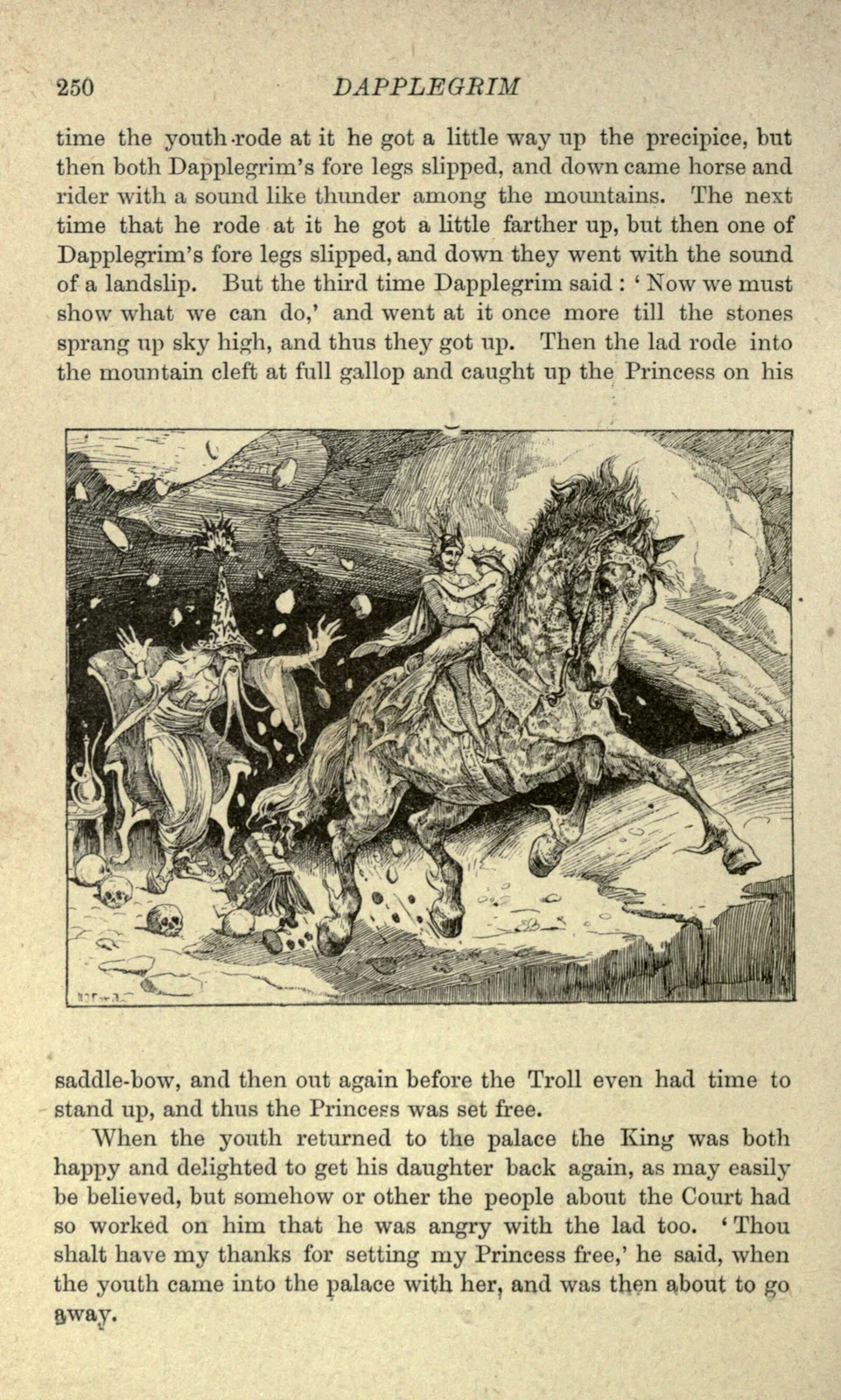
Dapplegrim carries the rescued princess and her rescuer out of the troll’s mountain, H. J. Ford, 1890
Ford depicts the powerful dappled horse carrying the princess and her rescuer out of the mountain as stones fly. This belongs to the Dapplegrim adaptation in Lang’s 1890 collection; the wizard-like troll is the illustrator’s treatment of that episode.
Overview
The youngest of twelve brothers receives a herd of mares as his inheritance and discovers an extraordinary dapple-grey foal among them. Fed by all twelve mares over successive years, the speaking animal grows so huge that he must lie down for his rider to mount. His glossy coat reflects sunlight like a mirror. As Dapplegrim, he needs exceptional iron-and-steel shoes and an entire royal stable to himself.
He scales a near-vertical rock to rescue a princess and stamps a shadowing ridge down into the earth. When the king demands a matching bridal mount, Dapplegrim guides his rider to another dappled horse that breathes fire and lives in Hell. Their struggle ends in its capture. Dapplegrim identifies the princess when she hides as a duck and then a loaf of bread. He next conceals his rider as a tick in his left nostril and as a clod between hoof and shoe, obstructing her search each time. The first horse's knowledge and assistance are explicit; the tale does not identify him as an enchanted prince.
Origins & earliest records
Dapplegrim is a named Norwegian wonder-tale horse in Asbjørnsen and Moe's collection, translated by Dasent in Popular Tales from the Norse, first published in 1859. The inspected electronic text includes a second-edition notice without a securely dated print title page. These dates trace collection and translation rather than the beginning of the horse-helper motif.
Records & interpretation
The story provides size comparisons, a reflective dappled coat, speech, unusual feeding and landscape-changing strength. Its fiery matching horse is a second animal within the same episode, not an alias for Dapplegrim. This is textual evidence for supernatural helpers and tests; it is not a veterinary record or proof that a horse could flatten a ridge.
In the literature
“Dapple had to lie down on all fours”
Tale XL, Dapplegrim; Final year of the foal’s growth · George Webbe Dasent
The horse’s great size requires it to kneel before its rider can mount.
Selected bibliography
Documented works and useful reading. This is not a list of every appearance.
- 01
Dapplegrim (Popular Tales from the Norse)
Inspected named tale XL. Electronic witness includes a notice to the second edition; its exact print date is unresolved.
- 02
Popular Tales from the Norse — Dapplegrim
Dasent historical English translation of Asbjørnsen and Moe; hosted PG8933 includes a Second Edition notice, but its exact selected print edition date and printed pages are unresolved. 1859 is the first English collection context only. Exact observed chapter anchors and episode locators used.
Family & connections
A source-supported family tree or inspiration record has not yet been compiled for this profile. Related reading below indicates a connection in subject matter, not a proven lineage or creative influence.
Located primary passages
Specific passages supporting details in this entry, grouped by their published witness.
Popular Tales from the Norse — Dapplegrim
Dasent historical English translation of Asbjørnsen and Moe; hosted PG8933 includes a Second Edition notice, but its exact selected print edition date and printed pages are unresolved. 1859 is the first English collection context only. Exact observed chapter anchors and episode locators used.
- The speaking dapple foal has the youth kill the other foals so it can suck twelve mares over successive years. It grows so tall that it must lie down for him to mount, then takes him into royal service.
Tale XL, Dapplegrim; Rearing on twelve mares and giant stature
- With specially heavy iron-and-steel shoes, Dapplegrim climbs the smooth cliff on a third attempt and carries the princess from a Troll cave. Newly shod, it later stamps a shading ridge down into the ground until sunlight reaches the king’s hall.
Tale XL, Dapplegrim; Cliff ascent, princess rescue and removal of the ridge
- Dapplegrim explains that its match lives in Hell. Grain and ox carcasses distract hostile birds and beasts, then spiked ox hides protect it in the horse duel; the youth bridles the defeated fire-breathing dapple horse.
- Dapplegrim exposes the princess’s duck and loaf disguises, then hides the youth as a tick in its nostril and earth between hoof and shoe. She fails to find him; the king acknowledges the match and the couple ride the paired horses to their wedding.
Complete named tale read. Exact selected print date, page numbers and earliest attestations are not inferred.
References
Sources supporting this profile. Linked pages have their own scope and editorial standards.
- Primary textPopular Tales from the Norse — Dapplegrim (tale XL)Research access: 2026-10-05
Image credits
Historical illustrationDapplegrim carries the rescued princess and her rescuer out of the troll’s mountain, H. J. Ford, 1890
Ford depicts the powerful dappled horse carrying the princess and her rescuer out of the mountain as stones fly. This belongs to the Dapplegrim adaptation in Lang’s 1890 collection; the wizard-like troll is the illustrator’s treatment of that episode.