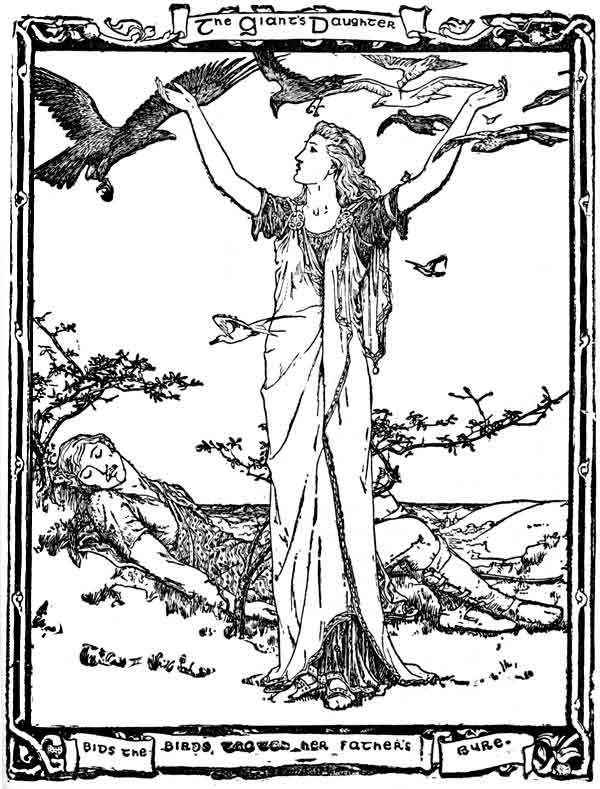
Batten: Auburn Mary commands birds to watch the byre
Printed Giant’s Daughter caption and adjacent narrative name Auburn Mary; birds surround her raised hands. Her father is not pictured. John Dickson Batten (1860–1932) credited by title page. 1892 first publication; selected impression undated.
Overview
The giant’s youngest daughter summons the captive privately and asks him to choose her instead of her older sisters. When her father demands impossible labour, she lets the exhausted young man sleep and leaves the cattle-house cleaned and feather-thatched. To reach a magpie’s nest she submits to a far more terrible transformation: her disassembled bones become climbing steps, and her body is restored afterwards. One omitted finger does not return. That missing part lets the young man recognise her among identically presented brides, without the narrator treating bodily difference as evidence of an evil nature.
Mary then makes cut apple pieces answer her father’s calls and flees with her husband on a blue-grey filly. Objects taken from the horse’s ears become enormous barriers, ending in the lake that drowns her father. Near the prince’s home she warns that a kiss will erase his memory of her. A household greyhound inadvertently fulfils that condition, leaving her alone; a shoemaker subsequently shelters her after encountering her reflection. At a later wedding, golden and silver pigeons emerge from her cup and reenact unequal sharing while recalling her labours. The prince recognises her and reaffirms their marriage. Her supernatural assistance, bodily restoration and animated substitutes support this individual profile; she is not simply an ordinary human bride entered to increase creature numbers.
Origins & earliest records
Jacobs’s 1892 adaptation combines Campbell’s principal tale 2 with other touches, including the final casket-and-key comparison from Curtin. Mary’s complete rescue sequence is inspectable here. The name and exact episodes remain bound to this adapted witness rather than every regional helpful-daughter tale.
Records & interpretation
Completed tasks, reassembled body, speaking apple fragments and the pigeon revelation are literary attestations. They provide no evidence of real human disassembly and resurrection. The missing finger is a narrative identifier and remembered sacrifice, not a diagnostic category.
In the literature
“I have but nine fingers”
THE BATTLE OF THE BIRDS; Mary describes the incomplete restoration
To obtain the magpie eggs, Mary directs the youth to use her disassembled bones as steps and restore her afterward. Failure to tread on one finger bone leaves her with nine fingers. This missing little finger lets him distinguish her from identically dressed sisters at their marriage; it is not silently described as a missing leg.
Selected bibliography
Documented works and useful reading. This is not a list of every appearance.
- 01
Celtic Fairy Tales: The Battle of the Birds
Full selected episode and relevant editorial source note inspected; cited earlier collections remain attributed, not falsely claimed as newly read.
- 02
Celtic Fairy Tales — The Battle of the Birds
Joseph Jacobs, Celtic Fairy Tales, undated selected PG7885 print/transcription; THE BATTLE OF THE BIRDS and noteXXIV. Whole narrative and editorial note independently read; Campbell/Curtin combination explicitly acknowledged.
Family & connections
A source-supported family tree or inspiration record has not yet been compiled for this profile. Related reading below indicates a connection in subject matter, not a proven lineage or creative influence.
Located primary passages
Specific passages supporting details in this entry, grouped by their published witness.
Celtic Fairy Tales — The Battle of the Birds
Joseph Jacobs, Celtic Fairy Tales, undated selected PG7885 print/transcription; THE BATTLE OF THE BIRDS and noteXXIV. Whole narrative and editorial note independently read; Campbell/Curtin combination explicitly acknowledged.
- The giant’s youngest daughter secretly instructs the captive youth to choose her. She lets him sleep while arranging the byre’s cleaning and feather roof, making the apparent achievements possible. Her father’s desired match to the Green City prince is rejected.
THE BATTLE OF THE BIRDS; Marriage preference and two completed tasks
- To obtain the magpie eggs, Mary directs the youth to use her disassembled bones as steps and restore her afterward. Failure to tread on one finger bone leaves her with nine fingers. This missing little finger lets him distinguish her from identically dressed sisters at their marriage; it is not silently described as a missing leg.
THE BATTLE OF THE BIRDS; Bone-ladder sacrifice, reconstitution and identification
- Mary arranges answering apple pieces to postpone pursuit, then directs retrieval of objects from the filly’s ear that become thorn forest, rock and a lake. The first two only delay her father, while the final lake drowns him. These are selected narrative devices; comparative afterlife interpretations are not adopted.
- Mary warns against any greeting kiss, but an old greyhound touches the returning youth’s mouth and he forgets her. She lodges with a shoemaker and reaches the new wedding, where two birds from her wine recount the tasks and missing finger. Memory returns, and the casket-key analogy justifies choosing Mary.
THE BATTLE OF THE BIRDS; Forgotten bride and renewed recognition
Complete selected narrative read. Raven and giant are distinct; foster parentage and missing finger retained precisely. No verse, prayers or ritual formulas reproduced; ancient-diffusion speculation not adopted.
Primary source witness
Joseph Jacobs, Celtic Fairy Tales, undated selected PG7885 print/transcription; THE BATTLE OF THE BIRDS and noteXXIV. Whole narrative and editorial note independently read; Campbell/Curtin combination explicitly acknowledged.
- Jacobs credits Campbell’s second Popular Tales story with touches from its seventh variant and other material, specifically the casket-key finish from Curtin’s Son of the King of Erin. He also adds a humorous storyteller ending and alters second-person usage. The resulting selection is an acknowledged composite rather than untouched field transcription.
Confirms selected editorial practice, not independent inspection of Campbell’s eight variants or Curtin’s book.
References
Sources supporting this profile. Linked pages have their own scope and editorial standards.
- Primary textJacobs, Celtic Fairy Tales: The Battle of the Birds and source noteResearch access: 2026-10-05
Image credits
Historical illustrationBatten: Auburn Mary commands birds to watch the byre
Printed Giant’s Daughter caption and adjacent narrative name Auburn Mary; birds surround her raised hands. Her father is not pictured. John Dickson Batten (1860–1932) credited by title page. 1892 first publication; selected impression undated.