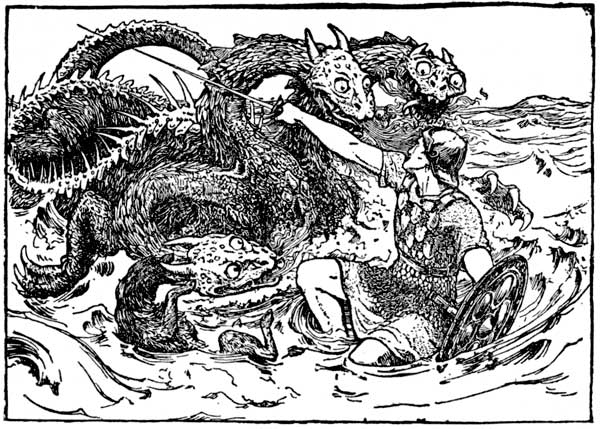
Batten: hero fighting the three-headed loch beast
Exact Sea Maiden episode image shows the hero with sword and shield against three distinct heads of the loch beast. John Dickson Batten (1860–1932) credited by title page. 1892 first publication; selected impression undated.
Overview
The household tells the fisherman’s son that the princess must meet the creature at a black rock beside the lake. A military suitor promises rescue but hides as soon as the monster appears. The young herdsman arrives on a black horse with his dog and engages it in an extended splashing struggle. Removing the first head sends the creature roaring back beneath the water, but the princess warns that it will return until all three are gone. On the following days the same hero defeats another head and then the last, wearing different fine clothes during his appearances.
He secures the heads on a knot and gives them to the princess, who supplies a ring and earrings in return. The cowardly officer threatens her and claims the victories, but at the proposed wedding she requires the genuine rescuer to remove the heads without cutting the knot. The herdsman succeeds and produces her gifts, establishing his identity. This creature is not the bargaining Sea-Maiden who appears later; the narrative assigns separate demands, actions and means of defeat to each. It does not say that the heads regenerate, that the beast breathes fire or that it possesses wings. Those features should not be imported from other many-headed dragons.
Origins & earliest records
The inspected Jacobs 1892 adaptation derives from Campbell’s Popular Tales, number 4. The lake-beast sequence belongs to that selected Scottish Gaelic-derived narrative and not automatically to every Sea-Maiden variant. The anonymous monster’s descriptive title identifies its episode rather than a traditional personal name.
Records & interpretation
The annual demand, three battles and knot test are literary evidence. No zoological specimen or historical tribute record is supplied. Three successive head losses differ from Hydra-like regrowth, making close reading necessary before creature traits are generalised.
In the literature
“There is a great beast with three heads in the loch”
THE SEA-MAIDEN; The dairymaid explains the princess’s impending sacrifice
A three-headed loch beast requires one victim each year, with the king’s daughter selected. The promised rescuer repeatedly flees, while the herd and his black dog fight on three days, removing one head each day. The wounded creature’s first retreat does not end the threat; final removal of all three heads does.
Selected bibliography
Documented works and useful reading. This is not a list of every appearance.
- 01
Celtic Fairy Tales: The Sea-Maiden
Complete selected episode and source note inspected; the preface explicitly admits altering and combining translated sources.
- 02
Celtic Fairy Tales — The Sea-Maiden
Joseph Jacobs, Celtic Fairy Tales, undated selected PG7885 print/transcription, THE SEA-MAIDEN and noteXVII. Collector’s editing and differences from Campbell’s variants explicitly retained.
Family & connections
A source-supported family tree or inspiration record has not yet been compiled for this profile. Related reading below indicates a connection in subject matter, not a proven lineage or creative influence.
Located primary passages
Specific passages supporting details in this entry, grouped by their published witness.
Celtic Fairy Tales — The Sea-Maiden
Joseph Jacobs, Celtic Fairy Tales, undated selected PG7885 print/transcription, THE SEA-MAIDEN and noteXVII. Collector’s editing and differences from Campbell’s variants explicitly retained.
- A three-headed loch beast requires one victim each year, with the king’s daughter selected. The promised rescuer repeatedly flees, while the herd and his black dog fight on three days, removing one head each day. The wounded creature’s first retreat does not end the threat; final removal of all three heads does.
- The fleeing general coerces the princess into crediting him and carries the severed heads home. At the wedding she requires removal from the knot on which the actual rescuer threaded them. Only the herd succeeds and produces her ring and earrings, exposing the claimant and securing their marriage.
THE SEA-MAIDEN; False hero’s claim and identification through trophies
Complete selected body and noteXVII independently read. Distinct sea captor, carlin and three-headed beast are not conflated; absent causes and anatomies not invented. No songs or ritual-formula excerpts.
Primary source witness
Joseph Jacobs, Celtic Fairy Tales, undated selected PG7885 print/transcription, THE SEA-MAIDEN and noteXVII. Collector’s editing and differences from Campbell’s variants explicitly retained.
- Jacobs credits Campbell Popular TalesNo4, explicitly omits the animal comrades’ births and moves the carlin episode. He separately reports a variant in which the husband comes from the maiden’s mouth. These are compiler-reported differences; his medieval chronology and missionary-diffusion theory are not adopted as proof.
Confirms Jacobs’s selected adaptation and stated variant, not independently visited Campbell texts or medieval manuscript dates.
References
Sources supporting this profile. Linked pages have their own scope and editorial standards.
- Primary textJacobs, Celtic Fairy Tales: The Sea-Maiden and source noteResearch access: 2026-10-05
Image credits
Historical illustrationBatten: hero fighting the three-headed loch beast
Exact Sea Maiden episode image shows the hero with sword and shield against three distinct heads of the loch beast. John Dickson Batten (1860–1932) credited by title page. 1892 first publication; selected impression undated.