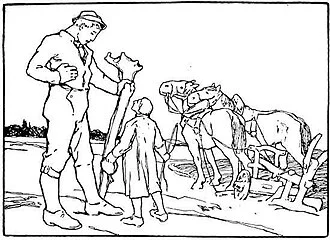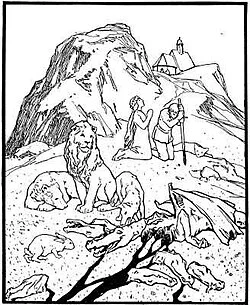
Slain dragon on the mountain with hunter and princess, Otto Ubbelohde,1909
Actual winged dragon lies defeated on the mountain below armed hunter and princess, with the hunters animal helpers. This is the exact Two Brothers dragon episode; the reproduction does not make each severed head independently legible.
Overview
A town mourns because the king's daughter must be given to a dragon living on a nearby hill. Previous knights have died attempting its defeat, and refusal would bring devastation to the country. A huntsman finds a church whose three cups confer strength enough to wield a buried sword. After sheltering the princess inside, he confronts the roaring seven-headed creature.
Fire streams from all seven mouths, but the huntsman's animal companions trample the burning grass. He cuts away six heads during successive attacks, then severs the tail; the helpers complete the killing. He preserves all seven tongues in the princess's handkerchief. When a treacherous marshal later claims victory, the tongues fit the displayed heads and reveal the lie. Their evidentiary role is a plot device, distinct from evidence available to a modern reader.
Origins & earliest records
This dragon belongs to the substantial Grimm tale60, Die zwei Brüder, selected through Margaret Hunt's1884 translation. It is one adversary in a longer story about twin brothers, animal helpers and mistaken identity. The numbered collected tale supplies a literary witness; it does not date the beginning of every seven-headed dragon tradition or identify this monster with classical hydras.
Records & interpretation
The primary episode states seven heads, fire from seven jaws, flight and the later fit of preserved tongues. It also distinguishes the huntsman's sword blows from his animals' final attack. These are concrete narrative details, not recovered anatomical specimens. The story's courtroom proof works within its fiction and should not be presented as external zoological verification.
In the literature
“he breathed fire out of seven jaws”
Tale 60, The Two Brothers; The dragon confronts the huntsman on the sacrifice hill · Margaret Hunt
The breath attack is counted across all seven mouths.
Selected bibliography
Documented works and useful reading. This is not a list of every appearance.
- 01
Household Tales, tale 60: The Two Brothers
Specific numbered primary tale inspected. English translation terms and literary transmission remain distinct from oral origin.
- 02
Household Tales — The Two Brothers
Margaret Hunt historical English translation (1884); Project Gutenberg5314. Exact numbered tale and observed HTML anchor used; no inferred printed page or earliest oral date.
Family & connections
A source-supported family tree or inspiration record has not yet been compiled for this profile. Related reading below indicates a connection in subject matter, not a proven lineage or creative influence.
Located primary passages
Specific passages supporting details in this entry, grouped by their published witness.
Household Tales, tale 60: The Two Brothers
Margaret Hunt historical English translation (1884); Project Gutenberg5314. Exact numbered tale and observed HTML anchor used; no inferred printed page or earliest oral date.
- The town mourns because its remaining maiden, the princess, must be given to a dragon demanding an annual virgin tribute. A huntsman gains strength from three cups and takes a buried sword. The dragon breathes fire from seven jaws; his animals trample it out, and he cuts off six heads and the tail before they tear it apart.
Tale 60, The Two Brothers; Annual sacrifice and contest with fire from seven jaws
- The hunter saves the princess and preserves seven tongues in her named handkerchief. During their exhausted sleep the marshal kills him and forces her to credit the marshal. The hunter’s animals obtain a healing root, restore his severed head and later correct its reversed orientation.
Tale 60, The Two Brothers; Tongue tokens, false claimant and the hunter’s revival
- At the marshal’s wedding feast the preserved dragon heads are displayed. The returning hunter asks for the missing tongues and fits each tongue to its mouth. With the princess’s handkerchief and animal necklaces, this establishes his victory and exposes the marshal, who is sentenced to death.
Tale 60, The Two Brothers; Seven heads and matching tongues expose the false claimant
Complete dragon sacrifice, combat, betrayal/revival and final token-recognition scenes read; surrounding twin-brother adventures are outside this enrichment. Original narrative curse causes and modern species identities are not inferred; prose only, no song or ritual-formula excerpts.
References
Sources supporting this profile. Linked pages have their own scope and editorial standards.
- Primary textHunt's Household Tales — 60 The Two BrothersResearch access: 2026-10-05
Image credits
Historical illustrationSlain dragon on the mountain with hunter and princess, Otto Ubbelohde,1909
Actual winged dragon lies defeated on the mountain below armed hunter and princess, with the hunters animal helpers. This is the exact Two Brothers dragon episode; the reproduction does not make each severed head independently legible.