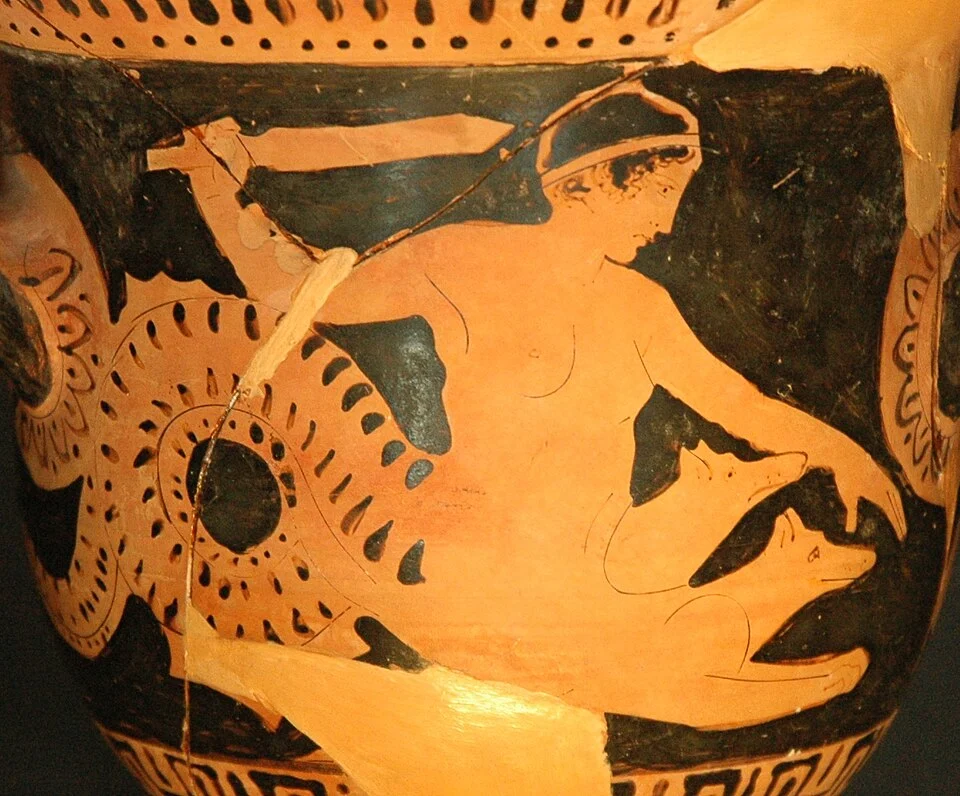
Scylla
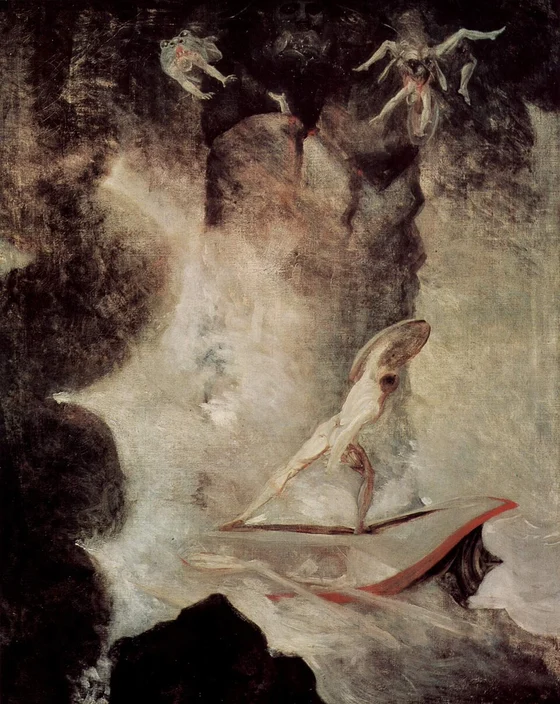
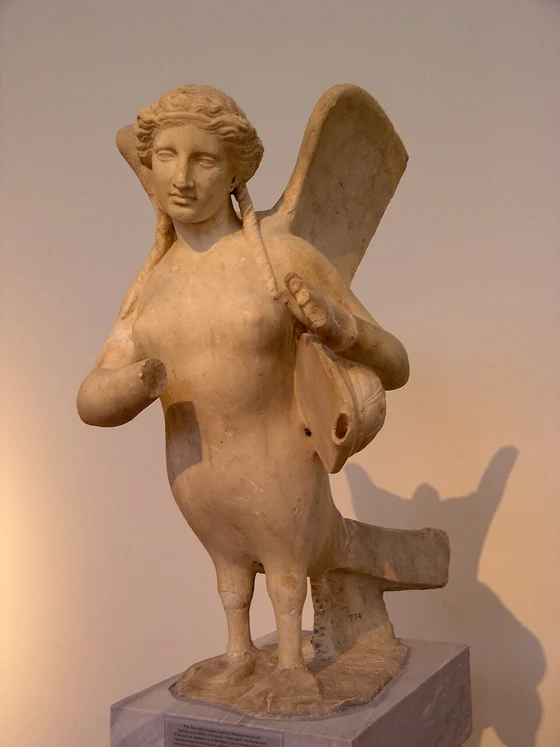
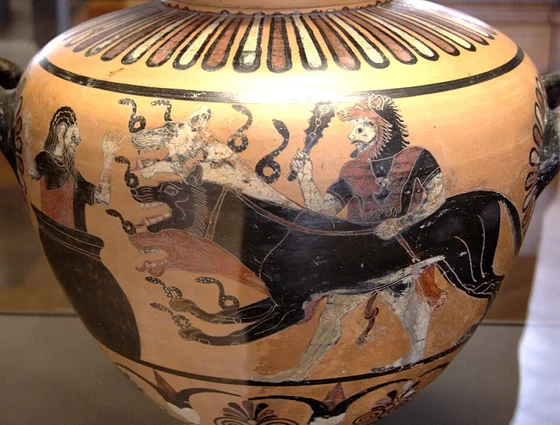
Image associated with the exact linked encyclopedia article; consult credited file description for its interpretation.
Overview
Circe describes Scylla as a cave-dwelling monster with six long necks, six dreadful heads and twelve misshapen feet. Her voice can resemble a young hound’s, despite the overwhelming danger of her actual form. She extends her heads from the rock to catch marine animals and men, making proximity rather than an open confrontation the source of the threat.
Odysseus sails near Scylla to avoid Charybdis, and she takes six of his companions. The episode leaves the hero unable to save everyone through courage or weapons. This is the Homeric sea monster, distinct from later transformation narratives about a young woman. A modern illustration should indicate which witness it follows, especially when choosing between the poem’s many necks and later canine lower-body forms.
Circe places the cave partway up an unclimbable, cloud-covered cliff, its opening facing west toward Erebus. Each of Scylla’s six heads has three tightly packed rows of teeth. Her lower body stays hidden while her heads reach out for dolphins, sea-dogs and larger marine creatures. When Odysseus asks whether he can repel her, Circe calls her an immortal danger and rejects battle as a solution. Delay to put on armour could expose the crew to a second seizure of six men. Instead she recommends swift passage and an appeal to Scylla’s mother, Crataiis, to prevent another attack.
The first crossing then exposes the difference between knowing the warning and being able to prevent the loss. Odysseus conceals Scylla’s threat from the crew lest they stop rowing, yet disobeys Circe by taking armour and two spears to the foredeck. He cannot see the monster. As everyone watches Charybdis, Scylla takes six of the strongest companions and carries them upward, calling his name. The poem compares their helpless movement to fish drawn from the sea; Odysseus remembers their deaths as his most pitiful sight. On his later solitary return, Zeus prevents Scylla from noticing him again.
Virgil’s Aeneid III.410–432 gives Helenus a different description: Scylla has a maiden’s upper form, while below are a monstrous sea-dragon body, dolphin tails and a wolfish belly. Sea-green hounds sound around her cavern. Helenus counsels Aeneas to take the longer circuit around Pachynus instead of entering this danger. This Roman witness supplies neither Homer’s precise six-neck anatomy nor a narrated transformation from a maiden; its composite form should be attributed to its own account.
Origins & earliest records
The selected foundation is Homer’s Odyssey XII, an Archaic Greek epic transmitted through later manuscripts and English translations. Samuel Butler’s 1900 rendering is retained alongside A. T. Murray’s line-numbered rendering. Virgil’s first-century BCE Aeneid provides a distinct Roman comparison; these literary witnesses do not date the beginning of every associated oral motif.
Records & interpretation
Odyssey XII.73–126, 201–259 and 426–446 separates Circe’s advance description, the crew’s crossing and Odysseus’s later return. Aeneid III.410–432 supplies Helenus’s route warning and its own description. The texts attest narrated dangers and differing representations; any identification with a physical strait or archaeological image requires its own evidence.
In the literature
“She has twelve mis-shapen feet, and six necks of the most prodigious length;”
Book XII, Circe’s description; paragraph beginning “Of these two rocks” · Samuel Butler
Scylla’s anatomy is described before the voyage through the straits.
“For Scylla is not mortal;”
Book XII, Circe’s reply; paragraph beginning “You dare devil” · Samuel Butler
Circe warns against trying to defeat Scylla by force.
“Scylla pounced down suddenly upon us and snatched up my six best men.”
Book XII, Ulysses’ narrated encounter; paragraph beginning “Then we entered the Straits” · Samuel Butler
The encounter fulfils the danger of six men being seized.
Selected bibliography
Documented works and useful reading. This is not a list of every appearance.
- 01
Odyssey, Book XII
Circe’s warning, first crossing and solitary return; Butler’s English rendering retained as the existing witness.
- 02
Odyssey, XII.73–126, 201–259 and 426–446
Line-numbered warning, crossing and return kept in their narrative sequence.
- 03
Aeneid, Book III.410–432
Helenus’s description and advice to circle Pachynus, distinguished from the Homeric encounter.
- 04
The Odyssey
Butler prose translation, originally published 1900 as confirmed by the second-edition preface; hosted corrected reprint. No unverified reprint date assigned.
Family, evolution & connections
Scylla and her named mother — Odyssey 12
Circe’s Scylla and Charybdis description and follow-up answer, Odyssey 12.73–126, Murray translation.
Scroll sideways to see all branches. With a keyboard, focus the tree and use the arrow keys.
- Crataiis, mother named by Circe
Explicit mother–daughter statement in Circe’s reply. No father, siblings or descendants are given here. Charybdis is not made a relative through proximity. The displayed maternal name follows this translation’s spelling; later alternative genealogies are not blended in.
Charybdis
In Odyssey Book 12, Circe contrasts Scylla’s attack with Charybdis’ engulfing waters and advises a route accepting a smaller loss. The monsters are linked by a narrative choice between dangers, not by genealogy or matching anatomy. A comparison should retain their distinct actions instead of treating both names as synonyms for one sea monster.
Crataiis, named in Murray’s translation
Circe identifies Crataiis as Scylla’s mother and advises Odysseus to call upon her to restrain another attack. The passage supplies no father or sibling; the nearby Charybdis is a separate danger, not a stated relative.
Located primary passages
Specific passages supporting details in this entry, grouped by their published witness.
Primary source witness
Butler prose translation, originally published 1900 as confirmed by the second-edition preface; hosted corrected reprint. No unverified reprint date assigned.
- Scylla’s anatomy is described before the voyage through the straits.
Book XII, Circe’s description; paragraph beginning “Of these two rocks”
- Circe warns against trying to defeat Scylla by force.
Book XII, Circe’s reply; paragraph beginning “You dare devil”
- The encounter fulfils the danger of six men being seized.
Book XII, Ulysses’ narrated encounter; paragraph beginning “Then we entered the Straits”
This passage documents one ancient literary version. Translation publication dates are not ancient composition dates or earliest-attestation claims.
Encyclopedia background
An additional attributed reference, separate from the editorial profile above.
Read the open encyclopedia overview
In Greek mythology, Scylla ( SIL-ə; Ancient Greek: Σκύλλα, romanized: Skýlla, pronounced [skýlːa]) is a legendary, man-eating monster that lives on one side of a narrow channel of water, opposite her counterpart, the sea-swallowing monster Charybdis. The two sides of the strait are within an arrow's range of each other—so close that sailors attempting to avoid the whirlpools of Charybdis would pass dangerously close to Scylla and vice versa.
Scylla is first attested in Homer's Odyssey, where Odysseus and his crew encounter her and Charybdis on their travels. Later myth provides an origin story as a beautiful nymph who is transformed into a monster.
Book Three of Virgil's Aeneid associates the strait where Scylla dwells with the Strait of Messina between Calabria, a region of Southern Italy, and Sicily. The coastal town of Scilla in Calabria takes its name from the mythological figure of Scylla and it is said to be the home of the nymph.
The Byzantine encyclopedia Suda describes Scylla as having the appearance of a beautiful woman "as far as its eyes," with six dog heads on each side, and a serpent body below.
The idiom "between Scylla and Charybdis" has come to mean being forced to choose between two similarly undesirable or risky outcomes, similar to "between a rock and a hard place".
Text from Wikipedia contributors, “Scylla”. CC BY-SA 4.0. Extracted introduction; formatting changed. Retrieved 5 October 2026. The source article may have changed since retrieval.
References
Sources supporting this profile. Linked pages have their own scope and editorial standards.
- Primary textSamuel Butler’s Odyssey translation: Book XIIResearch access: 2026-10-05
- Primary text in translationHomer, Odyssey XII, A. T. Murray translationResearch access: 2026-10-05
- Primary text in translationVirgil, Aeneid III, H. R. Fairclough translationResearch access: 2026-10-05
Image credits
Reference illustrationScylla
Image associated with the exact linked encyclopedia article; consult credited file description for its interpretation.