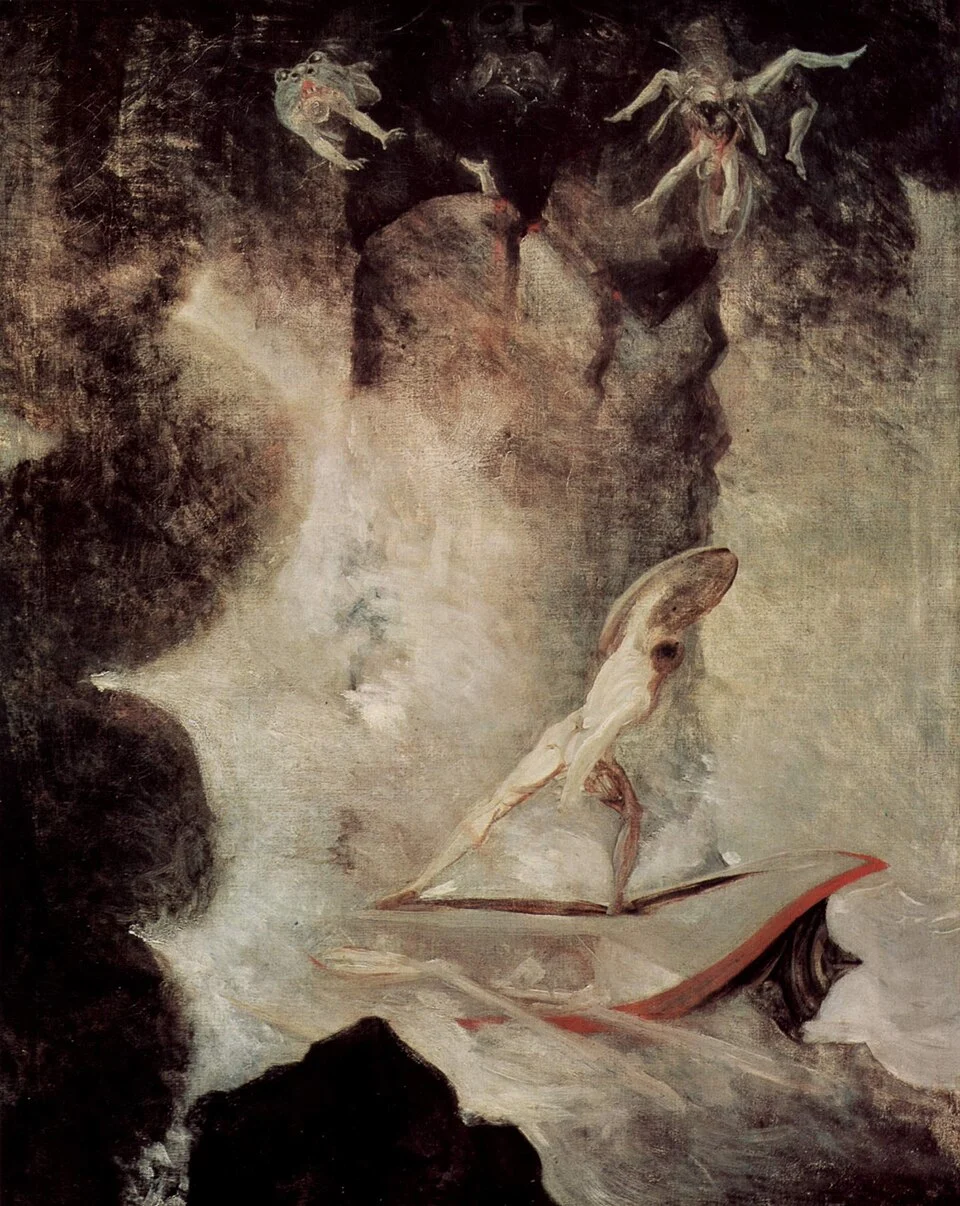
Charybdis
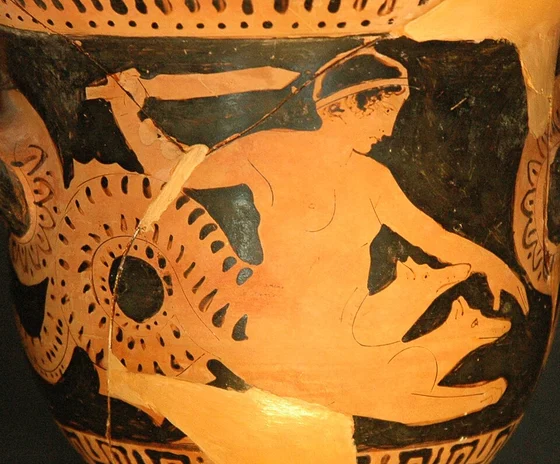
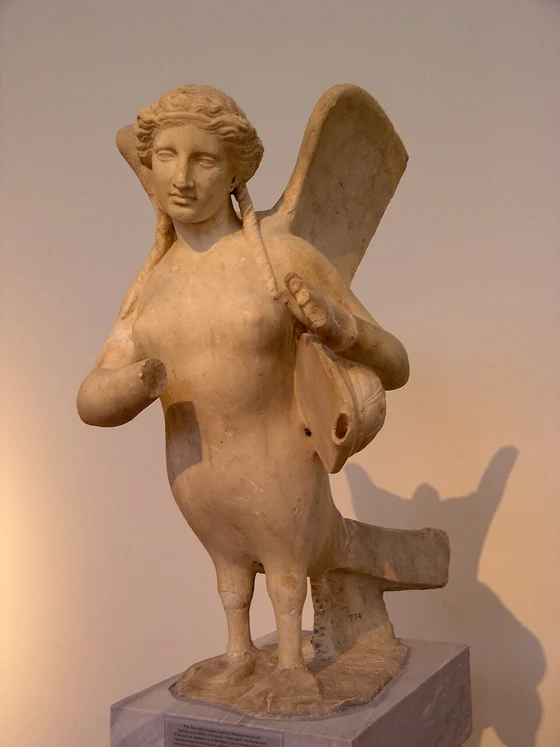
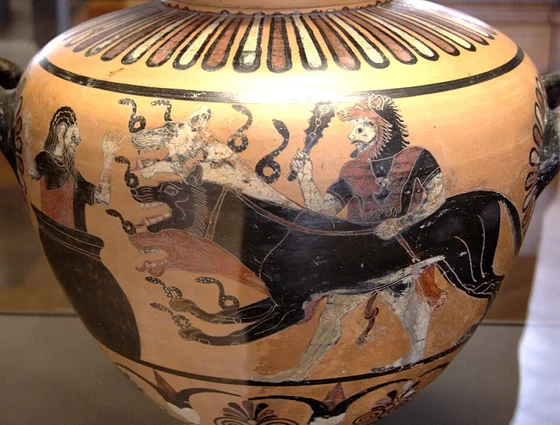
Image associated with the exact linked encyclopedia article; consult credited file description for its interpretation.
Overview
Circe’s warning gives Charybdis a repeated movement: water is drawn down and expelled three times a day. The danger appears beneath a rock with a fig tree, across from Scylla. Sailing too close at the wrong time can destroy the whole ship, which makes avoidance and timing more important than any plan to kill a visible animal.
Odysseus first steers toward Scylla to escape this greater risk. Later, after losing his ship, he survives a return to Charybdis by clinging above the water until wreckage is expelled. The narrative treats sea motion as an active and terrifying presence. It does not supply a conventional creature anatomy, and modern attempts to identify a particular real whirlpool remain separate interpretations of the epic.
Circe’s warning places the two cliffs within a bowshot of each other. Charybdis occupies the lower cliff beneath the leafy fig tree, while Scylla’s high cave lies opposite. Her swallowing and disgorging occur three times each day; Circe says that even the Earth-shaker could not save a ship caught during the intake. The prescribed choice is thus to accept the limited loss on Scylla’s side rather than put the entire crew within Charybdis’s reach.
During the crossing, expelled water seethes like a cauldron over fire and casts spray onto both cliffs. When it is drawn back, the surrounding rock roars and dark sand becomes visible below. The crew’s attention fixes on that spectacle as Scylla attacks from the other side. The return comes only after Zeus destroys the ship following the slaughter of Helios’s cattle. Odysseus lashes keel and mast together with an ox-hide stay, but a changed wind carries him back. He clings to the fig tree without a foothold or reachable upper branches, waiting until Charybdis releases the timbers. He drops beside them and paddles away by hand; divine protection also keeps Scylla from seeing him.
Virgil’s Helenus retains the threefold intake and expulsion in Aeneid III.410–432, placing Charybdis on one side of the divided Sicilian passage and Scylla on the other. His advice is the long circuit around Pachynus. That voyage counsel differs from Circe’s forced choice in Homer; it does not add an independently described head, limbs or animal body to Charybdis.
Origins & earliest records
The selected foundation is Homer’s Odyssey XII, an Archaic Greek epic transmitted through later manuscripts and English translations. Samuel Butler’s 1900 rendering is retained alongside A. T. Murray’s line-numbered rendering. Virgil’s first-century BCE Aeneid provides a distinct Roman comparison; these literary witnesses do not date the beginning of every associated oral motif.
Records & interpretation
Odyssey XII.101–110, 201–259 and 404–446 separates Circe’s advance description, the crew’s crossing and Odysseus’s later return. Aeneid III.410–432 supplies Helenus’s route warning and its own description. The texts attest narrated dangers and differing representations; any identification with a physical strait or archaeological image requires its own evidence.
In the literature
“Three times in the day does she vomit forth her waters, and three times she sucks them down again;”
Book XII, Circe’s description; paragraph beginning “You will find the other rock” · Samuel Butler
Charybdis alternately expels and swallows water.
“Neptune himself could not save you;”
Book XII, Circe’s description; paragraph beginning “You will find the other rock” · Samuel Butler
Circe cautions that being caught in the sucking phase is fatal even with divine aid.
Selected bibliography
Documented works and useful reading. This is not a list of every appearance.
- 01
Odyssey, Book XII
Circe’s warning, first crossing and solitary return; Butler’s English rendering retained as the existing witness.
- 02
Odyssey, XII.101–110, 201–259 and 404–446
Line-numbered warning, crossing and return kept in their narrative sequence.
- 03
Aeneid, Book III.410–432
Helenus’s description and advice to circle Pachynus, distinguished from the Homeric encounter.
- 04
The Odyssey
Butler prose translation, originally published 1900 as confirmed by the second-edition preface; hosted corrected reprint. No unverified reprint date assigned.
Family & connections
A source-supported family tree or inspiration record has not yet been compiled for this profile. Related reading below indicates a connection in subject matter, not a proven lineage or creative influence.
Located primary passages
Specific passages supporting details in this entry, grouped by their published witness.
Primary source witness
Butler prose translation, originally published 1900 as confirmed by the second-edition preface; hosted corrected reprint. No unverified reprint date assigned.
- Charybdis alternately expels and swallows water.
Book XII, Circe’s description; paragraph beginning “You will find the other rock”
- Circe cautions that being caught in the sucking phase is fatal even with divine aid.
Book XII, Circe’s description; paragraph beginning “You will find the other rock”
This passage documents one ancient literary version. Translation publication dates are not ancient composition dates or earliest-attestation claims.
Encyclopedia background
An additional attributed reference, separate from the editorial profile above.
Read the open encyclopedia overview
Charybdis ( ; Ancient Greek: Χάρυβδις, romanized: Khárybdis, Attic Greek: [kʰárybdis]; Latin: Charybdis, Classical Latin: [kʰäˈrʏbd̪ɪs̠]) is a sea monster in Greek mythology. Along with the sea monster Scylla, she appears as a challenge to epic characters such as Odysseus, Jason, and Aeneas. The descriptions of Greek mythical chroniclers and Greek historians locate her in the Strait of Messina.
The idiom "between Scylla and Charybdis" has come to mean being forced to choose between two similarly dangerous situations.
Text from Wikipedia contributors, “Charybdis”. CC BY-SA 4.0. Extracted introduction; formatting changed. Retrieved 5 October 2026. The source article may have changed since retrieval.
References
Sources supporting this profile. Linked pages have their own scope and editorial standards.
- Primary textSamuel Butler’s Odyssey translation: Book XIIResearch access: 2026-10-05
- Primary text in translationHomer, Odyssey XII, A. T. Murray translationResearch access: 2026-10-05
- Primary text in translationVirgil, Aeneid III, H. R. Fairclough translationResearch access: 2026-10-05
Image credits
Reference illustrationCharybdis
Image associated with the exact linked encyclopedia article; consult credited file description for its interpretation.