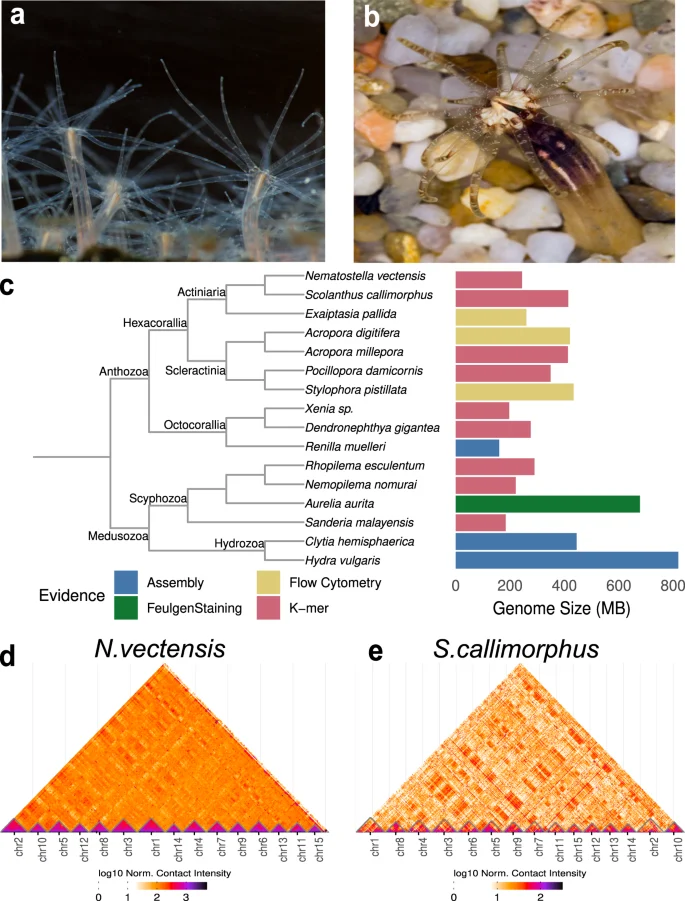
Nematostella vectensis anemones in panel a of Zimmermann and colleagues’ 2023 comparative genome figure; panel b shows the separate species Scolanthus callimorphus
Panel a shows Nematostella vectensis photographed by Patrick RH Steinmetz. Panel b shows a different species, Scolanthus callimorphus, photographed by Robert Reischl. The lower panels compare genome-size estimates and chromosome contact maps; their colours encode data rather than animal pigmentation.
Overview
Nematostella vectensis, the starlet sea anemone, is a cnidarian model for investigating animal development and genome organization. Bob Zimmermann and colleagues published a chromosome-level reference in 2023 alongside a genome of its relative Scolanthus callimorphus. Their Nematostella animals came from a long-maintained laboratory line, the offspring of the CH2 and CH6 lines originally collected by Cadet Hand. Genome material and developmental transcript samples were obtained under specified culture conditions. The study therefore describes a defined research resource, not a genomic census of all wild starlet anemone populations.
Short-read analysis estimated the Nematostella genome at approximately 244 million base pairs, substantially smaller than an earlier estimate. Long DNA reads and chromosome-contact information improved assembly continuity, while short and long RNA reads supported 24,525 gene models and 36,280 transcripts. The researchers identified fifteen chromosomes, in agreement with earlier chromosome-spread evidence. Each had a corresponding chromosome in Scolanthus containing most of the same homologous genes. However, their local order had often changed. Conservation of chromosome membership is thus different from an unchanged sequence of neighboring genes.
Comparisons with other cnidarians, a sponge and several bilaterians allowed the team to infer ancient chromosome-level gene groupings and their subsequent splits or fusions. Those reconstructed linkage groups are hypotheses about ancestral organization; living Nematostella is not the ancestral animal itself. Developmental Hox and NK genes illustrated the distinction between scales of conservation. Many remained on related chromosomal regions, but clusters could be dispersed, interrupted or differently ordered. The authors proposed that relatively nearby regulatory sequences might allow such local rearrangements without requiring the long-range organization familiar from some vertebrate genomes.
The chromosome-contact data did not reveal clear topologically associated domains: folding patterns that can help delimit gene regulation in other animals. This was not proof that the anemone has no meaningful three-dimensional genome structure. The authors explicitly allowed for patterns at different scales, higher resolution or within more homogeneous cell populations. Absence of the CTCF boundary protein and comparatively short distances between regulatory regions and genes informed their evolutionary explanation, but the proposed causal history remained hypothetical. The genome resource makes these comparisons possible while keeping observed sequence arrangements separate from reconstructed ancestral regulation.
Origins & earliest records
The focal Nvec200 reference represents laboratory descendants of the CH2 and CH6 lines.
Evidence & interpretation
Long-read sequencing, transcript annotation and chromosome-contact comparisons underpin the reference; ancient linkage groups and regulatory evolution are reconstructed interpretations.
Selected bibliography
Documented works and useful reading. This is not a list of every appearance.
- 01
Topological structures and syntenic conservation in sea anemone genomes
Nature Communications 14:8270; DOI 10.1038/s41467-023-44080-7. Complete main report and Methods; CC BY 4.0.
- 02
Sea Anemone Genome Reveals Ancestral Eumetazoan Gene Repertoire and Genomic Organization
Science 317:86–94, 6 July 2007. DOI 10.1126/science.1139158.
Family, evolution & connections
Selected cnidarian protein-sequence branching (Zimmermann et al., 2023)
Nine retained terminals from Supplementary Figure 1: eight cnidarian samples and D. melanogaster as a selected bilaterian outgroup. Other sampled animals are omitted. Abbreviated tip names follow the source figure.
Scroll sideways to see all branches. With a keyboard, focus the tree and use the arrow keys.
- Selected cnidarians and bilaterian outgroup
- D. melanogaster - selected outgroup
- Selected Cnidaria
- H. magnipapillata - source label
- Selected Anthozoa
- A. digitifera
- Selected sea anemones
- M. senile / E. pallida pair
- M. senile
- E. pallida
- Selected Edwardsiidae
- Scolanthus and remaining sampled edwardsiids
- E. lineata / E. carnea pair
- E. lineata
- E. carnea
The Divergence estimates Methods describe 541 shared BUSCO orthologues, taking the highest-scoring transcript for duplicated BUSCOs. MAFFT E-INS-i alignments were trimmed with trimAl gappyout, then analysed with IQ-TREE 2.0.6 and gene-partitioned model selection. Subsequent r8s Langley-Fitch dating fixed the bilaterian-cnidarian calibration at 595.7 and 688.3 million years. Only the displayed branching is retained. Red ranges in the source figure concern calibrated ages, not bootstrap support; neither ages, ranges nor branch lengths are reproduced. No numerical confidence is shown for these nodes. This selected study tree does not establish living species as direct ancestors. Chromosomal linkage diagrams in Figure 2 are separate comparisons. Adapted from Zimmermann et al. (2023), CC BY 4.0: tips pruned, omitted branches suppressed and layout redrawn.
Taxonomic classification
A hierarchy of classified groups, not a chain of direct ancestors.
- kingdomAnimalia
- phylumCnidaria
- classAnthozoa
- orderActiniaria
- familyEdwardsiidae
- genusNematostella
- speciesNematostella vectensis
Worm sea anemone — Scolanthus callimorphus
Zimmermann and colleagues’ chromosome assemblies retain a one-to-one correspondence between fifteen chromosome pairs: most matching genes remain on corresponding chromosomes, although their order is largely rearranged. This reconstructs shared chromosome history from sampled genomes; it does not make either living anemone the other’s ancestor or imply identical gene regulation.
Located primary passages
Specific passages supporting details in this entry, grouped by their published witness.
Sea Anemone Genome Reveals Ancestral Eumetazoan Gene Repertoire and Genomic Organization
2007 published article
- The draft assembly supports conserved gene content, intron positions and large-scale linkage shared with vertebrates. Ancestral reconstruction remains incomplete and does not recover regulatory interactions or make the living anemone an ancestor.
Complete main pp.86–94; assembly, introns, linkage and concluding remarks.
Supplemental Methods, datasets and reanalysis unreviewed; historical draft, not current chromosome assembly.
References
Sources supporting this profile. Linked pages have their own scope and editorial standards.
- ResearchZimmermann and colleagues 2023, primary comparative genome report, CC BY 4.0Research access: 2026-10-05
Image credits
Scientific animal photographs and comparative genome figureNematostella vectensis anemones in panel a of Zimmermann and colleagues’ 2023 comparative genome figure; panel b shows the separate species Scolanthus callimorphus
Panel a shows Nematostella vectensis photographed by Patrick RH Steinmetz. Panel b shows a different species, Scolanthus callimorphus, photographed by Robert Reischl. The lower panels compare genome-size estimates and chromosome contact maps; their colours encode data rather than animal pigmentation.