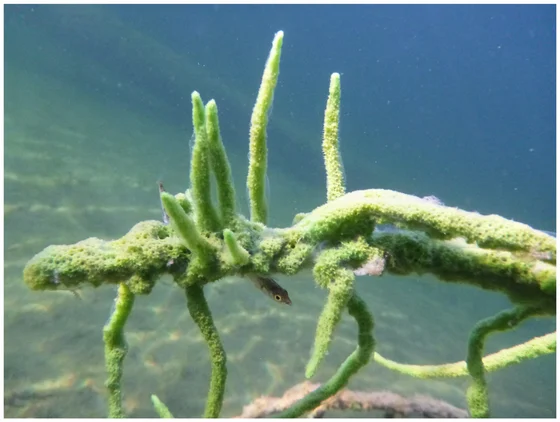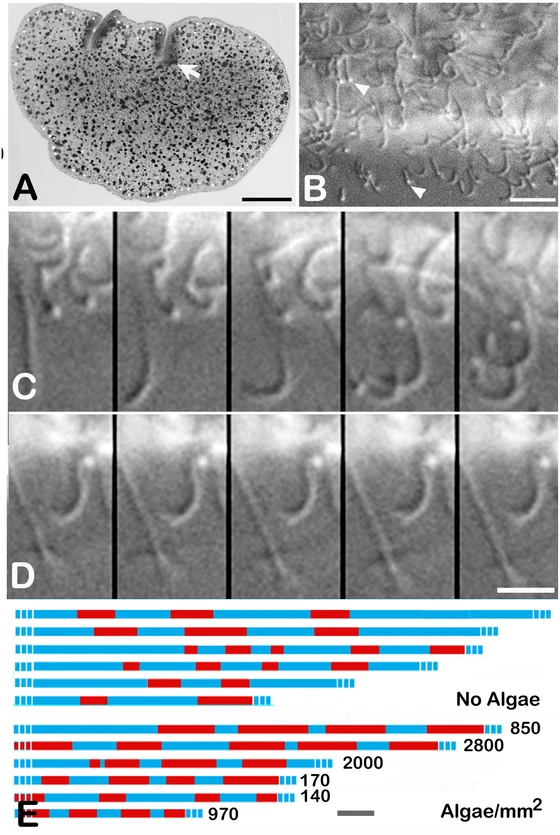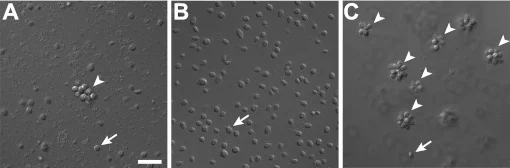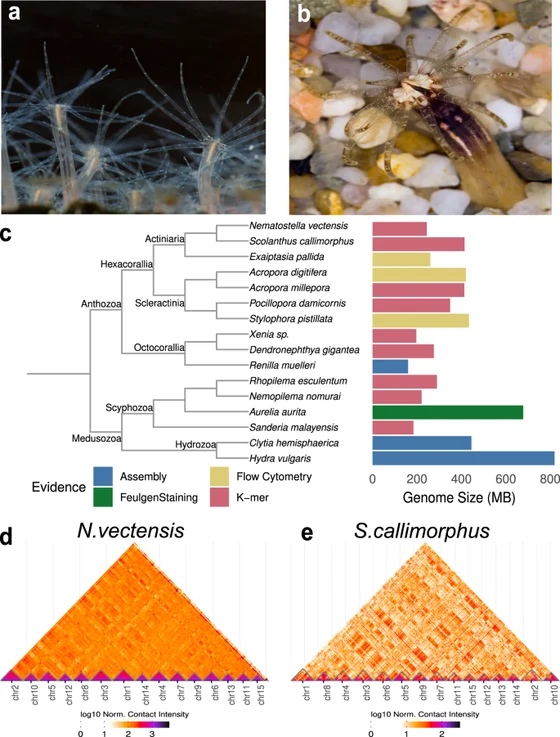
Steven Haddock’s black silhouette of Hormiphora californensis, with oval comb-jelly body and two trailing branched tentacles
Steven Haddock’s silhouette represents the comb jelly with an oval body, indicated comb rows and two long tentacles bearing side branches. It is a simplified reference drawing, not a photograph or a scale measurement of the animal. The transparent original is preserved.
Overview
Hormiphora californensis is a roughly two-centimeter, globular comb jelly described in the focal study as abundant in the temperate Pacific. Its extended feeding tentacles and easily observed embryos make it useful for aquarium-based research. Darrin T. Schultz and colleagues published a chromosome-scale genome in 2021, using the Monterey Bay individual Hc1 as the source of DNA and RNA for the assembly and annotation. Hc1 came from a Tucker trawl in 2016. Other material included a second wild individual and an animal from the seventh generation of an aquarium culture founded by a spawning event involving ten wild individuals.
The assembly contained 110.6 million base pairs in 44 scaffolds, with 99.47 percent of its sequence concentrated in the 13 longest scaffolds. Chromosome-spread microscopy independently supported 13 chromosome pairs: four images gave a count of 26, while other counts differed by up to three chromosomes. The combined evidence was stronger than equating a scaffold count alone with a karyotype. The annotation identified 14,265 protein-coding genes, most supported by long transcript reads. Its authors nevertheless warned that additional tissues and developmental stages could reveal genes missing from the adult-derived annotation.
Chromosome 1 in Hc1 showed evidence for three large, overlapping differences in orientation between its two inherited copies. The authors examined chromosome-contact patterns to distinguish these putative heterozygous inversions from correctable assembly errors. A separate aquarium individual lacked the same off-diagonal contact pattern. One alternative gene order in Hc1 also matched a region of the related comb jelly Pleurobrachia bachei. These observations suggested substantial variation within and between closely related animals; they did not establish that every member of the species has the same inversions or measure their frequency across the wild population.
Long transcript reads also revealed complex gene organization. Many genes were nested within introns of other genes, including some doubly nested examples. Shared short sequences at the beginning of numerous transcripts were interpreted as trans-spliced leaders; incomplete transcript capture meant that the observed fraction could underestimate their prevalence. These details illustrate why automated gene counts from fragmented assemblies require scrutiny. Sequence comparisons supported a close relationship with P. bachei and led the authors to suggest that the existing genus boundary might need revision. That proposal is retained as the study's taxonomic interpretation. The genome resource helps investigate animal evolution but does not by itself settle the branching order of the earliest animal lineages.
Origins & earliest records
Living Pacific comb jelly; focal genome specimen Hc1 was collected in Monterey Bay in December 2016.
Evidence & interpretation
Sequencing and manual annotation are supported by independent chromosome-spread counts and chromosome-contact comparisons; several evolutionary explanations remain interpretations.
Selected bibliography
Documented works and useful reading. This is not a list of every appearance.
- 01
A chromosome-scale genome assembly and karyotype of the ctenophore Hormiphora californensis
G3 11:jkab302, DOI10.1093/g3journal/jkab302; complete main report and Methods. CC BY 4.0.
Family, evolution & connections
Sampled comb-jelly mitochondrial branching (Schultz et al., 2021)
All twelve accession-labelled terminals in Supplementary Figure S9A, including two Hormiphora californensis individuals, three Beroe forskalii accessions and the Tethya actinia sponge outgroup. This is the mitochondrial panel, not the separate COX1 or 18S trees.
Scroll sideways to see all branches. With a keyboard, focus the tree and use the arrow keys.
- Mitochondrial sample tree
- Sampled ctenophores
- Sampled Coeloplana and Vallicula (posterior 1 / bootstrap 100)
- Coeloplana pair (posterior 1 / bootstrap 100)
- Coeloplana loyai LN898113
- Coeloplana yulianicorum LN898114
- Vallicula multiformis LN898115
- Remaining sampled ctenophores (posterior 1 / bootstrap 100)
- Sampled Beroe (posterior 1 / bootstrap 100)
- Beroe cucumis NC_045305
- Beroe forskalii accessions — retained three-way branching (posterior 1 / bootstrap 100)
- Beroe forskalii MG655624
- Beroe forskalii MG655622
- Beroe forskalii MG655623
- Sampled Hormiphora, Pleurobrachia and Mnemiopsis (posterior 1 / bootstrap 100)
- Hormiphora / Pleurobrachia sample pair (posterior 1 / bootstrap 100)
- Hormiphora californensis study samples (posterior 1 / bootstrap 100)
- Pleurobrachia bachei JN392469
- Mnemiopsis leidyi NC_016117
- Tethya actinia NC_006991 — outgroup
Eight mitochondrial loci: COX1, COX2, COX3, CYTB, ND1, ND2, ND4 and ND5. Supplementary Methods describe translation alignments in MAFFT, a concatenated alignment, RAxML rapid maximum-likelihood bootstrapping with 250 searches, and a separate MrBayes analysis. Original displayed posterior probabilities and maximum-likelihood bootstrap values are retained; none are recomputed. A study-specific mitochondrial hypothesis, not an ancestor chain or a comprehensive ctenophore species tree. The caption describes a protein tree, while Methods alternate nucleotide/protein wording; reported Bayesian sampling and burn-in settings are not reconstructed here. Separate COX1 and 18S panels raise generic-boundary questions and are not blended into this panel. Beroe accession branching is preserved as displayed, and the unlabelled root receives no invented support. Adapted from Schultz et al. (2021), CC BY 4.0: layout redrawn, accession labels expanded, branch lengths omitted; all terminals retained.
Taxonomic classification
A hierarchy of classified groups, not a chain of direct ancestors.
- kingdomAnimalia
- phylumCtenophora
- familyPleurobrachiidae
- genusHormiphora
- speciesHormiphora californensis
Pleurobrachia bachei and sampled Pleurobrachia
Schultz and colleagues report distinct mitochondrial genomes for Hormiphora californensis and Pleurobrachia bachei, while their 18S and COX1 trees place H. californensis within the sampled Pleurobrachia clade. The marker results question the historical genus boundary; they do not make P. bachei a living ancestor or establish a completed nomenclatural revision.
References
Sources supporting this profile. Linked pages have their own scope and editorial standards.
- ResearchSchultz and colleagues 2021, official Europe PMC full text, CC BY 4.0Research access: 2026-10-05
Image credits
Scientific organism reference silhouetteSteven Haddock’s black silhouette of Hormiphora californensis, with oval comb-jelly body and two trailing branched tentacles
Steven Haddock’s silhouette represents the comb jelly with an oval body, indicated comb rows and two long tentacles bearing side branches. It is a simplified reference drawing, not a photograph or a scale measurement of the animal. The transparent original is preserved.