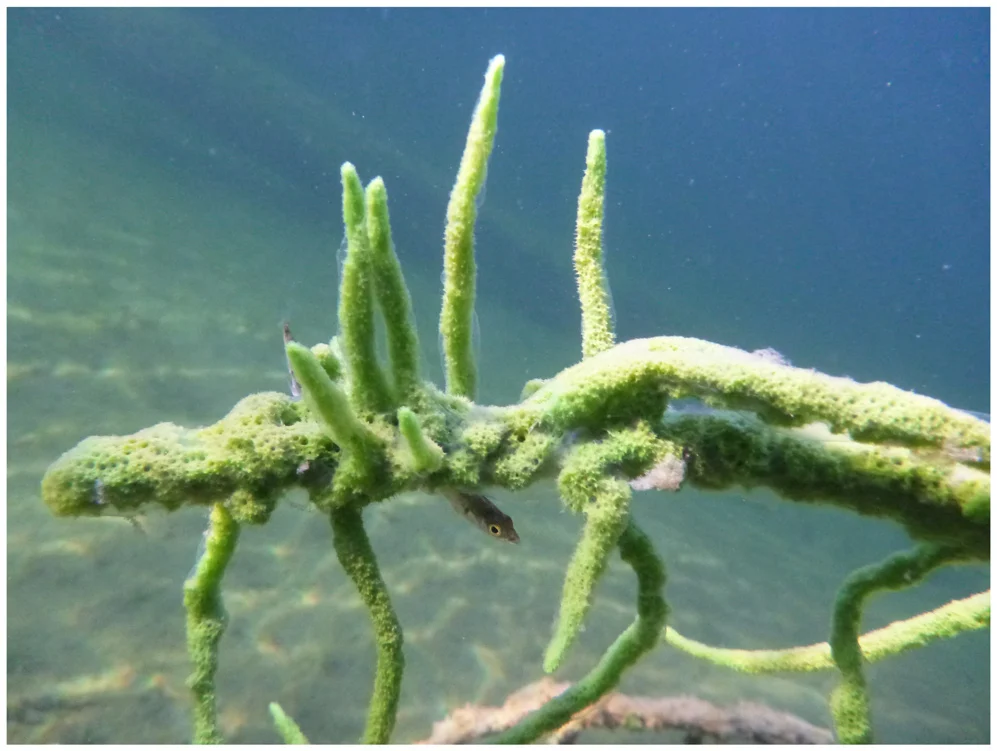
Representative Spongilla lacustris freshwater sponge with green branching projections photographed by Sally Leys,2025figure1
Sally Leys’s photograph shows a representative Spongilla lacustris, with green growth encrusting submerged branches and projecting into the water. The paper calls it similar to the specimen used for genome sequencing; it is not a photograph of that sequenced individual. The small fish visible nearby is not identified by the caption.
Overview
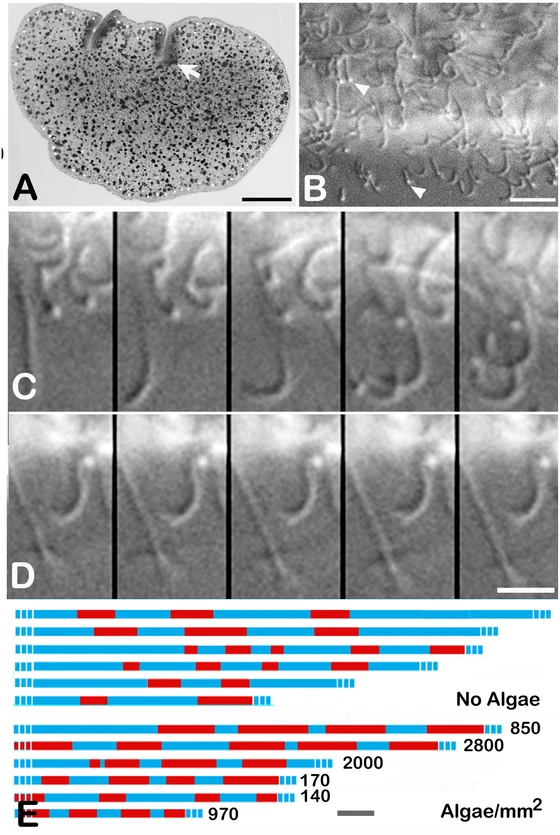
Spongilla lacustris filters water through canals and chambers of ciliated choanocytes. A 2021 study analyzed 10,106 cells from eight-day-old animals and assigned eighteen differentiated cell types. These include cells involved in contraction, digestion and removal of other cells. This is a study-specific classification, rather than a universal count for sponges.
Experiments implicated nitric oxide in initiating and regulating contraction. Imaging also revealed secretory neuroid cells extending around choanocyte collars and cilia. Despite expression of genes associated with synapses in other animals, the researchers observed no corresponding synaptic contact with targeted vesicle release. The proposed role of neuroid cells in coordinating feeding remains an interpretation; their evolutionary relationship to neurons is unresolved. Gene-expression similarities do not establish that this living sponge is an ancestor of animals with nervous systems.
A separately published 2025 genome report describes the sponge’s broader natural history. It occurs across the Holarctic region, often encrusting submerged wood, rocks and artificial surfaces in shallow lakes and rivers. Fingerlike projections can extend above an otherwise spreading crust. Its skeleton includes siliceous spicules. Green coloration is associated with algal inhabitants, while individuals protected from light may be yellow. Different algal species have been recorded from different sponges; the identification of one genome-associated alga does not establish a single universal symbiont for this sponge species.
Freshwater persistence also involves gemmules, dormant structures containing cells from which a new sponge can develop. The 2025 report summarizes both sexual reproduction and seasonal gemmule formation, drawing on earlier physiological studies. Its own sequenced material came from gemmules grown at the University of Alberta. The original sponge had been collected at O’Connor Lake on Vancouver Island and identified by Sally Leys. Tissue was sampled on 6 February 2021. This specimen is recorded as GHC0000126, with Tree of Life identifier odSpoLacu1; those are study identifiers, rather than a new species type designation.
The resulting sponge assembly spans approximately 248.7 million bases, with 99.73% assigned to twenty-three chromosome-scale scaffolds. It carries an annotation of 30,435 protein-coding genes, a result of that assembly and annotation pipeline rather than an immutable count. Manual curation removed duplicated haplotypic sequences and repaired joins. The authors also flag a collapsed repeat joining the arms of chromosome seven. Although the assembly is strongly scaffolded, its reported completeness against one animal single-copy-gene reference set is 64.4%; chromosome placement and gene-set completeness measure different properties.
The same material yielded a genome assigned only to Choricystis sp. and three bacterial metagenome bins. These associated sequences must be distinguished from the sponge’s own chromosomes. The sponge identification received an additional molecular check: its ribosomal spacer sequence fell among previously recognized Spongilla lacustris samples with 97% bootstrap support. This corroborates the sampled identification without demonstrating that all populations are genetically identical or resolving every relationship among freshwater sponges.
Origins & earliest records
Account based on Musser and colleagues’ 2021 cellular study.
Evidence & interpretation
The 2021 cell study uses single-cell expression, spatial labeling, microscopy and contraction experiments. The 2025 genome note records specimen provenance, long-read/Hi-C assembly, quality metrics and an ITS taxonomic check; associated microbial sequences are separate assemblies.
Selected bibliography
Documented works and useful reading. This is not a list of every appearance.
- 01
Profiling cellular diversity in sponges informs animal cell type and nervous system evolution
Science 374, 717–723; complete main narrative read. Supplementary Methods not inspected.
- 02
The chromosome-level genome sequences of the freshwater sponge, Spongilla lacustris (Linnaeus, 1759) and the chlorophyte cobiont Choricystis sp., and the associated microbial metagenome sequences
Wellcome Open Research 10:222, version1, first published25April2025. Complete main Background, genome reports, tables, sampling, assembly, verification and annotation Methods read in retained16-page PDF; CC Attribution. Specimen GHC0000126/odSpoLacu1, host assembly GCA_949361645.1.
Family, evolution & connections
Taxonomic classification
A hierarchy of classified groups, not a chain of direct ancestors.
- GenusSpongilla
- SpeciesSpongilla lacustris
Choricystis sp. — sequenced algal cobiont
Leys and colleagues assembled a separate Choricystis genome from the same cultured sponge material. The alga remains identified only to genus; this sampled association does not establish one universal algal partner, a quantified nutritional benefit or shared ancestry. Host and cobiont chromosome assemblies are distinct.
References
Sources supporting this profile. Linked pages have their own scope and editorial standards.
- ResearchMusser et al. 2021, author manuscriptResearch access: 2026-10-05
- ResearchLeys et al. 2025 genome data note (CC Attribution)Research access: 2026-10-05
Image credits
Scientific organism specimen photographRepresentative Spongilla lacustris freshwater sponge with green branching projections photographed by Sally Leys,2025figure1
Sally Leys’s photograph shows a representative Spongilla lacustris, with green growth encrusting submerged branches and projecting into the water. The paper calls it similar to the specimen used for genome sequencing; it is not a photograph of that sequenced individual. The small fish visible nearby is not identified by the caption.