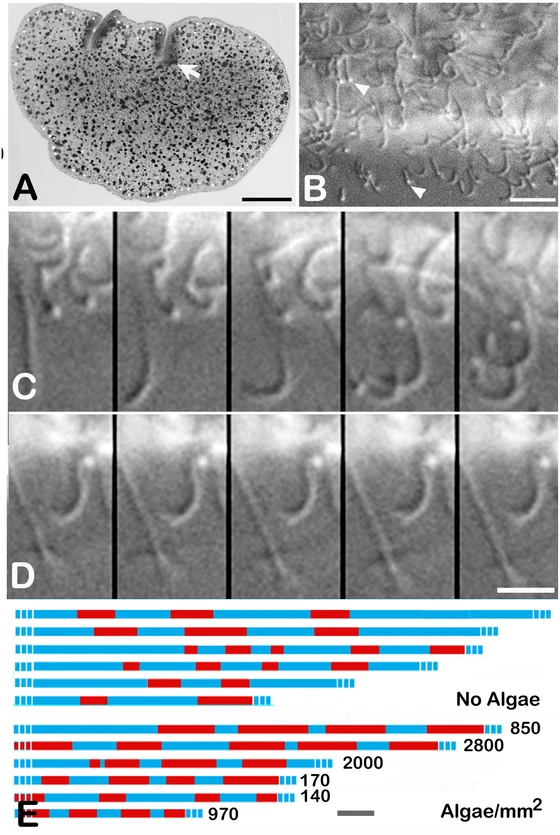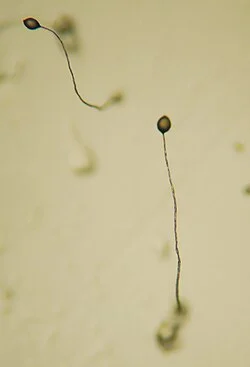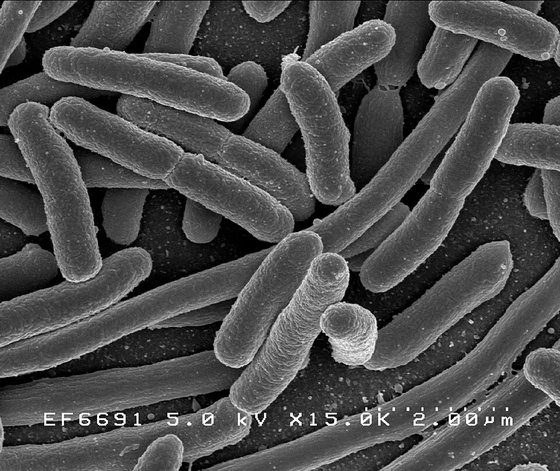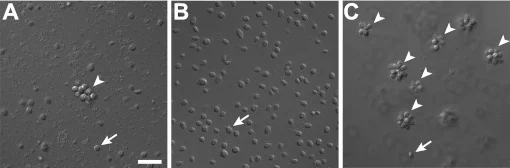
Salpingoeca rosetta single cells and rosette colonies under three bacterial culture conditions, Alegado and colleagues 2012 figure 1
These micrographs compare the original ATCC 50818 culture, an antibiotic-treated culture lacking rosettes, and that culture after addition of Algoriphagus machipongonensis. Arrowheads identify rosette colonies and arrows mark representative single cells. The scale bar is 2 micrometres. The panels document particular laboratory conditions, rather than a universal colony state.
Overview
Salpingoeca rosetta is a microscopic marine eukaryote studied for its ability to live as solitary cells and organized colonies. The 2012 experiments of Alegado and colleagues distinguish attached cells, solitary swimmers, chains and rosettes from loose cell associations. In their colony assay, a rosette contains at least four closely associated cells arranged with their flagella pointing outward. Such colonies develop through repeated divisions of a founder cell with incomplete separation, leaving neighboring cells connected by fine bridges. This is different from a group assembled simply by independent cells gathering together.
The environmental culture deposited as ATCC 50818 carried a mixed bacterial community and produced rosettes only sporadically. Antibiotic treatment generated a line called Rosette Colonies Absent, or RCA. These cells still multiplied while feeding on remaining bacteria, but did not form rosettes even after the antibiotics were removed. Adding bacteria from the original community restored development. Among 64 independent bacterial isolates screened from that culture, Algoriphagus machipongonensis supplied the active stimulus. A culture fed only this bacterium also formed rosettes, separating a particular developmental cue from a general need to consume bacterial food.
Chemical fractionation identified RIF-1, a sulfonolipid, as a rosette-inducing molecule. Its activity was present in bacterial cell envelopes and conditioned medium; the isolated compound was characterized using mass spectrometry and nuclear magnetic resonance. Tested ordinary sphingolipids did not substitute for it. Purified RIF-1 acted over a wide concentration range, but the response was not a simple increase without limit: its dose-response curve was bell-shaped. Moreover, the purified molecule induced fewer colonial cells than the enriched lipid fraction. The authors considered differences in delivery or additional bacterial molecules as explanations, rather than claiming that RIF-1 alone reproduced every effect of the live bacterium.
Choanoflagellates are close living relatives of animals, making this experimental system informative for questions about multicellular development. That relationship does not make this living species a preserved animal ancestor. The study proposes that bacterial signals might have influenced early animal evolution, but does not observe that historical event. Likewise, the highly sensitive response suggests a receptor-mediated process without identifying the receptor. More efficient prey capture and release of the signal in bacterial membrane vesicles were ecological or mechanistic hypotheses in this report, distinct from the demonstrated induction of colonies in laboratory cultures.
Origins & earliest records
The study uses environmental culture ATCC 50818 and experimentally derived RCA and Px1 lines. These culture identifiers are not assigned the status of nomenclatural types here. No date for the origin of the living species is inferred from its relationship to animals.
Evidence & interpretation
Microscopy, bacterial supplementation, fractionation, mass spectrometry and NMR support the laboratory developmental interaction. The paper distinguishes purified RIF-1 activity from the greater activity of an enriched lipid fraction. Proposed receptors, ecological benefits and ancient evolutionary effects remain hypotheses.
Selected bibliography
Documented works and useful reading. This is not a list of every appearance.
- 01
A bacterial sulfonolipid triggers multicellular development in the closest living relatives of animals
eLife 1:e00013, DOI 10.7554/eLife.00013. Complete main Introduction, Results, Discussion and Materials and Methods; CC Attribution.
- 02
The rosetteless gene controls development in the choanoflagellate S. rosetta
eLife3:e04070; selected PMC publication9October2014; DOI10.7554/eLife.04070.
Family, evolution & connections
Taxonomic classification
A hierarchy of classified groups, not a chain of direct ancestors.
- groupChoanoflagellates
- genusSalpingoeca
- speciesSalpingoeca rosetta
Algoriphagus machipongonensis
Alegado and colleagues found that this co-isolated prey bacterium restored rosette-colony development in their colony-deficient Salpingoeca culture. Its sulfonolipid RIF-1 provided a developmental cue. The experiment connects feeding and bacterial signalling with multicellular organization; it does not identify the bacterium as an ancestor of the choanoflagellate or demonstrate that all wild colonies require this single species.
Located primary passages
Specific passages supporting details in this entry, grouped by their published witness.
The rosetteless gene controls development in the choanoflagellate S. rosetta
eLife3:e04070; selected PMC publication9October2014; DOI10.7554/eLife.04070.
- A screened mutant failed to form rosettes while retaining individual growth and chain colonies. Genetic linkage and antibody blocking implicated Rosetteless, a secreted C-type lectin-like protein concentrated in the rosette extracellular core. Sugar binding and the mechanism of action were not demonstrated. The authors lacked transgenic complementation or targeted deletion; homology versus convergence with animal proteins remained unresolved. This extant choanoflagellate is an animal relative, not an actual animal ancestor.
Complete Introduction, Results and Discussion; Table1 and selected figure captions.
Methods, supplementary data and movies unread; no raw-data reanalysis. Publisher v3 PDF says9October2014; landing catalogue later version-of-record date is4November2014. Publisher challenge cache is excluded as evidence.
References
Sources supporting this profile. Linked pages have their own scope and editorial standards.
- ResearchAlegado 2012 experimental rosette inductionResearch access: 2026-10-05
Image credits
Scientific organism microscopy experiment figureSalpingoeca rosetta single cells and rosette colonies under three bacterial culture conditions, Alegado and colleagues 2012 figure 1
These micrographs compare the original ATCC 50818 culture, an antibiotic-treated culture lacking rosettes, and that culture after addition of Algoriphagus machipongonensis. Arrowheads identify rosette colonies and arrows mark representative single cells. The scale bar is 2 micrometres. The panels document particular laboratory conditions, rather than a universal colony state.