Dictyostelium discoideum
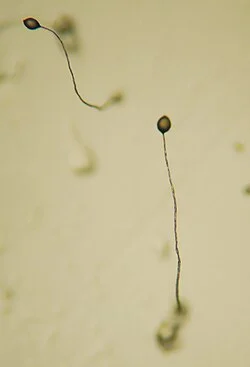
Image associated with the exact linked encyclopedia article; consult credited file description for its interpretation.
Overview
Dictyostelium discoideum lives as amoeboid cells that consume microbes in soil. When food becomes scarce, cells can gather into a multicellular structure and ultimately produce a spore-bearing fruiting body. The participants differentiate into distinct roles, making the organism a useful experimental system for studying communication, movement and cooperation among cells.
Despite the traditional label slime mould, Dictyostelium is an amoebozoan rather than a fungus. Its multicellular stage develops through aggregation, offering a contrast with an animal embryo produced by repeated division of one starting cell. Genome sequencing has provided tools for testing how signalling and differentiation work. The resemblance of some functions across kingdoms does not make the amoeba a direct ancestor of animals or plants.
Aggregation is also a problem of recognition: neighboring cells must adhere and coordinate their different developmental roles. Wang and Shaulsky examined this experimentally in 2015 using the laboratory strain AX4 and genetically modified derivatives. Their work focused on TgrC1, a surface glycoprotein involved in development and discrimination between cell populations. Cells lacking its gene normally stop at the loose-aggregate stage and produce very few spores. This is an experimental mutant phenotype, rather than the usual fate of starving wild amoebae.
The researchers screened 8,000 insertion mutants and found three mutations that partially rescued development in the TgrC1-deficient background. They then investigated one suppressor, an insertion in stcA. The affected cells could proceed to fruiting bodies and produced more spores than their parental mutant, but developed late and less consistently than AX4. Critically, restored development did not restore normal recognition behavior. Tests with differently labelled cell populations showed that the suppressor-bearing cells still separated from populations they had previously failed to recognize. The authors consequently argue that developmental and recognition functions can be experimentally separated.
Mixed populations further revealed that stalk and spore differentiation need not be rescued in the same way. TgrC1-deficient cells mixed with suppressor-bearing cells contributed strongly to spores but were mostly absent from the stalk. In contrast, AX4 cells tended to segregate from them. The authors interpret the results as evidence for different contributions of within-cell regulation and signals supplied by neighboring cells. The proposed extracellular signal was not identified by these experiments; altered sorting also changes which cells remain close enough to receive signals.
The comparison with TgrB1-deficient cells was less decisive: the suppressor did not significantly change their measured development or spore production, but the underlying phenotype was variable. The investigators explicitly retain uncertainty about whether weak suppression was missed. Their screen also was not exhaustive. This source therefore illustrates a testable regulatory distinction, rather than supplying a complete pathway diagram or evidence that recognition involves conscious social judgment. Its sporulation assays used three independent biological replicates, each with three technical replicates; repeated measurements do not become nine independent biological experiments.
Origins & earliest records
The scientific species and laboratory model were established through biological observation and experimental culture; their history is distinct from the evolutionary origin of social amoebae. A major genome study appeared in 2005. That publication describes a research milestone rather than the birth of the species or multicellularity.
Evidence & interpretation
Observed aggregation, cell differentiation and fruiting-body formation support the social life cycle. Genome analysis identifies candidate molecular systems, while experiments test their roles. Similarity between genes or behaviours in different organisms requires careful evolutionary interpretation; a present-day amoeba is not a surviving snapshot of a universal ancestral cell. Mutant screens, fluorescently labelled mixed populations and replicated sporulation assays distinguish partial developmental rescue from unchanged recognition defects.
Selected bibliography
Documented works and useful reading. This is not a list of every appearance.
- 01
The genome of the social amoeba Dictyostelium discoideum
Selected institutional scientific reading; not a complete bibliography.
- 02
TgrC1 Has Distinct Functions in Dictyostelium Development and Allorecognition
PLOS ONE 10(4), e0124270. Complete main Introduction, Results, Discussion, Methods and captions read. CC BY4.0 factual adaptation credited; supporting figure files and experiments not reproduced.
Family, evolution & connections
Dictyostelium and sampled relatives: one SSU gene tree
The eight displayed dictyostelid tips pruned from Figure 3’s 129-taxon analysis.
Scroll sideways to see all branches. With a keyboard, focus the tree and use the arrow keys.
- Sampled dictyostelids
- Selected groups 3 and 4
- Group 4 pair
- Dictyostelium purpureum
- Group 3 pair
- Dictyostelium sp. menorah
- Dictyostelium minutum
- Selected groups 1 and 2 (lower support)
- Group 2 pair
- Acytostelium ellipticum
- Polysphondylium pallidum
- Group 1 pair
- Dictyostelium deminutum
- Dictyostelium bifurcatum
Maximum-likelihood SSU rDNA topology; actual Figure 3 inspected. Source group numbers retained; outgroups and branch lengths omitted. A single-locus 2009 hypothesis, not a complete modern species tree. Names follow the figure rather than silently adopting subsequent generic revisions. The lower intergroup branch has only 55 / 69 bootstrap support in the two analyses; weak deeper placement outside this subtree is not represented.
Taxonomic classification
A hierarchy of classified groups, not a chain of direct ancestors.
- kingdomProtozoa
- phylumMycetozoa
- classDictyosteliomycetes
- orderDictyosteliales
- familyDictyosteliaceae
- genusDictyostelium
- speciesDictyostelium discoideum
Dictyostelium purpureum in Shadwick’s SSU tree
The inspected SSU rDNA figure pairs D. discoideum with sampled D. purpureum. This is a strongly supported pair in that gene tree, not a claim that all species were sampled or that one living amoeba is the other’s ancestor.
Located primary passages
Specific passages supporting details in this entry, grouped by their published witness.
TgrC1 Has Distinct Functions in Dictyostelium Development and Allorecognition
Wang and Shaulsky2015, PLOS ONE10(4)e0124270,20April2015; DOI10.1371/journal.pone.0124270
- The study distinguishes cell differentiation from recognition of compatible cells during social amoeba development. A suppressor mutation partly improves development when TgrC1 is absent but does not repair the recognition defect. Mixing experiments suggest different dependencies for stalk and spore differentiation. The incomplete rescue and inconclusive TgrB1 comparison constrain the proposed signaling explanation; these experiments do not establish a fully resolved mechanism.
No experimental replication or raw-data analysis; cellular allorecognition is not evidence for human racial categories. The2005 genome paper remains only an abstract/bibliography lead.
Encyclopedia background
An additional attributed reference, separate from the editorial profile above.
Read the open encyclopedia overview
Dictyostelium discoideum is a species of soil-dwelling amoeba belonging to the phylum Amoebozoa, infraphylum Mycetozoa. It is one of a number of distantly related spore-forming species collectively referred to as the slime molds, due to the presence of both single-celled and multicellular forms at different stages in its life cycle.
D. discoideum is a eukaryote that transitions from a collection of unicellular amoebae into a multicellular "slug" and then into a fruiting body within its lifetime. Its unique asexual life cycle consists of four stages: vegetative, aggregation, migration, and culmination. The life cycle of D. discoideum is relatively short, which allows for timely viewing of all stages. The cells involved in the life cycle undergo movement, chemical signaling, and development, which are applicable to human cancer research. The simplicity of its life cycle makes D. discoideum a valuable model organism to study genetic, cellular, and biochemical processes in other organisms.
Text from Wikipedia contributors, “Dictyostelium discoideum”. CC BY-SA 4.0. Extracted introduction; formatting changed. Retrieved 5 October 2026. The source article may have changed since retrieval.
References
Sources supporting this profile. Linked pages have their own scope and editorial standards.
- ResearchThe genome of the social amoeba Dictyostelium discoideumResearch access: 2026-10-05
- ResearchWang and Shaulsky 2015 primary genetic experiments (CC BY4.0)Research access: 2026-10-05
Image credits
Reference illustrationDictyostelium discoideum
Image associated with the exact linked encyclopedia article; consult credited file description for its interpretation.