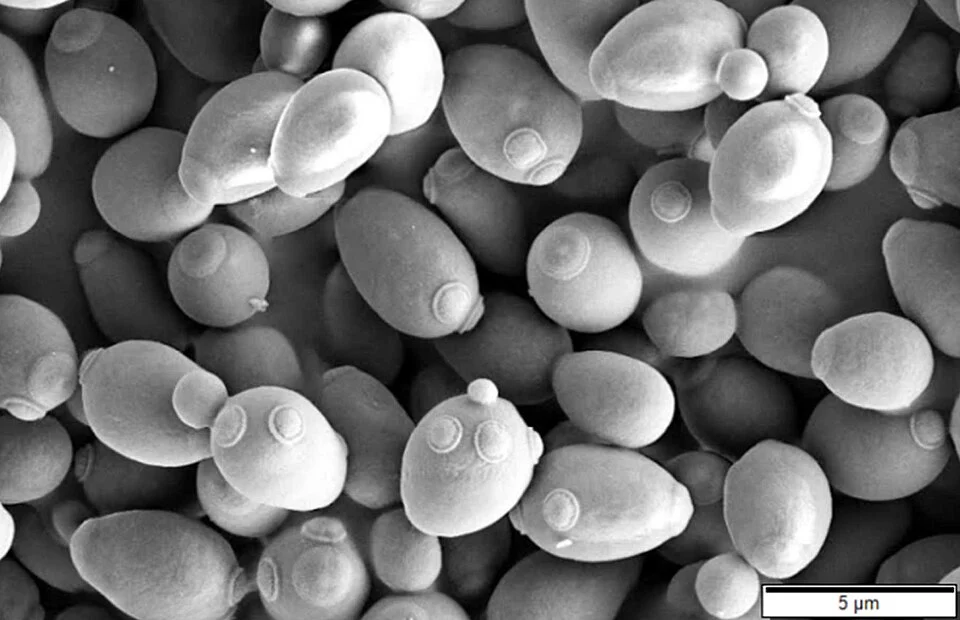
Saccharomyces cerevisiae, SEM image
Illustration associated with the linked encyclopedia article. Refer to the file record for the subject and interpretation.
Overview
Budding yeast is a eukaryotic microorganism with a nucleus and many cellular systems also found in larger organisms. New cells grow as buds from existing cells. Different strains have been used in baking, brewing and other fermentations, while laboratory strains allow researchers to investigate inheritance, cell division and metabolism under controlled conditions.
The species is especially valuable because genetic experiments can connect particular genes to cellular processes. A genome resource is therefore more than a list of DNA letters: it brings together strain information, gene functions and published evidence. Industrial, wild and laboratory yeasts need not behave identically. Calling yeast a simple organism is useful only if it does not erase the complexity of its regulation and life cycle.
A 2018 population study makes this variation concrete. Peter and colleagues analysed 1,011 isolates drawn from fermentation, other human-associated environments and wild settings such as soil, insects and trees. They newly sequenced 918 and incorporated 93 previously sequenced strains. Because 217 had been genetically manipulated, the analysis of natural ploidy used a smaller set of 794. Most of that subset was diploid, but some isolates carried more chromosome sets. Whole chromosome gains and losses were also found, particularly in certain domesticated groups. These are distinctions among sampled strains, rather than fixed properties of every budding yeast cell.
The resulting population tree contained 26 identified clades and three groups with mixed ancestry. Geography, habitat and human association helped explain the structure, but did not form perfectly separate categories: sake and Mediterranean oak strains were notable exceptions to a simple wild-versus-domesticated division. A rooted comparison with related Saccharomyces species supported an East Asian origin, and the sampled non-Chinese strains were consistent with a shared out-of-China dispersal. This remains a reconstruction from available genomes, rather than proof that every unsampled population shares an identical history or a precise archaeological date for domestication.
The researchers also constructed a pangenome: the combined gene repertoire across their collection. They identified 4,940 core open reading frames and 2,856 variable ones. Some variable genes were interpreted as arrivals from related species, especially S. paradoxus, while others were assigned more distant sources. Such gene exchange and differences in gene copy number show why a single reference strain cannot represent all genetic possibilities in the species. A predicted gene or inferred transfer is not automatically a demonstrated biochemical function.
Growth measurements under selected laboratory conditions connected genetic variation with phenotypic differences. Copy-number variants accounted for larger portions of the explained variation than single-nucleotide variants in the associations detected by this study. However, many rare variants were poorly captured by the association design, and explained variance did not exhaust estimated heritability. The investigation therefore supplies a resource for testing traits rather than a complete catalogue of the causes of every industrial or ecological performance difference.
Origins & earliest records
Human use of yeast in fermentation predates its scientific identification. The species' evolutionary origin cannot be dated from the beginning of brewing or from the first laboratory culture. Its role in modern genetics developed through experimental strains, microscopy and increasingly detailed genetic and genome-based resources.
Evidence & interpretation
Microscopy records budding cells; fermentation experiments measure metabolic products; and genetic manipulation tests the functions of particular genes. The Saccharomyces Genome Database integrates this literature. Results from a reference laboratory strain are powerful evidence, but they should not automatically be extended to every wild or industrial strain. Population sequencing, flow-cytometry ploidy measurements and controlled growth assays provide strain-specific evidence; geographic origin and gene-transfer assignments are comparative inferences.
Selected bibliography
Documented works and useful reading. This is not a list of every appearance.
- 01
Budding Yeast for Budding Geneticists: A Primer on the Saccharomyces cerevisiae Model System
Selected institutional scientific reading; not a complete bibliography.
- 02
Genome evolution across 1,011 Saccharomyces cerevisiae isolates
Nature 556, 339-344; DOI10.1038/s41586-018-0030-5. Full main text plus sampling, sequencing, ploidy and relevant pangenome Methods read. CC BY4.0 adapted factual account; supplements and statistical pipelines not reproduced.
- 03
Genome evolution across1,011 Saccharomyces cerevisiae isolates
Nature556,339–344(2018); DOI10.1038/s41586-018-0030-5; published11April2018, issue19April2018; actual complete publisherHTML retrieved successfully natively despite webtool identity-provider redirect
Family, evolution & connections
Five sampled Saccharomyces lineages — Scannell et al. 2011
Five Figure 3 terminals, with historical names.
Scroll sideways to see all branches. With a keyboard, focus the tree and use the arrow keys.
- Five sampled nonhybrid yeast lineages
- S. bayanus var. uvarum (historical S. bayanus label)
- Sampled kudriavzevii and remaining lineages
- Saccharomyces kudriavzevii
- Sampled cerevisiae, paradoxus and mikatae
- Saccharomyces mikatae
- S. cerevisiae / S. paradoxus pair
- Saccharomyces paradoxus
Relaxed molecular clock using 106 genes after complete-orthogroup parameter estimation failed. Branching follows Figure 3. No confidence values or calendar dates are represented. Figure percentages describe relative divergence, not bootstrap support. The paper explicitly uses S. bayanus to mean S. bayanus var. uvarum; that historical convention is retained here. Later-discovered species and hybrid reticulation are outside this sample; living tips are not ancestors.
Seven Saccharomyces species groups in the 2018 concatenated-gene analysis
Figure 2 maximum-likelihood tree, with within-species sampled strains collapsed into seven species groups. The separate Figure 1 SNP-based population tree and map are excluded.
Scroll sideways to see all branches. With a keyboard, focus the tree and use the arrow keys.
- Selected Saccharomyces complex (Figure 2)
- S. eubayanus / S. uvarum pair
- Saccharomyces eubayanus
- Saccharomyces uvarum
- Remaining sampled species groups
- Saccharomyces arboricola
- Four remaining species groups
- Saccharomyces kudriavzevii
- S. mikatae and sister pair
- Saccharomyces mikatae
- S. cerevisiae / S. paradoxus pair
- Saccharomyces paradoxus (sampled strains collapsed)
Peter and colleagues aligned 2,018 one-to-one orthologous coding sequences across 41 genomes, partitioned by codon position. RAxML GTRGAMMA used 100 rapid bootstraps; no support values are transferred because the selected figure does not display them. Collapsing sampled strain branches does not assert that every strain or species was sampled. The figure’s distance and introgressed-gene heat maps are not node confidence or dates. Introgression and mosaic genomes complicate a single branching summary. The alternative ASTRAL gene-tree summary is not blended into this concatenated result; no direct ancestors are designated. Adapted from Peter et al. under CC BY 4.0 by collapsing strain tips and omitting distances and map.
Taxonomic classification
A hierarchy of classified groups, not a chain of direct ancestors.
- kingdomFungi
- phylumAscomycota
- classSaccharomycetes
- orderSaccharomycetales
- familySaccharomycetaceae
- genusSaccharomyces
- speciesSaccharomyces cerevisiae
Saccharomyces paradoxus
Scannell and colleagues’ Figure 3 pairs S. cerevisiae with S. paradoxus in a five-lineage comparison. This is sampled branching, not a claim that one living species descended from the other.
Saccharomyces mikatae
Figure 3 places S. mikatae sister to the sampled S. cerevisiae and S. paradoxus pair. Species omitted from this 2011 comparison cannot be assigned positions from this figure.
Saccharomyces paradoxus
Peter and colleagues traced most inferred introgressed open reading frames in their 1,011 Saccharomyces cerevisiae genomes to S. paradoxus. Every sampled isolate retained at least one such gene, with differing amounts among populations. This genomic inference supports gene flow across the species boundary; a simple sister-branch tree cannot depict those exchanges. It does not identify each hybridization event or make either living species the direct ancestor of the other.
Located primary passages
Specific passages supporting details in this entry, grouped by their published witness.
Genome evolution across 1,011 Saccharomyces cerevisiae isolates
Nature556,339–344(2018); DOI10.1038/s41586-018-0030-5; published11April2018, issue19April2018; actual complete publisherHTML retrieved successfully natively despite webtool identity-provider redirect
- A geographically and ecologically broad collection of1,011 budding-yeast isolates reveals substantial variation beyond the standard laboratory reference. The reported pangenome contains4,940 core and2,856 variable open reading frames. Most of the794 isolates evaluated in their natural ploidy state were diploid; human-associated groups showed additional variation. The phylogenetic analysis supports an East Asian origin and subsequent dispersal, a sampled evolutionary inference rather than an exhaustive historical census.
Not complete Methods, loss-of-heterozygosity/genotype–phenotype sections or supplementary matrices; no reproduced analysis, current taxonomic-origin consensus or uniform wild population genome claimed. Numbers refer to this sampled study, not every living yeast strain.
Encyclopedia background
An additional attributed reference, separate from the editorial profile above.
Read the open encyclopedia overview
Saccharomyces cerevisiae (), also called brewer's yeast or baker's yeast, is a species of yeast (single-celled fungal microorganisms). The species has been instrumental in winemaking, baking, and brewing since ancient times. It is believed to have been originally isolated from the skin of grapes. It is one of the most intensively studied eukaryotic model organisms in molecular and cell biology, much like Escherichia coli as the model bacterium. It is the microorganism which causes many common types of fermentation. S. cerevisiae cells are round to ovoid, 5–10 μm in diameter. It reproduces by budding.
Many proteins important in human biology were first discovered by studying their homologs in yeast; these proteins include cell cycle proteins, signaling proteins, and protein-processing enzymes. S. cerevisiae is currently the only yeast cell known to have Berkeley bodies present, which are involved in particular secretory pathways. Antibodies against S. cerevisiae are found in 60–70% of patients with Crohn's disease and 10–15% of patients with ulcerative colitis, and may be useful as part of a panel of serological markers in differentiating between inflammatory bowel diseases (e.g. between...
Text from Wikipedia contributors, “Saccharomyces cerevisiae”. CC BY-SA 4.0. Extracted introduction; formatting changed. Retrieved 5 October 2026. The source article may have changed since retrieval.
References
Sources supporting this profile. Linked pages have their own scope and editorial standards.
- ResearchBudding Yeast for Budding Geneticists: A Primer on the Saccharomyces cerevisiae Model SystemResearch access: 2026-10-05
- ResearchPeter et al. 2018 primary population-genomics study (CC BY4.0)Research access: 2026-10-05
Image credits
Reference imageSaccharomyces cerevisiae, SEM image
Illustration associated with the linked encyclopedia article. Refer to the file record for the subject and interpretation.