Fly agaric
Image associated with the exact linked encyclopedia article; consult credited file description for its interpretation.
Overview
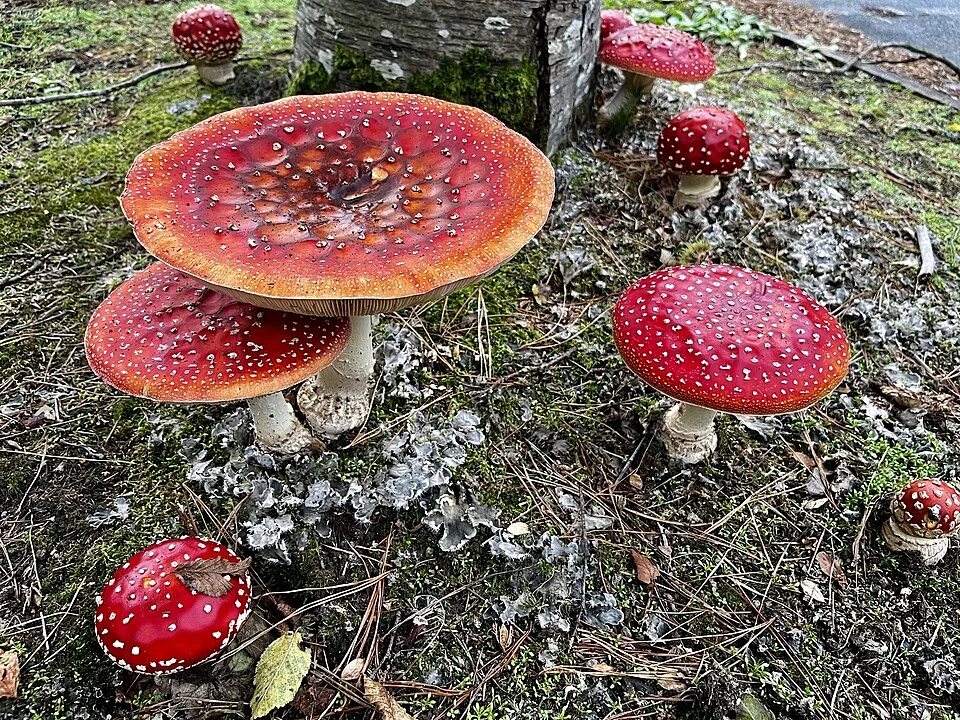
Fly agaric is familiar for a red cap dotted with pale remnants of the protective veil, though appearance can vary. The mushroom is a reproductive structure rather than the whole organism: much of the fungus exists as a network of hyphae associated with soil and roots. It commonly forms mutualistic relationships with trees such as birch and pine.
The fungus participates in nutrient exchange with its hosts, making its ecological role more informative than its fairy-tale silhouette. Scientific identification considers several anatomical features and increasingly molecular evidence; a red-and-white cap alone is not a complete identification method. Fly agaric also contains biologically active compounds and is toxic. This profile describes its natural history and does not convert traditional associations or online depictions into food or medical advice.
A 2026 study by Nickles and colleagues adds a source-specific history of introduced populations. The name Amanita muscaria is used broadly for a complex of cryptic lineages, some still without formal species names. Cap colour does not reliably separate all of them. The researchers sequenced 24 mushrooms: nine from South Africa, eleven from Europe, two from Australia and two from California, together with an Amanita pantherina outgroup. South African and Australian specimens came from pine plantations. This sampling was designed to investigate the South African introduction, rather than comprehensively survey the global complex.
Comparisons of gene markers and genomic variation placed all nine sampled South African mushrooms in Clade II, the Eurasian lineage also represented among introduced Australian and South American material. Historical records and the genetic results favoured a European source for the South African introduction. The exact source population and number of introductions remained unresolved. Some trees grouped South African and Australian material particularly closely; that could reflect a shared European source and does not by itself establish movement from Australia to Africa.
The South African samples had lower nucleotide diversity than the European comparison and a shift in the distribution of variant frequencies consistent with a founder event. Sampling differences could also influence these statistics. No sampled mushroom pairs were identified as clones, and the genetic relationships were consistent with continuing sexual reproduction. One closely related pair came from a single plantation. These observations concern the sampled fruiting bodies and inferred genetic individuals, not a census of every fungal network beneath those forests.
The study links historical dispersal with present-day genomic diversity. Pine forestry provided a context for spread, but mushroom records and nearby tree photographs do not experimentally identify every individual root partner. Genomic differences associated with possible stress-response functions likewise do not demonstrate which adaptations enabled establishment. The authors called for denser sampling to identify European sources and determine whether additional lineages occur in South Africa. Introduced populations therefore add a modern biogeographic history to the fungus without assigning a geological age to the living species or treating its entire species complex as genetically uniform.
Origins & earliest records
Fly agaric was scientifically named within the long history of mushroom classification, but naming is not its evolutionary beginning. Modern records describe occurrence and relationships with host trees. The species' exact origin is undated here, and the age of fungal-plant symbiosis generally must not be assigned to this particular living fungus.
Evidence & interpretation
Observed root associations support its mycorrhizal role, while specimens and molecular comparisons inform classification. The visible fruiting body is only part of the fungal network. Appearance varies and related taxa can complicate identification; toxicological evidence concerns particular compounds and exposures rather than a reliable judgement based solely on cap colour. The 2026 historical and genomic comparison supports a lineage-specific introduction account, with sampling and alternative-source limits; nearby-tree records are not equivalent to experimentally verified root associations.
Selected bibliography
Documented works and useful reading. This is not a list of every appearance.
- 01
Symbionts
Selected institutional scientific reading; not a complete bibliography.
- 02
Equipped for success: genomes and metabolomes of the European Amanita muscaria are conserved in its novel South African range
New Phytologist; first online 12 March 2026, May 2026 issue. DOI 10.1111/nph.71064. Complete Introduction, population-origin Results, historical/sampling/assembly/variant/kinship/marker-tree Methods and Discussion read; specialized-metabolism Results and supplementary analyses not inspected. CC BY 4.0; attributed original summary.
- 03
Convergent losses of decay mechanisms and rapid turnover of symbiosis genes in mycorrhizal mutualists
Nature Genetics 47:410–415 (2015), DOI 10.1038/ng.3223; corrected publisher HTML.
Family, evolution & connections
Eight selected mushroom tips in the 2012 Amanita analysis
Eight tips pruned from Figure 2; additional branches above the frostiana group are omitted. Historical infraspecific labels are retained as printed.
Scroll sideways to see all branches. With a keyboard, focus the tree and use the arrow keys.
- Selected Figure 2 Amanita subtree
- A. murinoflammeum / A. umbrinella pair
- Amanita murinoflammeum
- Amanita umbrinella
- Remaining selected tips
- Amanita wellsii
- Other selected tips
- Two sampled A. muscaria labels
- A. muscaria subsp. flavivolvata
- Selected A. frostiana group
- Amanita frostiana
- A. pulverulenta / A. pudica pair
- Amanita pulverulenta
- Amanita pudica
Maximum likelihood branching from four ribosomal loci, 2,994 aligned characters and 108 sampled species; Bayesian support was also assessed. Support labels are not supplied for every internal branch. This transfers neither trophic ancestral states nor cellulase presence/absence. The two muscaria labels are samples in this study, not a declaration of current accepted species boundaries.
Selected Amanita mitogenomes — Wang 2025
Six tips pruned from Figure 9: two outgroups and four Amanita species. Other sampled mushrooms omitted.
Scroll sideways to see all branches. With a keyboard, focus the tree and use the arrow keys.
- Selected sample
- Outgroup pair (posterior 1)
- Coprinellus micaceus
- Stropharia rugosoannulata
- Amanita (posterior 1)
- A. thiersii
- Remaining selected Amanita (posterior 1)
- A. basii
- A. muscaria / A. sinensis (posterior 1)
- A. sinensis
Bayesian mitochondrial protein-coding-gene analysis; MrBayes, one million generations and 25% burn-in. Original retained posterior probabilities are shown, not recomputed after pruning. One mitochondrial hypothesis, not a complete species tree. The larger Figure 8 changes some other Amanita placements; the authors emphasize limited sampling. Gene-arrangement bars are not branching support. No dates or direct ancestors inferred.
Taxonomic classification
A hierarchy of classified groups, not a chain of direct ancestors.
- kingdomFungi
- phylumBasidiomycota
- classAgaricomycetes
- orderAgaricales
- familyAmanitaceae
- genusAmanita
- speciesAmanita muscaria
Amanita frostiana (selected 2012 tree)
Figure 2 places two muscaria labels beside a larger group containing A. frostiana. Pruning other tips does not make frostiana the sole closest relative.
Pinus seedlings in a root-inoculation experiment
A. muscaria formed ectomycorrhizal root tips on Pinus seedlings in the study’s inoculation experiment; A. inopinata did not. No specific pine species is inferred here.
Amanita sinensis
Figure 9 recovers A. muscaria and A. sinensis as sisters in this mitochondrial dataset. It does not identify either living species as the other’s ancestor.
Amanita basii
A. basii branches beside the muscaria/sinensis pair in Figure 9. This study-specific relationship uses sampled mitochondrial genes, rather than a genus-name assumption.
Located primary passages
Specific passages supporting details in this entry, grouped by their published witness.
Convergent losses of decay mechanisms and rapid turnover of symbiosis genes in mycorrhizal mutualists
2015
- Fly agaric independently evolved tree-root symbiosis. Reported peroxidase loss preceded that transition; expression comparisons identify candidate symbiosis genes without proving every protein’s function.
Complete Main and captions 1–4; fly-agaric enzyme reconstruction; change history, 9 March 2015.
Methods, supplementary trees and reanalysis unreviewed. Gene ancestry and function remain inferences; no toxin-function or universal fungal relationship claim.
Encyclopedia background
An additional attributed reference, separate from the editorial profile above.
Read the open encyclopedia overview
Amanita muscaria, commonly known as the fly agaric or fly amanita or simply red toadstool, is a basidiomycete fungus of the genus Amanita. Its name may come from its historical use to kill flies or from the effects it causes (a medieval belief held that flies could enter the head and cause madness). It is a distinctive, large, white-gilled mushroom typically featuring a bright red cap covered with white warts. The complex genetic diversity of A. muscaria suggests that it is a species complex. It is a widely distributed mushroom native to temperate and boreal forests of the Northern Hemisphere, now also naturalised in the Southern Hemisphere, forming symbiotic relationships with various trees and spreading invasively in some regions.
Ingestion of the mushroom can cause poisoning, especially in children and those seeking its hallucinogenic effects, due to psychoactive compounds like muscimol and ibotenic acid; however, fatal poisonings are extremely rare. Parboiling reduces toxicity; drying converts ibotenic acid into muscimol while retaining psychoactive effects. Some cultures use it as food after preparation. Indigenous peoples of Siberia used A. muscaria as an inebriant and entheogen. It has been controversially linked to Santa Claus, Viking berserkers, Vedic soma, and early Christianity, though evidence is sparse and disputed. Its rise in the 2020s as a hallucinogen has led to governmental scrutiny.
A. muscaria has appeared in art and literature since the Renaissance, becoming iconic in fairy tales, children's books, and media like Disney's Fantasia (1940) and the Super Mario video games. It has also influenced literary depictions of altered perception—most notably in Alice's Adventures in Wonderland—and has been referenced in novels by writers including Oliver Goldsmith, Thomas Pynchon, and Alan Garner.
Text from Wikipedia contributors, “Amanita muscaria”. CC BY-SA 4.0. Extracted introduction; formatting changed. Retrieved 5 October 2026. The source article may have changed since retrieval.
References
Sources supporting this profile. Linked pages have their own scope and editorial standards.
- ResearchSymbiontsResearch access: 2026-10-05
- ResearchFly Agaric fact sheetResearch access: 2026-10-05
- ResearchEquipped for success: genomes and metabolomes of the European Amanita muscaria are conserved in its novel South African rangeResearch access: 2026-10-06
Image credits
Reference illustrationFly agaric
Image associated with the exact linked encyclopedia article; consult credited file description for its interpretation.