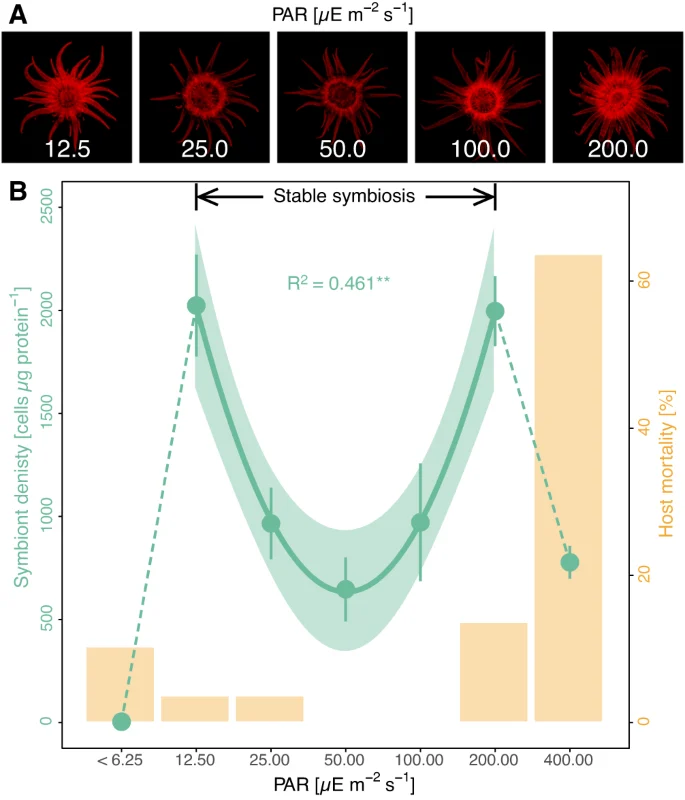
Chlorophyll fluorescence photographs of Exaiptasia diaphana CC7 anemones under different light treatments with symbiont-density and mortality plot, Rädecker and coauthors2023figure3
The upper photographs show chlorophyll fluorescence from algal symbionts in the CC7 study lineage of Exaiptasia diaphana under different light treatments. Red is the fluorescence display, not the anemones’ ordinary appearance. The lower plot compares symbiont density and host mortality in those experimental conditions.
Overview
Exaiptasia diaphana, often called Aiptasia in experimental literature, is a sea anemone used to study the partnership between cnidarians and photosynthetic algae. The animal and the algae remain distinct organisms, even when the algae live inside its tissues. In a 2023 investigation, researchers used the clonal anemone lineage CC7 with its native algal community dominated by Symbiodinium linucheae, strain SSA01. Those identifiers describe the experimental material; they do not imply that every anemone population contains exactly the same symbionts.
The partnership involves both exchange and competition. Algal photosynthesis supplies carbon compounds that can support the animal’s metabolism. Nitrogen, including ammonium, supports the production of amino acids in both partners. The study tested whether additional carbon available to the host changes how nitrogen is divided between them. It compared animals bearing algae with experimentally prepared animals without algae, using isotope tracers, chemical measurements and NanoSIMS imaging to distinguish uptake into animal tissue from uptake into algal cells.
Adding pyruvate increased the host’s assimilation of ammonium. Under the same treatment, ammonium assimilation by the algae decreased. The researchers interpret this contrast as evidence that greater availability of usable carbon lets the animal retain more nitrogen, restricting what remains available to its algal partners. The experiment followed a period without supplementary feeding, so it does not isolate a universal nutrient balance for every diet or natural habitat. Nor does measured isotope enrichment directly record every pathway by which nitrogen is recycled.
A separate experiment gradually acclimated animals to different light levels over six months, followed by a month without supplemental food. Intermediate light conditions supported stronger photosynthetic activity and the lowest symbiont densities. Densities increased toward the limits of stable association. At near-dark conditions the animals lost most algae but remained viable; the highest light treatment caused substantial host mortality. These outcomes belong to the experimental conditions and clonal material, rather than a temperature- or light-tolerance rule for all cnidarians.
The combined findings support a model in which carbon availability changes competition for nitrogen and helps regulate the symbiont population. More algae therefore need not indicate a healthier association. The authors discuss how altered nutrient recycling could contribute to destabilization during environmental stress, but this light-and-carbon study is not a direct heatwave experiment. Its measurements also have technical limits: tissue preparation can dilute isotope enrichment, and some microscopy regions represent tissue areas rather than individually resolved host cells. These qualifications matter when comparing the model system with natural coral bleaching.
Origins & earliest records
Source-specific physiological account based on Rädecker and colleagues’ 2023 experiments; no original species description or type material examined.
Evidence & interpretation
Stable-isotope labeling, NanoSIMS tissue imaging, ammonium fluxes, photosynthetic measurements and long-term light acclimation connect carbon supply with host–symbiont nitrogen competition. Mechanistic and environmental extensions are distinguished from the direct experiments.
Selected bibliography
Documented works and useful reading. This is not a list of every appearance.
- 01
Coupled carbon and nitrogen cycling regulates the cnidarian–algal symbiosis
Nature Communications14,6948; complete main Results/Discussion and Material and methods. CC BY4.0 adaptation credited. CC7 host lineage and dominant SSA01 algal strain; light experiment seven treatments, not a universal tolerance survey.
Family, evolution & connections
Taxonomic classification
A hierarchy of classified groups, not a chain of direct ancestors.
- PhylumCnidaria
- GenusExaiptasia
- SpeciesExaiptasia diaphana
Symbiodinium linucheae-dominated algal community
Rädecker and colleagues studied anemones whose resident algal community was dominated by Symbiodinium linucheae. Isotope imaging showed that adding pyruvate increased ammonium assimilation in host gastrodermis while reducing assimilation by algal cells. This supports carbon-dependent nutrient competition within a symbiosis under the experiment’s conditions. It does not establish identical responses in every coral, symbiont lineage or natural habitat.
References
Sources supporting this profile. Linked pages have their own scope and editorial standards.
- ResearchRädecker et al. 2023, primary physiological study (CC BY4.0)Research access: 2026-10-05
Image credits
Scientific organism fluorescence microscopy figureChlorophyll fluorescence photographs of Exaiptasia diaphana CC7 anemones under different light treatments with symbiont-density and mortality plot, Rädecker and coauthors2023figure3
The upper photographs show chlorophyll fluorescence from algal symbionts in the CC7 study lineage of Exaiptasia diaphana under different light treatments. Red is the fluorescence display, not the anemones’ ordinary appearance. The lower plot compares symbiont density and host mortality in those experimental conditions.