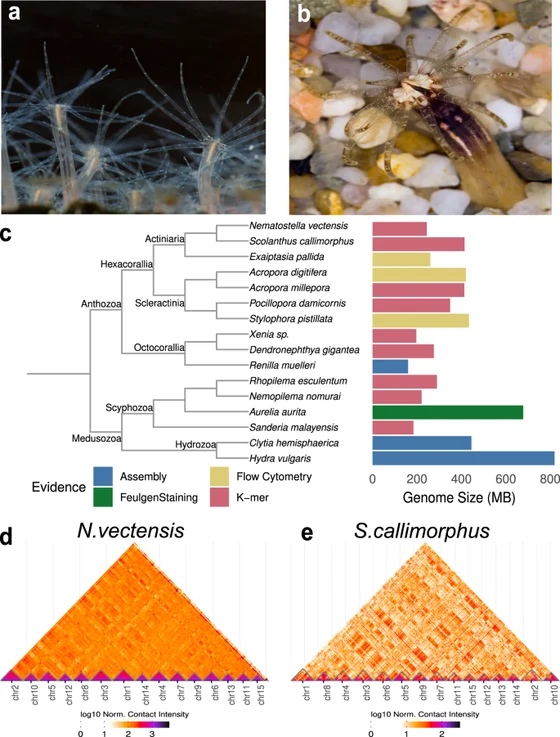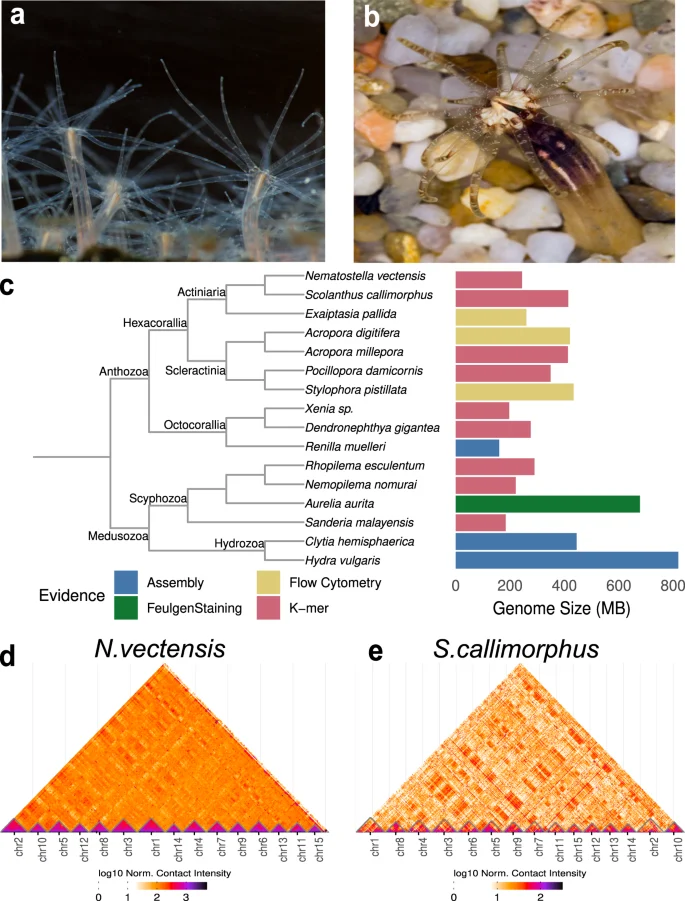
Scolanthus callimorphus anemone in panel b of Zimmermann and colleagues’ 2023 comparative genome figure; panel a shows the separate species Nematostella vectensis
Panel b shows Scolanthus callimorphus photographed by Robert Reischl. Panel a shows the separate species Nematostella vectensis, photographed by Patrick RH Steinmetz. The remaining panels compare genome-size estimates and chromosome contact maps; their colours encode genomic data rather than animal pigmentation.
Overview
Scolanthus callimorphus is an edwardsiid sea anemone described as the worm sea anemone in Zimmermann and colleagues' 2023 genome study. The paper places it in European intertidal habitats. Its actual study animals were collected at Île Callot, Carantec, France, then kept in seawater at 20 °C and fed newly hatched Artemia salina weekly or every two weeks. The researchers could not induce spawning in these laboratory animals and did not know their sex. That experimental limitation is specific to these animals and conditions; it is not a claim that the species cannot reproduce sexually.
The long-read sequencing material came from high-molecular-weight DNA extracted from one whole adult. Short-read modelling estimated a genome of about 414 million base pairs. PacBio reads and proximity-ligation data supported a chromosome-level assembly with 15 chromosomes. Sequencing depth was lower than for the companion Nematostella assembly. Consequently, the authors could not separate haploid and diploid coverage peaks with the same software workflow and used a different redundancy-removal procedure. This matters when comparing assembly products: a larger estimated genome is not itself evidence for a more complex animal, and an assembly is a reconstruction from molecular data rather than a complete catalogue of verified gene functions.
The comparison identified 8,117 of 8,692 mutual best gene matches on corresponding chromosomes in the two anemones. This supported a one-to-one relationship between their 15 chromosomes, while much of the local order of genes had changed. Their estimated separation around 174 million years ago comes from the study's molecular-clock analysis; it does not date a Scolanthus fossil or demonstrate that either living species descended directly from the other. Chromosome membership and adjacency therefore tell different evolutionary stories. The former can preserve an old large-scale pattern even when rearrangements have disrupted neighbouring genes. The authors used these and wider animal comparisons to investigate ancestral linkage groups, rather than treating an intact modern chromosome as an unchanged ancestral chromosome.
Origins & earliest records
The sampled animals came from Île Callot near Carantec, France. The 2023 work is a genome resource and comparative study, not the original species description or an exhaustive geographic survey.
Evidence & interpretation
Collection and laboratory provenance, single-adult DNA extraction, assembly methods and cross-species chromosome comparisons are documented in the main paper. Genome size and divergence time are model estimates; chromosome correspondence is a gene-content comparison.
Selected bibliography
Documented works and useful reading. This is not a list of every appearance.
- 01
Topological structures and syntenic conservation in sea anemone genomes
Nature Communications 14, 8270; Scolanthus collection, single-adult extraction, assembly and chromosome comparisons in main Results and Methods.
Family, evolution & connections
Selected cnidarian protein-sequence branching (Zimmermann et al., 2023)
Nine retained terminals from Supplementary Figure 1: eight cnidarian samples and D. melanogaster as a selected bilaterian outgroup. Other sampled animals are omitted. Abbreviated tip names follow the source figure.
Scroll sideways to see all branches. With a keyboard, focus the tree and use the arrow keys.
- Selected cnidarians and bilaterian outgroup
- D. melanogaster - selected outgroup
- Selected Cnidaria
- H. magnipapillata - source label
- Selected Anthozoa
- A. digitifera
- Selected sea anemones
- M. senile / E. pallida pair
- M. senile
- E. pallida
- Selected Edwardsiidae
- Scolanthus and remaining sampled edwardsiids
- E. lineata / E. carnea pair
- E. lineata
- E. carnea
The Divergence estimates Methods describe 541 shared BUSCO orthologues, taking the highest-scoring transcript for duplicated BUSCOs. MAFFT E-INS-i alignments were trimmed with trimAl gappyout, then analysed with IQ-TREE 2.0.6 and gene-partitioned model selection. Subsequent r8s Langley-Fitch dating fixed the bilaterian-cnidarian calibration at 595.7 and 688.3 million years. Only the displayed branching is retained. Red ranges in the source figure concern calibrated ages, not bootstrap support; neither ages, ranges nor branch lengths are reproduced. No numerical confidence is shown for these nodes. This selected study tree does not establish living species as direct ancestors. Chromosomal linkage diagrams in Figure 2 are separate comparisons. Adapted from Zimmermann et al. (2023), CC BY 4.0: tips pruned, omitted branches suppressed and layout redrawn.
Taxonomic classification
A hierarchy of classified groups, not a chain of direct ancestors.
- phylumCnidaria
- classAnthozoa
- familyEdwardsiidae
- genusScolanthus
- speciesScolanthus callimorphus
References
Sources supporting this profile. Linked pages have their own scope and editorial standards.
- ResearchZimmermann and colleagues 2023, primary comparative genome report, CC BY 4.0Research access: 2026-10-05
Image credits
Scientific animal photographs and comparative genome figureScolanthus callimorphus anemone in panel b of Zimmermann and colleagues’ 2023 comparative genome figure; panel a shows the separate species Nematostella vectensis
Panel b shows Scolanthus callimorphus photographed by Robert Reischl. Panel a shows the separate species Nematostella vectensis, photographed by Patrick RH Steinmetz. The remaining panels compare genome-size estimates and chromosome contact maps; their colours encode genomic data rather than animal pigmentation.