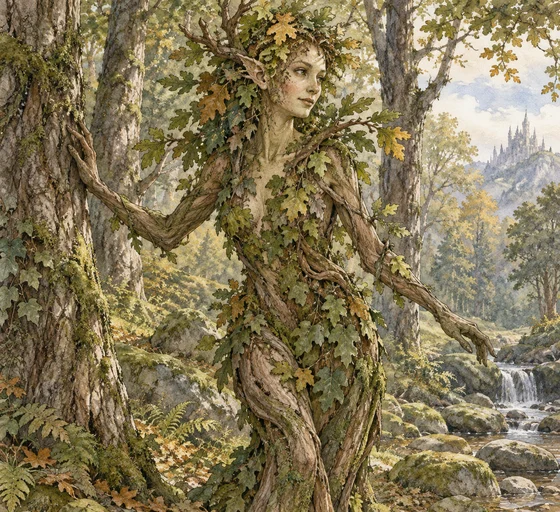
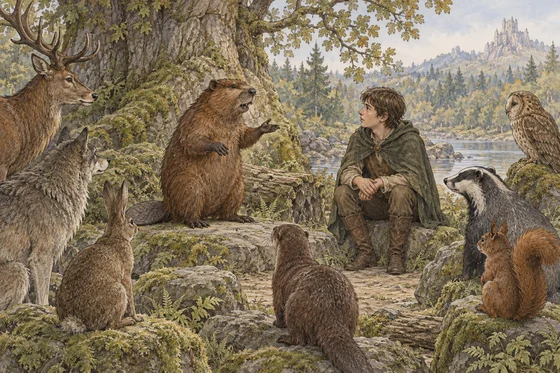
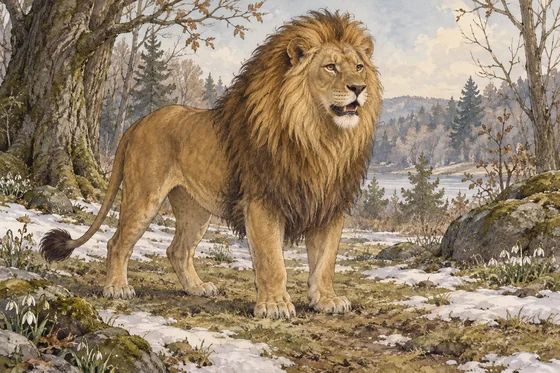
A sourced illustration has not yet been added. This gap is included in the coverage record.
Overview
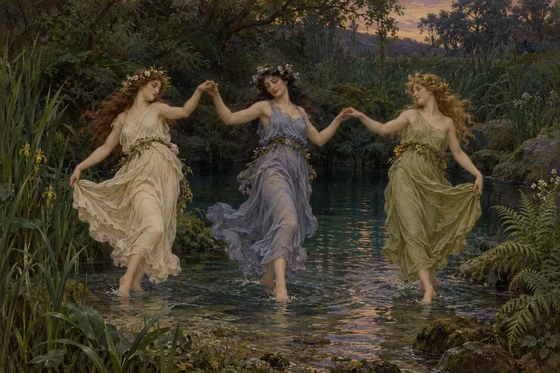
Narnian naiads are water-associated spirits or persons, identified particularly with rivers and streams. The Magician's Nephew includes the emergence of water beings in the newly created world, while Prince Caspian connects the living river with the return of an older Narnian order. Their association with an inhabited landscape makes water a participant in events rather than simply terrain to cross.
The novels' river figures and the watery beings shown in The Voyage of the Dawn Treader film require separate description. The latter adaptation uses fluid-bodied imagery that should not become a universal anatomical rule for Lewis's naiads. Nor should their name merge every merperson, sea inhabitant and river god into one species. This profile gathers the book's water-spirit category while keeping overlapping vocabulary visible and leaving detailed reproduction, lifespan and formal hierarchy unasserted where the primary scenes do not establish them.
First appearances & development
Naiads are part of the enchanted world described in the 1950 Lion, the Witch and the Wardrobe and the later creation narrative. Prince Caspian develops the living river setting. The 2010 Dawn Treader film supplies different watery imagery; its saltwater scene is not used to classify every book sea-person as a naiad.
Canon & continuity
The creation novel and Prince Caspian support the water-spirit and living-river setting, while the independent account distinguishes the film treatment. Secondary speculation that all naiads spent the entire winter physically frozen is not asserted. No complete hierarchy, reproductive system or absolute equivalence with merpeople is inferred from a shared water association.
Selected bibliography
Documented works and useful reading. This is not a list of every appearance.
- 01
The Lion, the Witch and the Wardrobe
Fauns and Talking Beasts in published Narnia.
- 02
Prince Caspian
Old Narnian peoples under Telmarine rule.
- 03
The Magician's Nephew
Creation of Narnia and selection of Talking Beasts.
- 04
The Chronicles of Narnia: The Voyage of the Dawn Treader
Film adaptation including Dufflepuds.
Family, evolution & connections
Eunice, Malis and Nycheia, the spring nymphs who seize Hylas
Theocritus’s thirteenth idyll names Eunice, Malis and Nycheia as nymphs dancing within a spring. Their seizure of Hylas, their attempt to comfort him and Heracles’s unsuccessful search form one complete ancient literary encounter. This provides a particular historical water-nymph context beside Narnia’s separately described naiads, without making their bodies, conduct or histories identical or establishing that Lewis consulted Lang’s rendering.
Syrinx, the Naiad transformed into reeds (Ovid)
Ovid explicitly calls Syrinx a Naiad and places her among Hamadryads before narrating her escape into reeds beside the Ladon. This gives a named historical water-nymph encounter beside Narnia’s water-associated persons. The comparison preserves the particular pursuit, bodily change and reed-pipe naming as Ovid’s story and makes no claim that Lewis consulted it.
Arethusa, the nymph who becomes a fountain (Ovid)
Arethusa gives a named ancient water-nymph encounter beside Narnia’s separate water-associated persons. In Ovid she speaks from a spring, recounts becoming water and reaches Ortygia underground with Diana’s help. These events belong to one literary witness and do not establish a universal Naiad transformation, a shared biography or documented consultation by Lewis.
Salmacis, the spring Naiad (Ovid)
Ovid names Salmacis a Naiad of a freshwater spring; Narnia uses Naiad for water-associated persons. This is a named-category comparison. Salmacis’s coercive pursuit and bodily-union episode are not attributed to Lewis’s characters, and no consultation of this particular tale is established.
References
Sources supporting this profile. Linked pages have their own scope and editorial standards.
- ReferenceNaiad (Narnia) — reference guideResearch access: 2026-10-05
Image credits
A sourced illustration has not yet been added. This gap is included in the coverage record.