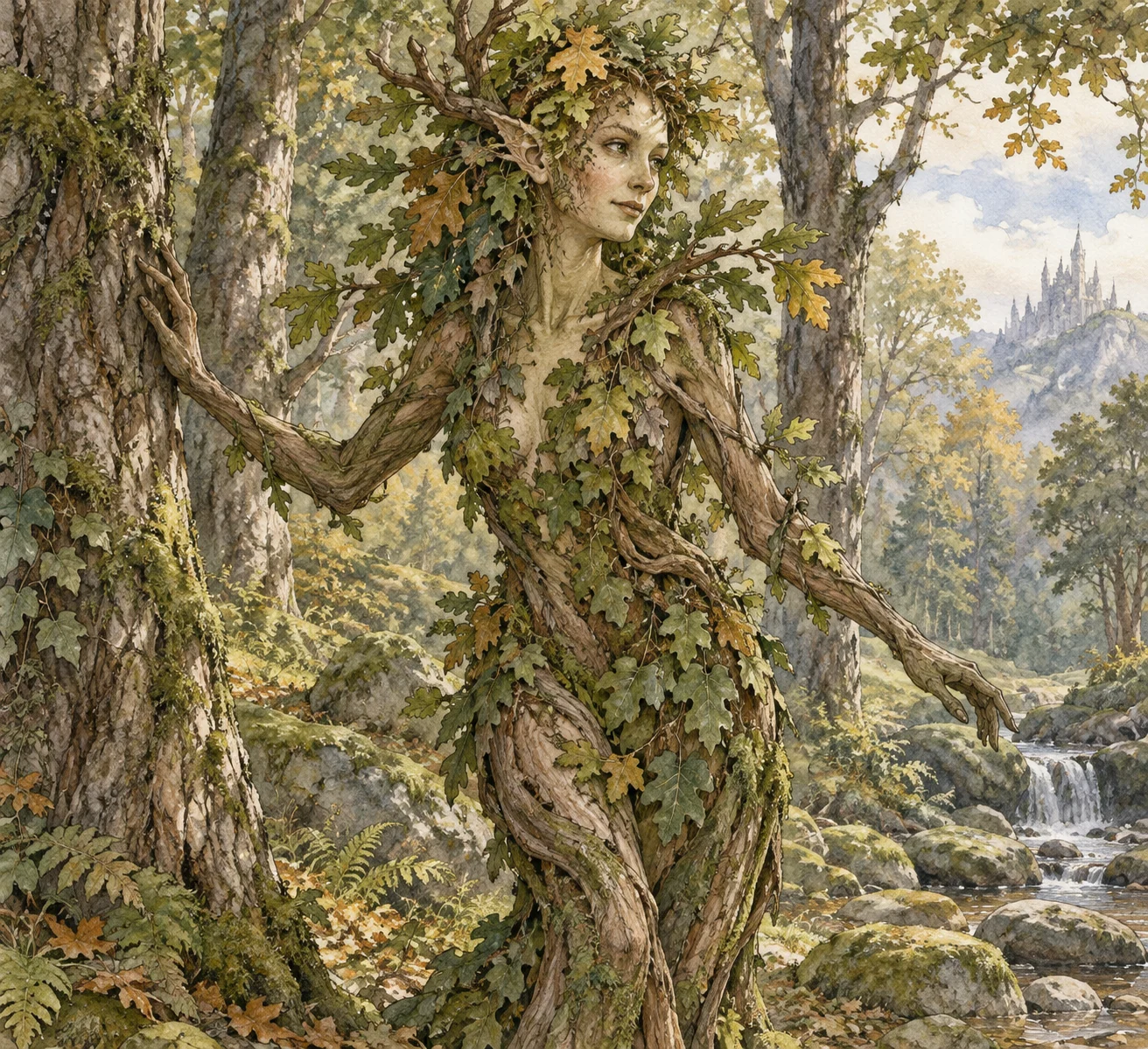
An imagined tree-shaped woodland dryad, interpreted through screen-form prose.
Original AI-generated interpretation; undescribed appearance, clothing and incidental setting are imagined, not official design evidence. Unofficial interpretation.
Overview
Narnian dryads are the tree-associated persons of the enchanted woodland, also described through overlapping terms such as wood gods, tree people and hamadryads. The novels do not supply a neatly divided scientific taxonomy for every label. Their presence gives forests an active social dimension: woodland celebrations, allegiance and the ability to awaken or move belong to more than a backdrop of ordinary timber.
Prince Caspian connects the return of that living woodland with the recovery of suppressed Old Narnia, while The Last Battle makes the destruction of a tree an immediate death for its associated spirit. That event turns exploitation of the forest into the killing of a person. The Magician's Nephew places woodland beings within the creation narrative. Screen adaptations may express them through leaf-filled or tree-shaped bodies, but the literary profile keeps descriptions tied to particular scenes rather than declaring one fixed visual anatomy for every dryad.
First appearances & development
Tree-associated spirits are part of the 1950 Lion, the Witch and the Wardrobe's enchanted woodland and recur in later Narnia novels. The Magician's Nephew gives them a creation setting, while The Last Battle establishes the mortal cost of tree destruction. Overlapping names are retained as vocabulary rather than assumed to define separate biological species.
Canon & continuity
The named novels establish tree persons, awakening and the death associated with a felled tree. The independent spirit account is used with its mixed terminology and adaptation sections visible. This supports a living woodland society without requiring a rigid division between every use of dryad, wood god and hamadryad or one universally fixed body shape.
Selected bibliography
Documented works and useful reading. This is not a list of every appearance.
- 01
The Lion, the Witch and the Wardrobe
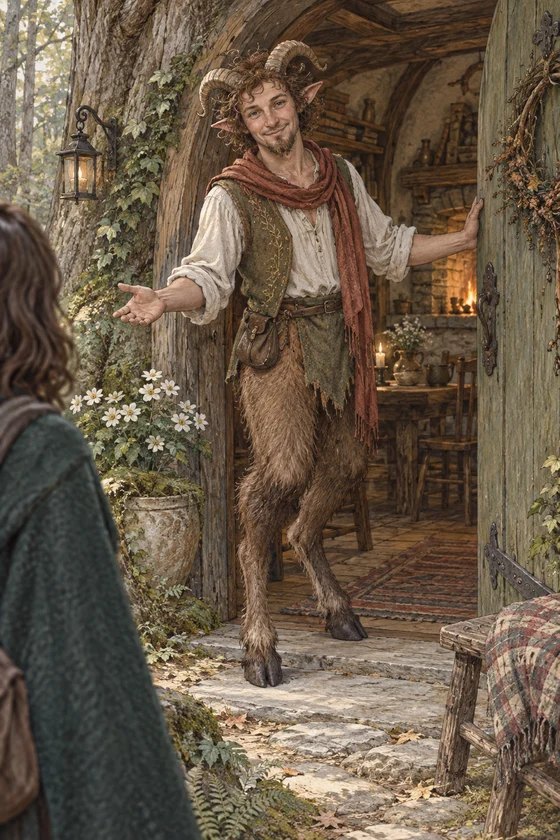
Fauns and Talking Beasts in published Narnia.
- 02
Prince Caspian
Old Narnian peoples under Telmarine rule.
- 03
The Magician's Nephew
Creation of Narnia and selection of Talking Beasts.
- 04
The Last Battle
Tash's manifestation, dwarfs, tree destruction and Narnia's ending.
Family, evolution & connections
Oak nymph in Erisicthon’s sacrilege (Ovid)
Narnia’s tree-associated persons can be compared with Ovid’s oak nymph, whose death accompanies the destruction of her sacred tree. Ovid’s surrounding sacrilege and hunger punishment belong to his particular narrative. The comparison does not make the two settings continuous or establish that Lewis used this translation.
Daphne, the nymph transformed into laurel (Ovid)
Daphne’s complete transformation into laurel gives a particular historical example of personhood continuing within a tree: Apollo feels a heartbeat beneath the bark, while the wood recoils from his kisses. This offers context beside Narnia’s tree-associated persons without classifying Daphne as a Narnian dryad, transferring her pursuit to them or establishing that Lewis consulted Ovid or this rendering.
Pomona, the orchard-tending Hamadryad (Ovid)
Ovid explicitly places Pomona among the Hamadryads of Latium and gives her detailed work with living fruit trees: pruning, grafting and irrigation. This supplies a particular Roman tree-nymph context beside Narnia’s woodland persons while preserving Pomona’s orchard, disguises and encounter as a distinct narrative, without documented author consultation.
References
Sources supporting this profile. Linked pages have their own scope and editorial standards.
- ReferenceDryad (Narnia) — reference guideResearch access: 2026-10-05
Image credits
Modern interpretationAn imagined tree-shaped woodland dryad, interpreted through screen-form prose.
Original AI-generated interpretation; undescribed appearance, clothing and incidental setting are imagined, not official design evidence. Unofficial interpretation.