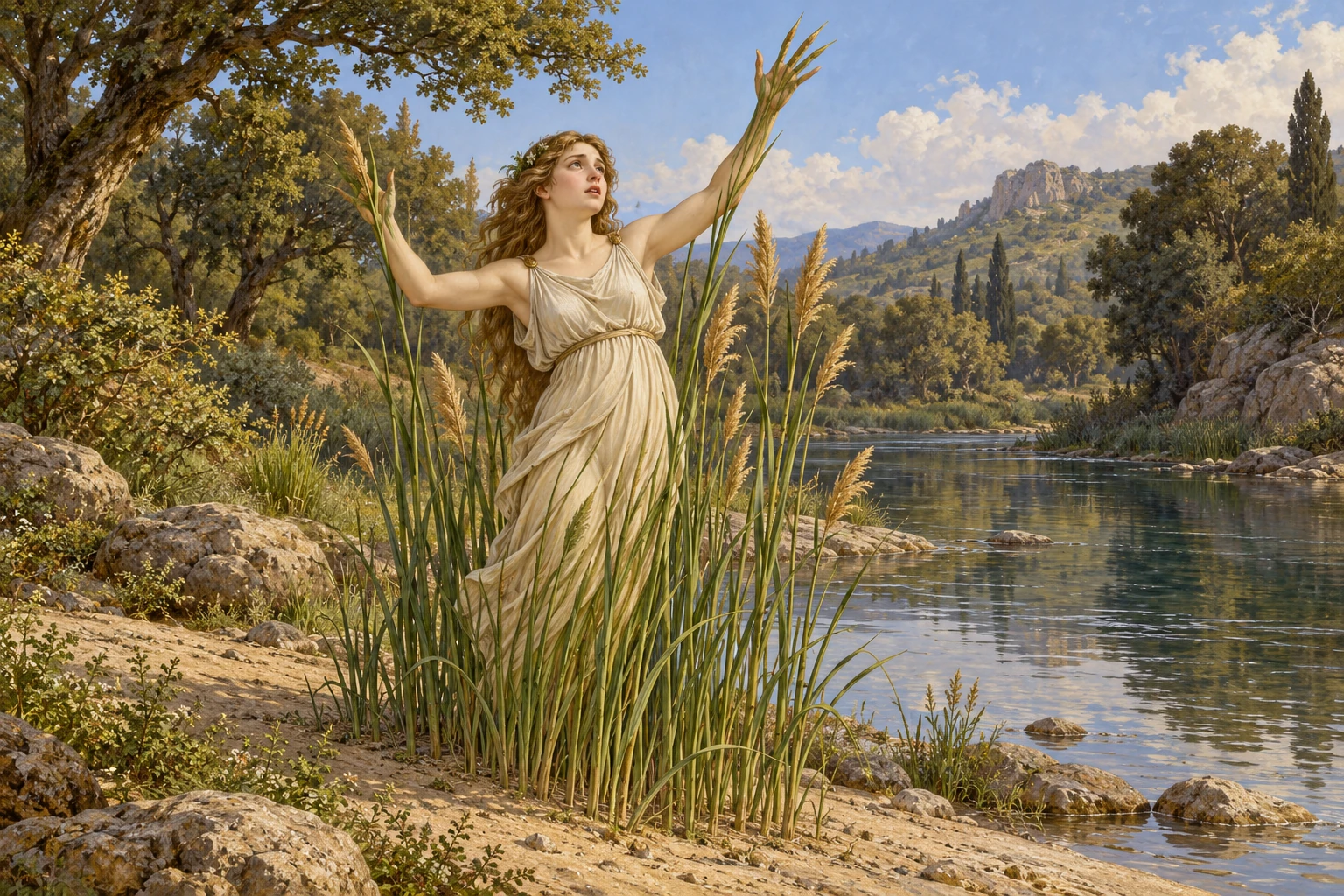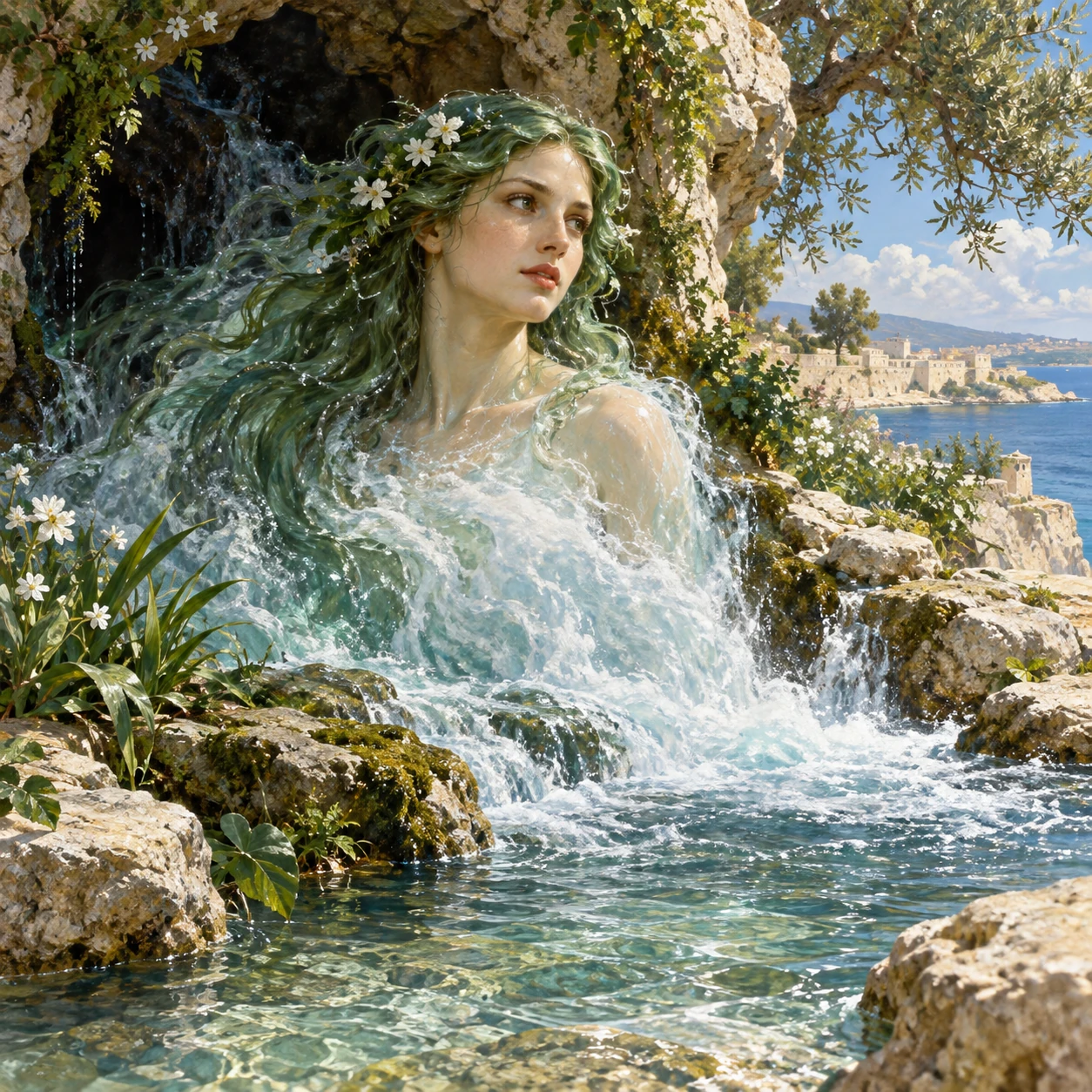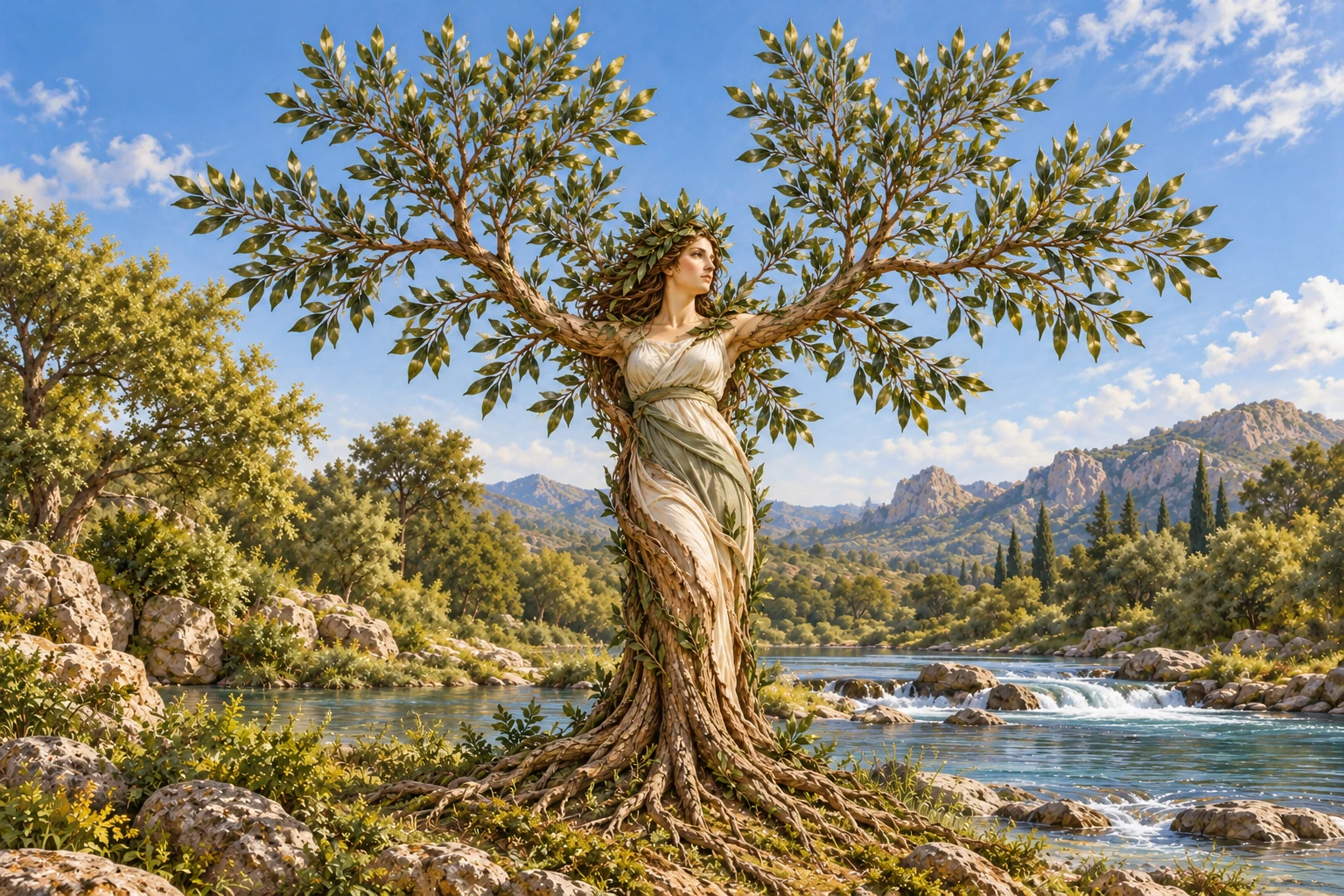
AI-generated interpretation of Daphne’s transformation into laurel in Ovid. The bark, foliage, branching arms and rooted feet follow the account; face, dress, landscape and the visible intermediate stage are artistic choices.
Daphne’s individual transformation is not a universal dryad anatomy or a Narnia design.
Overview
Ovid’s Daphne is the daughter of a river god and a nymph whose transformation connects a particular person with a laurel tree. The encounter begins after Apollo boasts about killing Python and dismisses Cupid’s smaller weapon. Cupid answers with two different arrows: a sharp golden one excites Apollo’s desire, while a blunt leaden one makes Daphne reject love. The poem therefore establishes opposed desires before the chase. Daphne prefers woodland hunting and asks her father to let her remain unmarried. His consent does not protect her from Apollo’s pursuit.
Apollo identifies his divine status, oracular authority, music and medicine while asking her to stop. His speech does not establish her agreement: she continues fleeing in fear, and he increases his speed. The narrator compares the pursuit to a hound gaining on a hare. Exhausted, Daphne turns towards her father’s waters and asks for help and a changed body. Before the prayer ends, bark encloses her torso, hair becomes foliage, arms become branches and feet become roots. This is a narrated bodily transformation, rather than a decorative association between an unchanged woman and a tree.
The ending continues beyond the change. Apollo touches the trunk and feels a heartbeat beneath the bark. The wood shrinks from his kisses. He nevertheless declares the laurel his chosen tree and associates its leaves with his brow, quiver and lyre, Roman victory processions and the Augustan doorway. He promises lasting green leaves. When the branches move, the poem says that their motion seems to him an answer to his love; that perception should not erase Daphne’s earlier refusal or become an independent statement of consent.
This profile follows Brookes More’s 1922 rendering of the complete encounter in Book I. Its Roman ceremonial conclusion belongs to Ovid’s literary account. Daphne’s river parentage and eventual tree body do not establish that she belongs to every later category called dryad, hamadryad or tree spirit. Her episode can provide a particular historical context beside fictional woodland persons while retaining its pursuit, transformation and ending as her own narrative.
Origins & earliest records
Ovid, Metamorphoses I.452–566, translated by Brookes More, Boston: Cornhill Publishing Co., 1922, as identified on the cached classical-text page.
Records & interpretation
Complete hosted Daphne and Phoebus section read from Cupid’s retaliation to the laurel’s movement after Apollo’s speech. No attached footnote references occur in this hosted section; original printed apparatus was not independently collated.
Selected bibliography
Documented works and useful reading. This is not a list of every appearance.
- 01
Metamorphoses I.452–566: Daphne and Phoebus
Complete selected encounter, including its ceremonial conclusion and Apollo’s interpretation of the tree’s movement.
Family, evolution & connections
Dryad (Narnia)
Narnia’s dryads provide a separate fictional context for persons associated with living trees. Daphne is instead a named river nymph transformed into laurel in one Roman poetic encounter. Her changed body, refusal and ceremonial appropriation belong to Ovid’s narrative, without supplying a general account of Narnian dryads or their origin.
References
Sources supporting this profile. Linked pages have their own scope and editorial standards.
- Ancient literary narrative in historical English translationOvid, Metamorphoses I, Brookes More 1922 historical translationResearch access: 2026-10-26
Image credits
Modern interpretation of a historical literary accountAI-generated interpretation of Daphne’s transformation into laurel in Ovid. The bark, foliage, branching arms and rooted feet follow the account; face, dress, landscape and the visible intermediate stage are artistic choices.
Daphne’s individual transformation is not a universal dryad anatomy or a Narnia design.