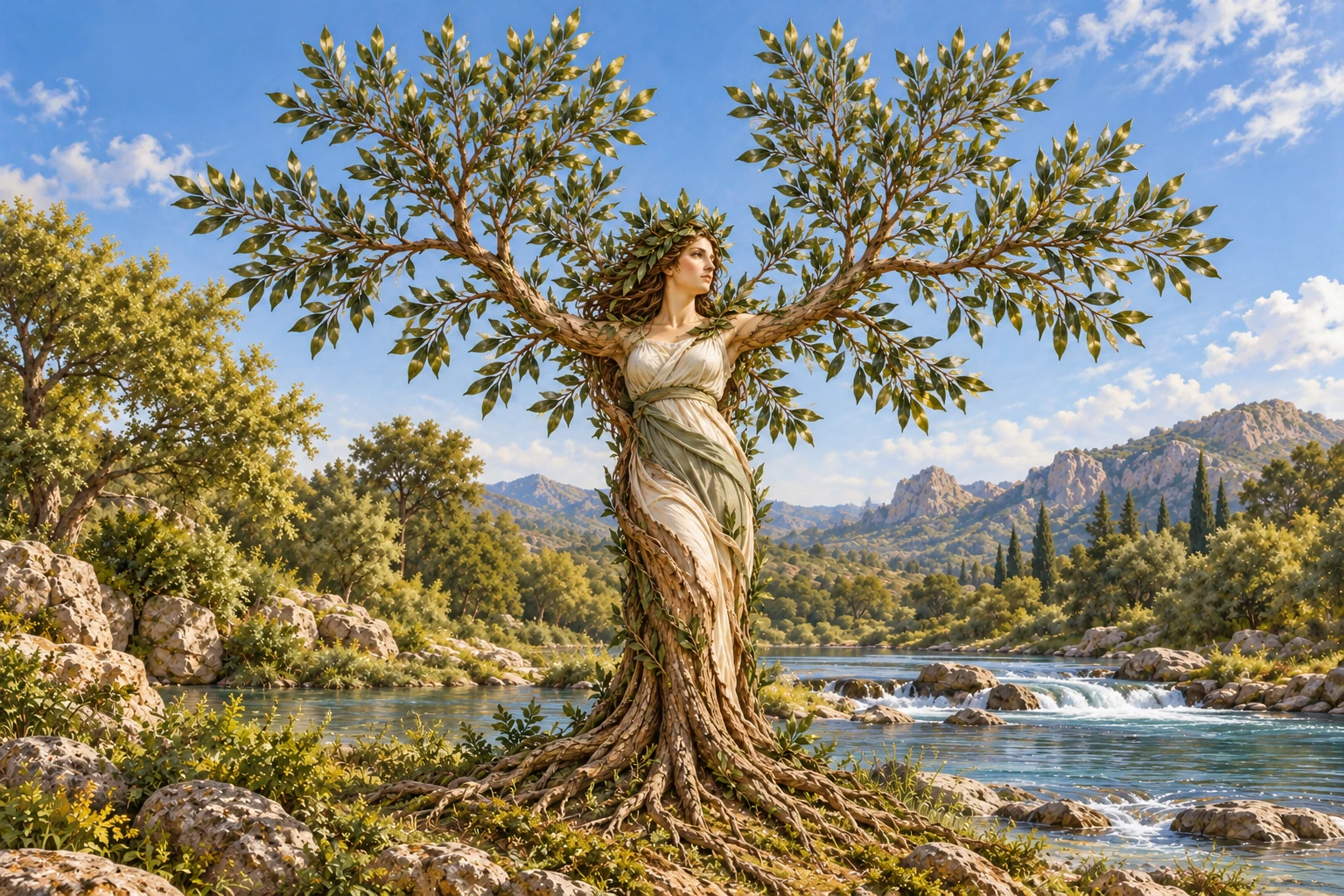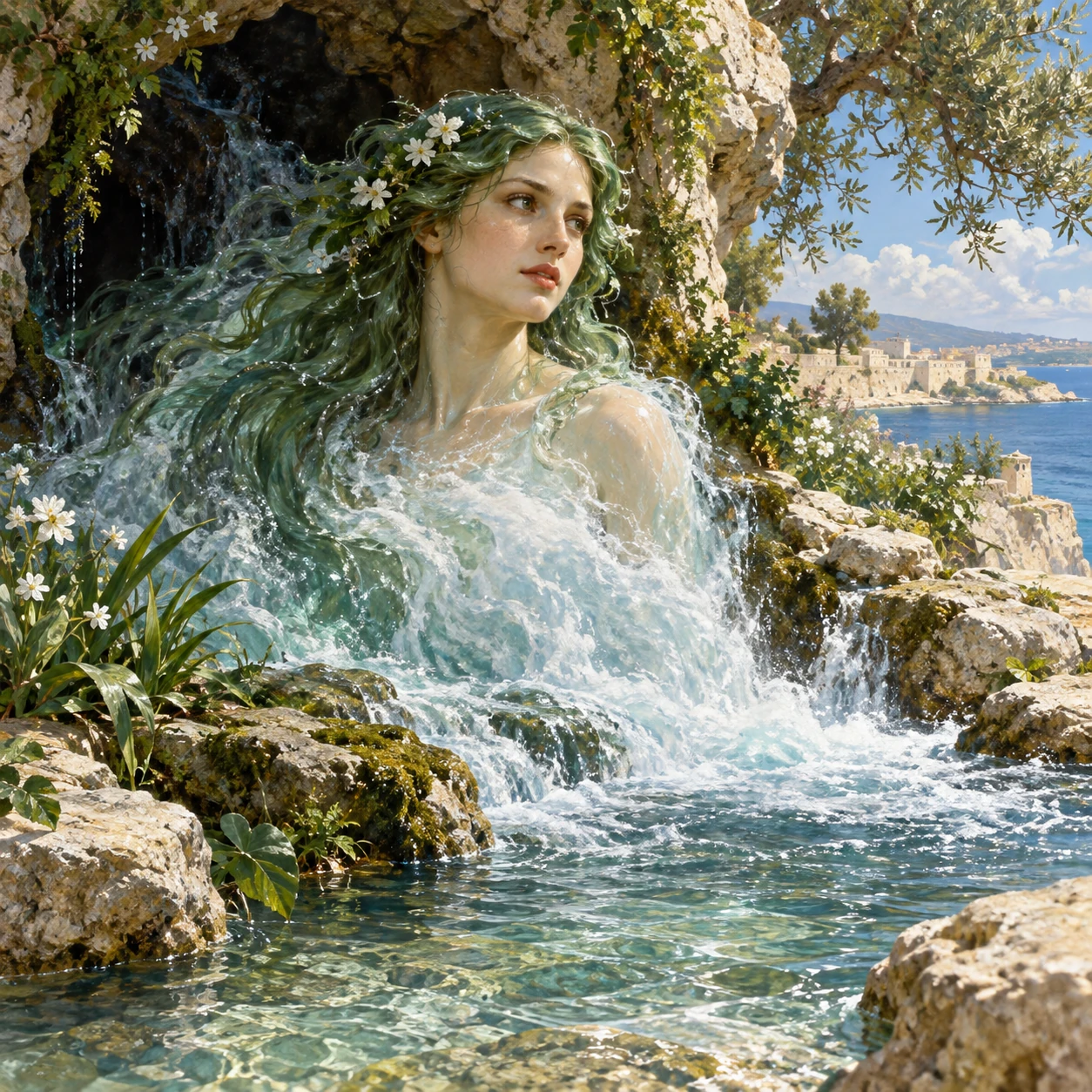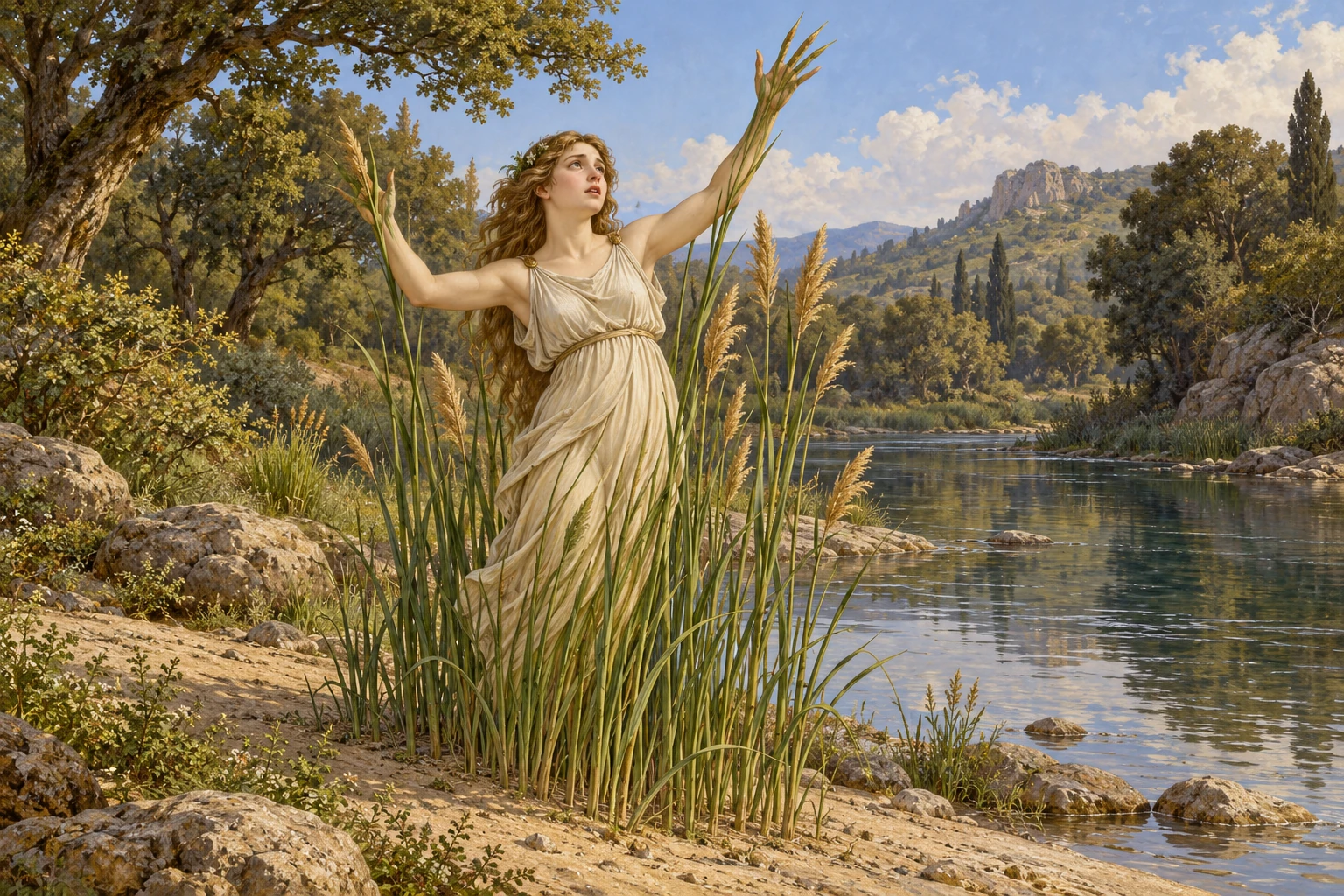
AI-generated interpretation of Syrinx’s change into reeds in Ovid. The appeal, river and transformation follow the account; face, dress and the gradual visible stage are artistic choices.
The narrative’s reed transformation and instrument naming belong to this specific Naiad account.
Overview
Ovid introduces Syrinx as a famous Naiad living among the Hamadryads on Arcadian Nonacris. This combination of labels is part of the selected text rather than a modern rule dividing every woodland and water spirit into separate species. She has repeatedly escaped pursuing gods and satyrs and follows Diana’s unmarried way of life. Her clothing and pursuits resemble the goddess’s; the passage distinguishes her horn bow from Diana’s golden one. Syrinx is therefore a named nymph with her own affiliations before she becomes connected with a musical instrument.
Pan sees her returning from the Lycian hill. She rejects his appeal and flees through the wild country until the Ladon’s water prevents further escape. She asks her sister nymphs to change her form. When Pan believes he has caught her, he holds marsh reeds instead of her body. The transformation is explicit, not an inference from reeds growing beside a river. Air moving through the reeds gives a plaintive, voice-like sound. Pan interprets the discovery as an enduring bond with her. Reeds of unequal lengths joined with wax then bear Syrinx’s name. The account does not say that she voluntarily joins him or returns to an unchanged body.
The telling has an important frame. Mercury has approached the many-eyed Argus, who guards the transformed Io, and plays reed music, described as a recent art, to make the watcher sleep. Argus asks how the instrument originated. Mercury begins Syrinx’s story, but the narration interrupts his speech and supplies what the completed tale would have contained. At the next transition, Mercury notices Argus becoming drowsy, stops talking, imposes sleep and kills him. Treating every word of the embedded account as a speech Argus heard would erase that distinction.
Syrinx’s transformation is embedded in a larger narrative about the transformed Io and the watcher Argus. The account moves between a story being told and the immediate purpose of that telling: Mercury needs to overcome the watcher’s remaining wakefulness. Syrinx’s own fate remains the change into reeds and the instrument’s name. Her pursuit and altered body are specific to this episode, while her explicit Naiad designation offers historical context for later fictional water-nymph categories.
Origins & earliest records
Ovid, Metamorphoses I.689–711, within I.567–779, translated by Brookes More, Boston: Cornhill Publishing Co., 1922, as identified on the cached classical-text page.
Records & interpretation
Complete containing Io and Jupiter section read through Book I ending. Syrinx story includes Mercury’s interrupted oral account, narrator-supplied completion and I.712 transition back to Argus. No attached footnote references occur in the hosted section; original printed apparatus not independently collated.
Selected bibliography
Documented works and useful reading. This is not a list of every appearance.
- 01
Metamorphoses I.567–779: Io and Jupiter, containing the complete Syrinx account
Syrinx at I.689–711, enclosing Mercury–Argus frame and complete containing section through Phaethon’s departure; narrative resumes Argus at I.712.
Family, evolution & connections
Naiad (Narnia)
Narnia’s naiads represent a distinct fictional water-spirit category beside the explicitly named Naiad Syrinx. Syrinx’s transformation into reeds and the instrument bearing her name form one complete literary encounter, rather than a universal rule for naiads. Narnia does not inherit those events through the shared category, and direct author consultation is not established.
References
Sources supporting this profile. Linked pages have their own scope and editorial standards.
- Ancient literary narrative in historical English translationOvid, Metamorphoses I, Brookes More 1922 historical translationResearch access: 2026-10-26
Image credits
Modern interpretation of a historical literary accountAI-generated interpretation of Syrinx’s change into reeds in Ovid. The appeal, river and transformation follow the account; face, dress and the gradual visible stage are artistic choices.
The narrative’s reed transformation and instrument naming belong to this specific Naiad account.