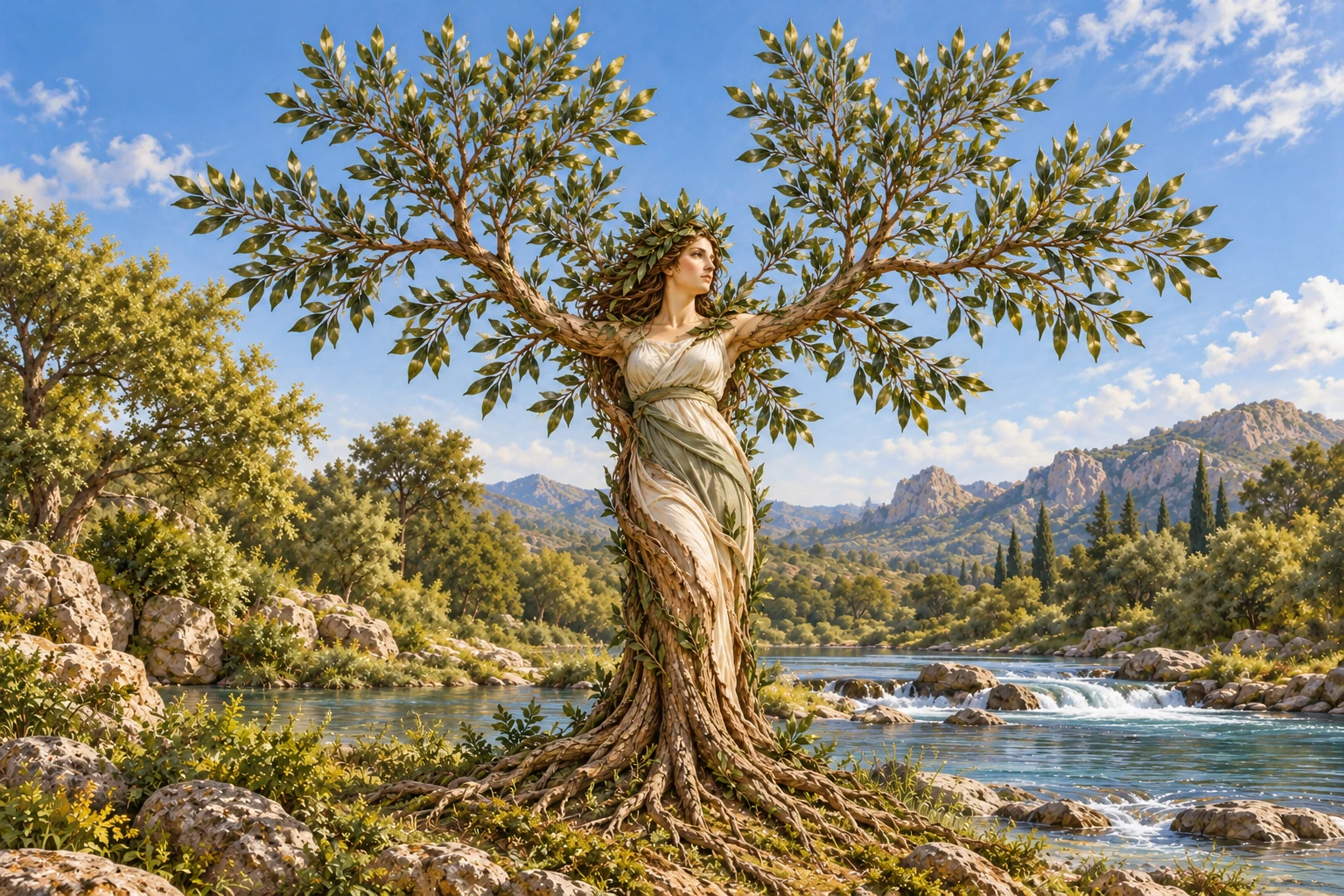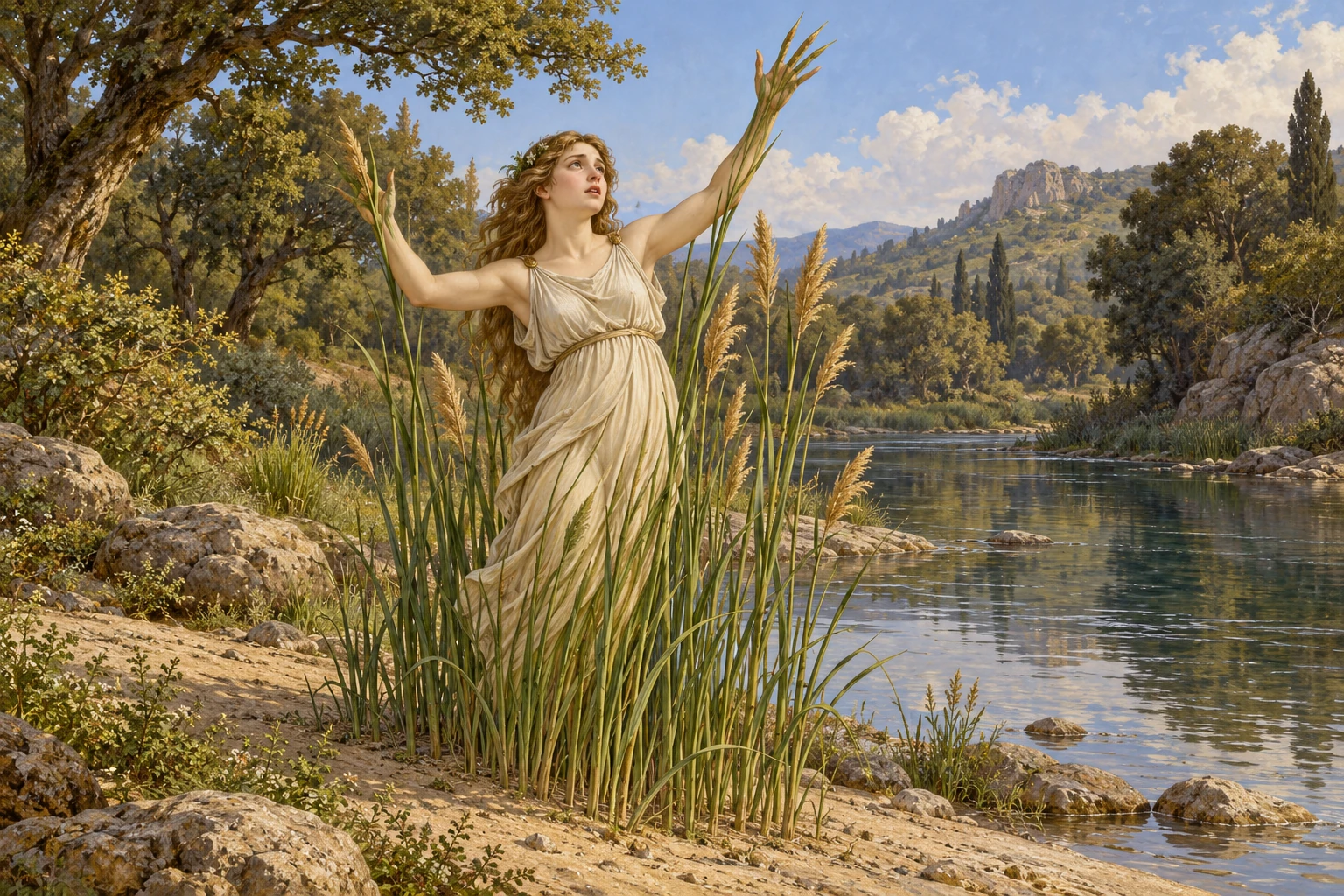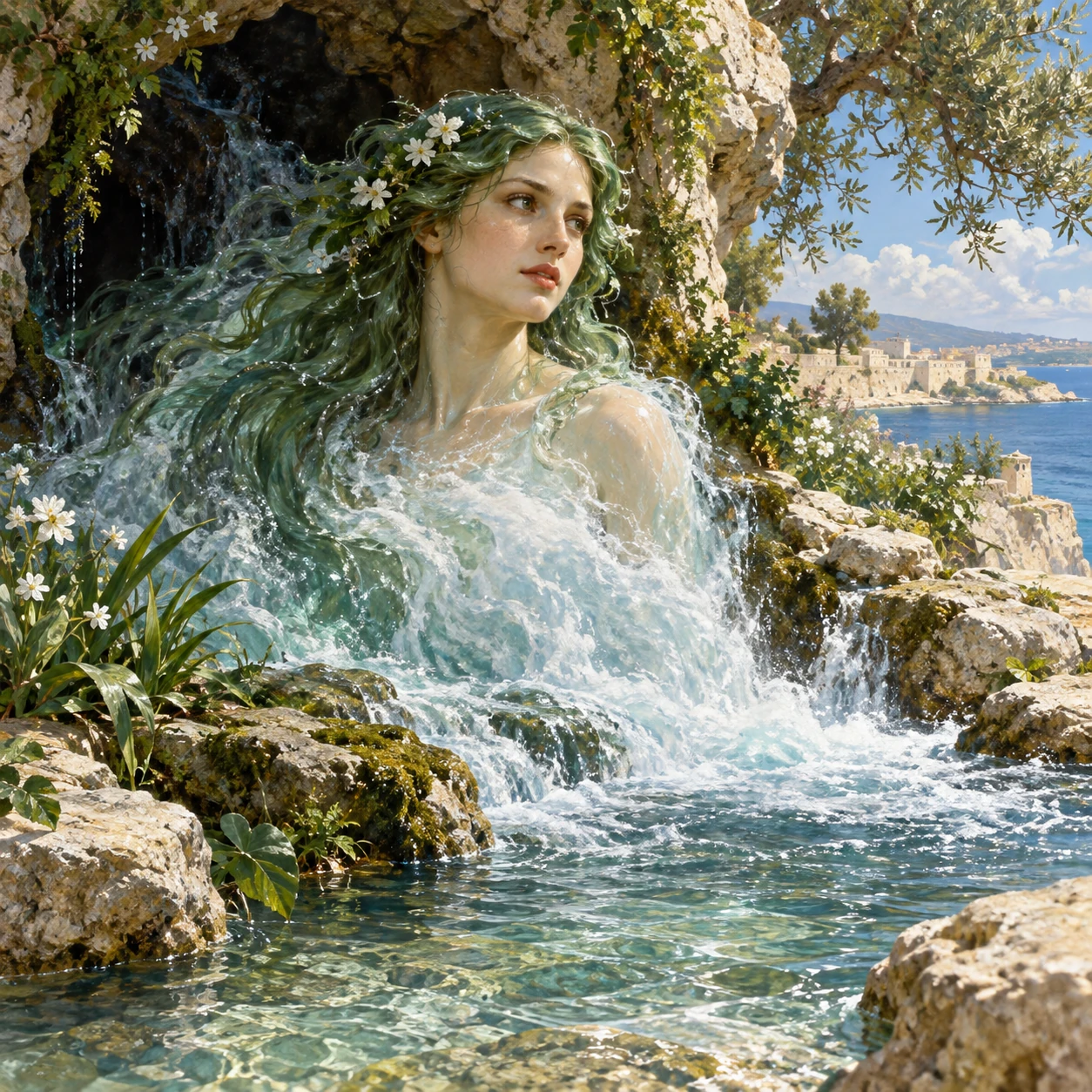
AI-generated interpretation of Arethusa, the nymph who becomes a fountain (Ovid). Source-grounded details and artistic choices are distinguished in the retained request; this is not documentary ancient artwork.
Full delivered frame inspected in contact sheet: green-haired adult fountain figure emerges as water amid rock and vegetation. Lower body dissolves into spring rather than clipped humanoid anatomy. Garlands, facial likeness and built setting artistic; no documentary claim.
Overview
Arethusa tells her own transformation story to Ceres within Calliope’s song in the fifth book of Ovid’s Metamorphoses. Earlier in that song she has asked Ceres to spare Sicily and reported seeing Proserpine below the earth. Once Ceres has recovered her daughter, she asks why Arethusa left her homeland and became a sacred stream. The fountain goddess raises her head from the spring, clears her green hair from her face and answers. Her ability to speak from water is thus part of the narrative’s present, while the pursuit belongs to her recollection.
She describes herself as a nymph from Achaia who preferred hunting and setting nets to praise for her appearance. After returning hot and weary from woodland, she enters a clear, quiet stream shaded by willows and poplars. A voice rises from the water: Alpheus asks where she is going. Arethusa flees, and the river pursues in human form through a succession of named places. The account describes fear and exhaustion, not an agreed courtship. When she calls on Diana, whose weapons she has carried, the goddess encloses her in a concealing cloud.
Concealment does not end the danger. Alpheus circles the cloud and remains because he finds no departing footprints. Cold sweat gathers on Arethusa, drops fall from her body and hair, and she dissolves into flowing water. The river recognizes her altered form and returns to his own watery state to encompass her streams. Diana opens the ground, and Arethusa plunges through subterranean caverns until she rises at Ortygia. The selected narration ends with this emergence; it does not give a subsequent marriage scene or restore her previous body.
This profile follows the complete Arethusa encounter in Brookes More’s historical rendering, keeping the earlier report to Ceres and the return to Calliope’s larger song visible. Its underground geography belongs to an ancient literary account, rather than a demonstrated hydrological route. The named fountain nymph offers a particular historical water-spirit context beside modern fantasy naiads; her changed body, pursuit and route are not a universal Naiad life cycle or evidence that C. S. Lewis consulted this translation.
Origins & earliest records
Ovid, Metamorphoses V.572–641, with V.487–508 contextual report and V.642 transition, in the hosted historical Brookes More translation. The same cached host’s Book I bibliography identifies More, Boston: Cornhill Publishing Co., 1922.
Records & interpretation
Complete hosted Arethusa section and relevant outer contest frame, preceding report to Ceres and following transition read. No attached note references in this hosted section; original print not independently collated.
Selected bibliography
Documented works and useful reading. This is not a list of every appearance.
- 01
Metamorphoses V.572–641: Arethusa and Alpheus
Complete encounter with Ceres question and Ortygia ending; relevant Calliope contest frame separately read.
Family, evolution & connections
Naiad (Narnia)
Narnia’s naiads provide a separate fictional context for a water-associated person such as Ovid’s Arethusa. The common category does not transfer her pursuit, dissolving body or subterranean route to them, and it does not establish that their author used this text.
References
Sources supporting this profile. Linked pages have their own scope and editorial standards.
- Primary literary narrative in historical English translationOvid, Metamorphoses V, Brookes More historical translationResearch access: 2026-10-26
Image credits
Modern interpretation of a historical literary accountAI-generated interpretation of Arethusa, the nymph who becomes a fountain (Ovid). Source-grounded details and artistic choices are distinguished in the retained request; this is not documentary ancient artwork.
Full delivered frame inspected in contact sheet: green-haired adult fountain figure emerges as water amid rock and vegetation. Lower body dissolves into spring rather than clipped humanoid anatomy. Garlands, facial likeness and built setting artistic; no documentary claim.