
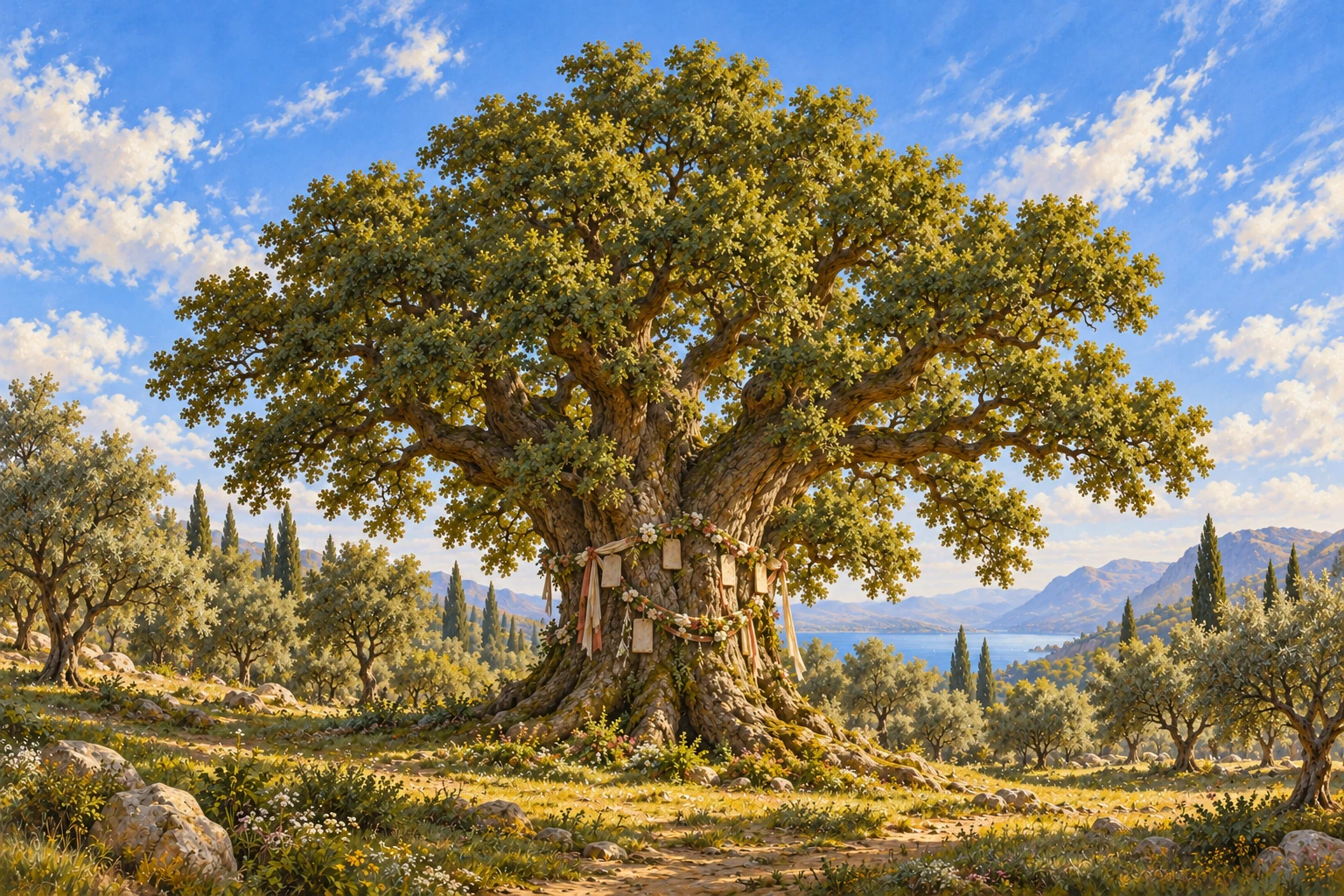
AI-generated interpretation of Ceres’s sacred oak before the attack in Ovid’s episode. Fillets, garlands and votive tablets follow the narrative; their designs, the tree’s form and landscape are imagined. The unnamed nymph speaks from within the wood, so no separate humanoid body is invented here.
A modern literary illustration, not a reconstruction of a historical ceremony or a game creature design.
Overview
Achelous tells this story while discussing transformations with his guests. Erisicthon disregards the gods and attacks an ancient grove belonging to Ceres. Its outstanding oak is almost a woodland in itself, hung with fillets, garlands and commemorative tablets for wishes granted. Dryads dance beneath it and join hands around its enormous trunk. The tree is therefore presented through sanctuary, ceremony and collective attachment before the violence begins; its importance does not depend on a universal botanical classification of nymphs.
When his servants hesitate to cut the oak, Erisicthon takes an axe himself and boasts that he would fell it even if it were a goddess. Leaves and acorns pale, the branches sweat, and the cut bark bleeds. He kills a man who tries to stop him, then resumes chopping. A voice speaks from within the wood: an unnamed nymph beloved by Ceres says that she is dying and foretells punishment for the attack. The tree finally falls under repeated blows and pulling ropes, bringing down part of the surrounding wood. The poem supplies the voice and fatal injury without describing a separate emerging humanoid body.
Her sisters, explicitly called Dryads in Riley’s translation, approach Ceres dressed for mourning and ask her to punish Erisicthon. Ceres agrees, but cannot meet Famine directly because the Destinies forbid their encounter. Instead she lends a mountain deity, Oreas, a dragon-drawn chariot to carry her command to the desolate region where Famine lives. Famine then enters Erisicthon’s bedroom, breathes hunger into him as he sleeps, and returns to her own barren country. The contrast between Ceres’s crops and appetite that cannot be satisfied turns the punishment into an inversion of nourishment.
Feasts do nothing to relieve him, and his appetite consumes his estate. He sells his daughter Metra, who appeals to Neptune and escapes her purchaser in a fisherman’s appearance. Once her father discovers her ability to change form, he repeatedly sells her; she escapes as different animals and returns with resources for him. This exploitation does not solve the hunger. At the end of the narrated case Erisicthon begins consuming his own limbs, while Achelous returns to the subject of his own transformations and missing horn. The nymph is not restored to life, and the narrative does not present punishment as repairing the destroyed grove.
Riley’s attached note calls the oak’s speaker a Hamadryad and explains that such beings share their trees’ deaths. That is the historical translator’s classification of this scene. Ovid’s translated narrative itself gives an unnamed nymph, her Dryad sisters and a particular act of sacrilege. The episode supports a source-specific relationship between a tree’s destruction, a spirit’s death and divine redress; it does not establish that all tree spirits share one lifespan, body, faith or response to felling. Riley’s separate rationalising explanation of Metra remains commentary rather than a second historical account of actual events.
Origins & earliest records
A particular episode in Ovid’s Metamorphoses, Book VIII, read in Riley’s historical prose translation. Ceres is the selected witness’s Roman name; this profile does not silently substitute every Greek Demeter account or claim an earliest oral origin.
Records & interpretation
Complete Fable VII through its ending and narrative-frame transition, the translator’s synopsis and explanation, and all eleven attached notes 91–101 read from the retained 1893 English edition. No modern translation or printed-page facsimile inspected.
Selected bibliography
Documented works and useful reading. This is not a list of every appearance.
- 01
Metamorphoses, Book VIII, Fable VII
Complete pp. 294–299, verses 738–884 including the closing frame, plus notes 91–101 and the translator’s Explanation.
Family, evolution & connections
Dryad (Dungeons & Dragons)
The Dungeons & Dragons dryad is a fictional forest fey. Ovid’s unnamed oak nymph provides a distinct classical tree-spirit account: her tree is attacked, she foretells punishment, and her Dryad sisters petition Ceres. This historical comparison does not establish the game’s tree-striding or charm mechanics, a universal tree-spirit biology, or consultation of Riley’s translation.
Dryad (Narnia)
Narnia’s tree-associated persons can be compared with Ovid’s oak nymph, whose death accompanies the destruction of her sacred tree. Ovid’s surrounding sacrilege and hunger punishment belong to his particular narrative. The comparison does not make the two settings continuous or establish that Lewis used this translation.
References
Sources supporting this profile. Linked pages have their own scope and editorial standards.
- Classical literary narrative in historical English translationRiley 1893, Ovid VIII, Fable VII and notes 91–101Research access: 2026-10-26
Image credits
Modern interpretation of a historical literary accountAI-generated interpretation of Ceres’s sacred oak before the attack in Ovid’s episode. Fillets, garlands and votive tablets follow the narrative; their designs, the tree’s form and landscape are imagined. The unnamed nymph speaks from within the wood, so no separate humanoid body is invented here.
A modern literary illustration, not a reconstruction of a historical ceremony or a game creature design.