
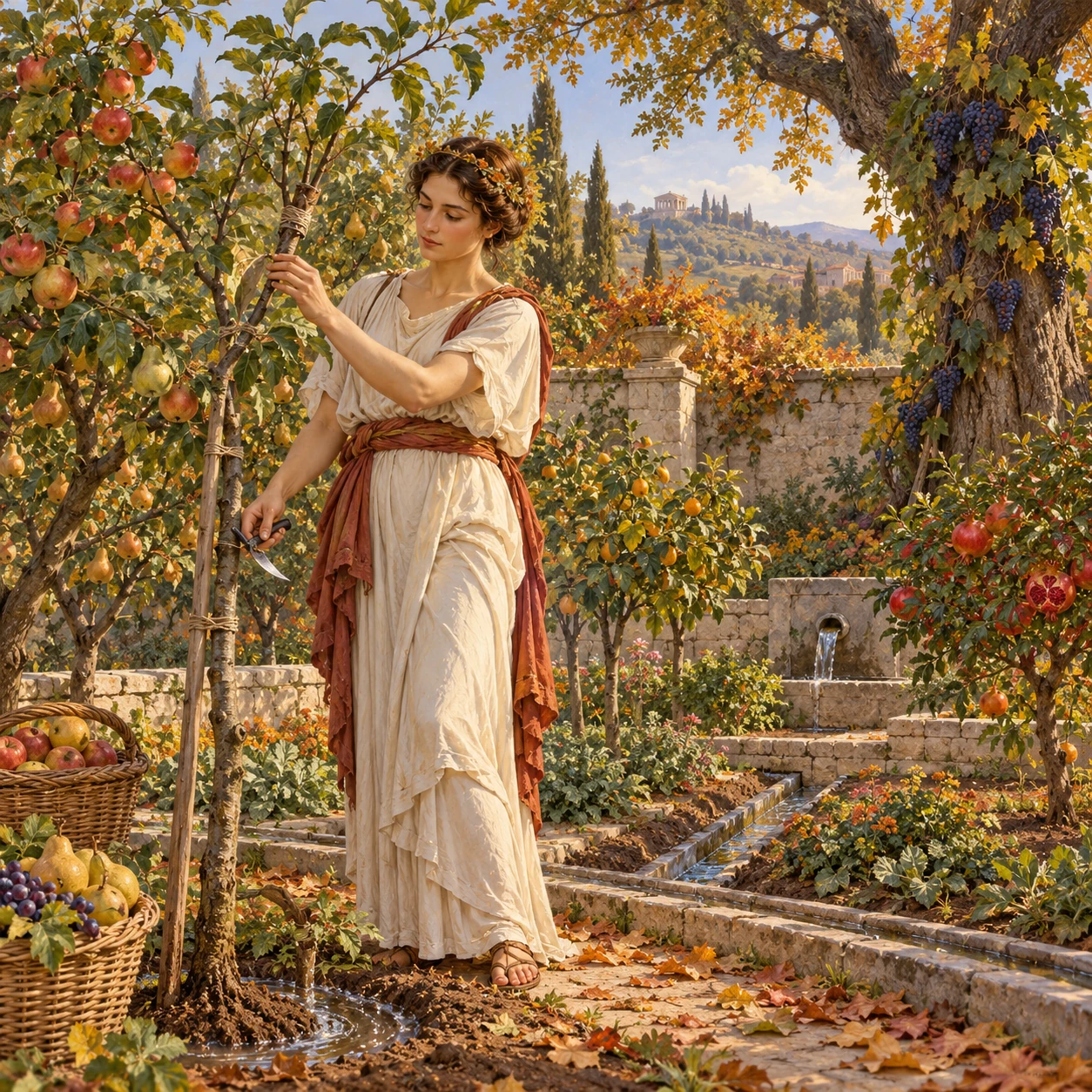
AI-generated interpretation of Pomona, the orchard-tending Hamadryad (Ovid). Source-grounded details and artistic choices are distinguished in the retained request; this is not documentary ancient artwork.
Full delivered frame inspected: clothed adult orchard keeper, complete feet, hand tending branch, fruit and irrigation context. Face, clothes and orchard architecture artistic. No anatomy or framing exception.
Overview
Ovid places Pomona among the Hamadryads of Latium during the reign of Proca. Her defining activity is the cultivation of fruit trees. She prunes excessive growth, grafts new shoots into divided bark and waters the roots. The narrative contrasts her interests with roaming woods or streams and gives her a curved pruning knife rather than a hunting weapon. This is a particular orchard-tending nymph, not an assertion that every tree spirit has the same occupation or that Pomona’s life is tied to one individual trunk.
Her enclosure also has a social purpose. She fears the violence of rural suitors, walls her orchard and refuses male visitors. Vertumnus repeatedly changes his appearance to gain access: reaper, hay worker, driver of oxen, pruner, fruit gatherer, soldier and fisherman are among his guises. Finally he enters as an old woman with white hair, a coloured head covering and a staff. Looking at an elm supporting a grapevine, he turns their association into an argument for marriage and speaks in praise of himself while concealing his identity.
The disguised visitor adds the story of Iphis and Anaxarete as a warning. It narrates a rejected suitor’s self-inflicted death and the woman’s transformation into stone; it is a persuasive story spoken by Vertumnus, rather than evidence that refusing a suitor creates a real obligation. His argument does not persuade Pomona. He then drops the disguise and appears as a young god. The poem says he intends force but that force becomes unnecessary because she is attracted to his revealed form. Keeping that final change of response distinct from the earlier threat preserves the account’s sequence without endorsing the warning tale.
The profile follows Riley’s historical English translation in the retained 1893 reprint, including the complete surrounding fables, their explanations and attached notes. Riley’s comments about Etruscan borrowing, seasonal symbolism and the origin of the story are editorial interpretation and have not been adopted as demonstrated history. Pomona’s explicit Hamadryad identity and care for living trees provide a particular historical comparison beside Narnia’s woodland persons; neither her orchard practices nor her encounter with Vertumnus becomes a general biography for them.
Origins & earliest records
Ovid, Metamorphoses XIV.623–771; full Riley fables XI–XIII retained from the 1893 George Bell and Sons reprint of Henry T. Riley’s earlier translation.
Records & interpretation
Complete narrative from Alban kings framing through Pomona/Vertumnus and nested Iphis/Anaxarete, continuing through the containing fables’ ending and explanations; all attached Book XIV notes 50–63 read.
Selected bibliography
Documented works and useful reading. This is not a list of every appearance.
- 01
Metamorphoses XIV, Fables XI–XIII
Pomona encounter at XIV.623–771; whole containing fables and explanations, notes50–63 retained/read.
Family, evolution & connections
Dryad (Narnia)
Narnia’s dryads offer a separate fictional setting for tree-associated persons beside the explicitly named Hamadryad Pomona. Their shared category does not make every dryad an orchard keeper, join their lives to Pomona’s story or establish Lewis’s use of Ovid or Riley.
References
Sources supporting this profile. Linked pages have their own scope and editorial standards.
- Primary literary narrative with historical commentaryOvid, Metamorphoses XIV, Riley historical English translation, 1893 reprintResearch access: 2026-10-26
Image credits
Modern interpretation of a historical literary accountAI-generated interpretation of Pomona, the orchard-tending Hamadryad (Ovid). Source-grounded details and artistic choices are distinguished in the retained request; this is not documentary ancient artwork.
Full delivered frame inspected: clothed adult orchard keeper, complete feet, hand tending branch, fruit and irrigation context. Face, clothes and orchard architecture artistic. No anatomy or framing exception.