
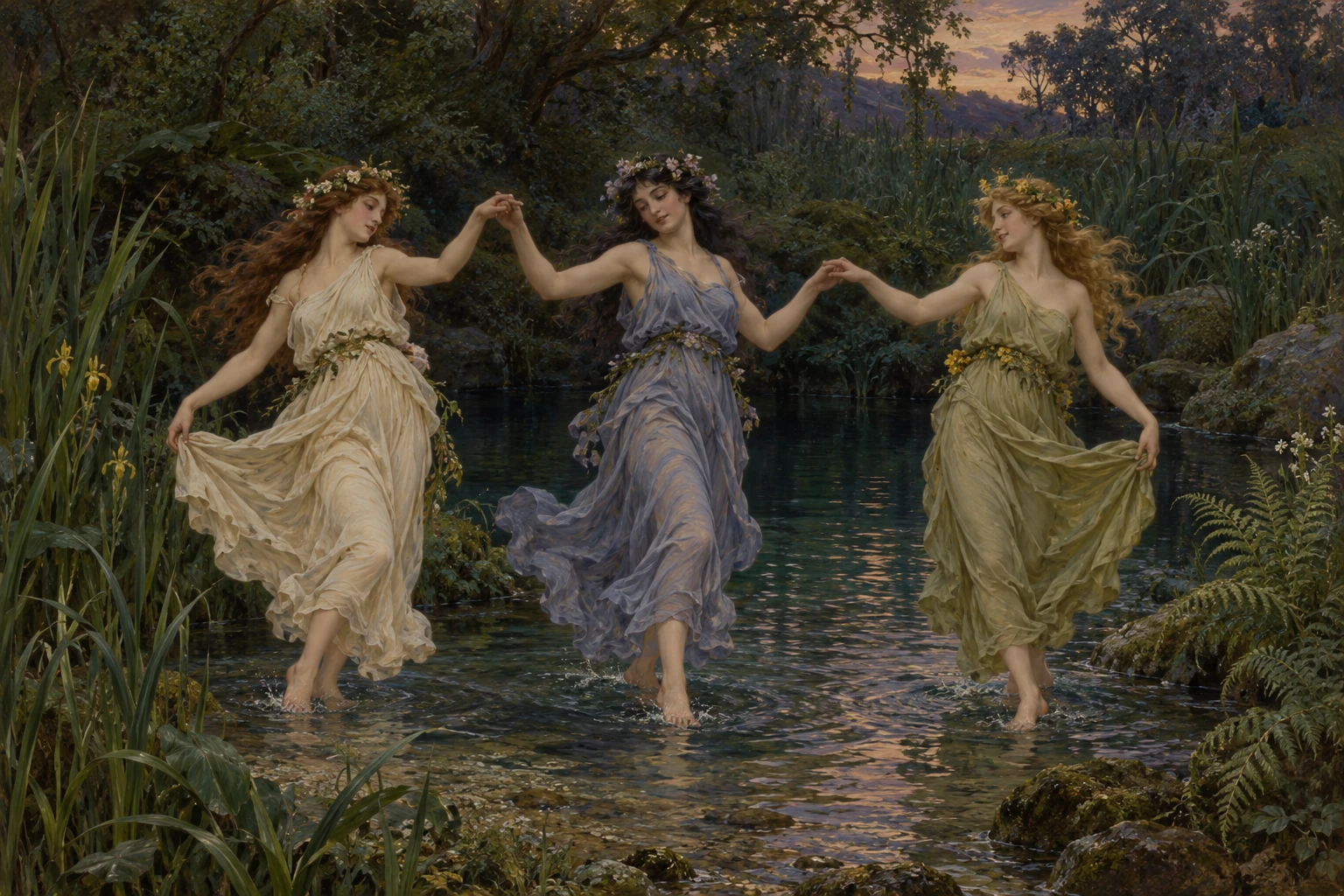
AI-generated interpretation of Eunice, Malis and Nycheia dancing in the spring before Hylas arrives. The three names, dance and spring setting follow Theocritus; humanlike adult forms, dress, garlands and appearance are artistic choices. The poem does not prescribe their anatomy.
One collective literary episode; not a depiction of Narnia characters or evidence of creator consultation.
Overview
In Theocritus’s thirteenth idyll, rendered into English prose by Andrew Lang, Eunice, Malis and Nycheia are three nymphs dancing within a spring. The passage calls them sleepless and describes them as dread goddesses of the country people. They belong to a particular encounter in the Argonautic voyage, not a catalogue prescribing the conduct or bodily form of every water spirit. The introductory address to Nicias places the story within a reflection on love before turning to Heracles and his companion Hylas.
The Argonauts have landed in the region of Propontis and are preparing their evening meal. Hylas takes a bronze vessel to fetch water for Heracles and Telamon. He finds a spring in a hollow, surrounded by rushes, maiden-hair and other marsh plants. As he extends the pitcher, all three nymphs cling to his hand, moved by love for him, and he sinks into the dark water. Lang’s comparison with a falling star is a poetic simile; the story does not turn him into a star or explain a physical means of underwater survival.
The narrative continues after the seizure. The nymphs hold the weeping Hylas on their laps and try to comfort him with gentle words. Heracles searches with bow and club, calling his name three times. Hylas hears and replies, but his voice sounds thin and distant although he is nearby. The searching hero wanders through trackless country while the ship and its company wait. The ending numbers Hylas among the Blessed and says that Heracles eventually reaches Colchis and Phasis on foot. It supplies neither a rescue of Hylas nor an explicit description of his death.
The three nymphs remain one collective episode here because they act together in the same encounter. No mermaid tails, fish bodies or fixed appearance are supplied for them. Lang’s attached note near the ship-waiting passage records a proposed Greek reading and a critical judgment about the text; it is editorial apparatus rather than another event. This complete literary witness provides historical water-nymph context while keeping its outcome and religious language separate from modern fantasy naiads or a claim that C. S. Lewis consulted this rendering.
Origins & earliest records
Theocritus, Idyl XIII, Hylas and Heracles, in Andrew Lang’s prose rendering, Theocritus, Bion and Moschus, London and New York: Macmillan and Co., 1889. The hosted title page and transcription attribution were checked; no physical volume or original Greek text independently collated.
Records & interpretation
Complete Idyl XIII, its Nicias framing and the ending through Heracles’s arrival at Colchis/Phasis read, pp.67–70. Attached note70 read in full: anchor paragraph, Greek conjecture block and following Meineke/textual comment, ending before note72.
Selected bibliography
Documented works and useful reading. This is not a list of every appearance.
- 01
Theocritus, Bion and Moschus, Rendered into English Prose
Idyl XIII, Hylas and Heracles, pp.67–70, complete introductory framing and narrative through the ending; complete attached note70 including Greek conjecture and Meineke comment. Next Idyl XIV begins p.71.
Family, evolution & connections
Naiad (Narnia)
Narnia’s naiads offer a separate fictional context for the traditional water-nymph category represented here by three named spring inhabitants. The Hylas encounter belongs to Theocritus’s selected poem: its seizure, comforting voices and unresolved separation are not transferred to Narnia. This is a qualified historical comparison, not a shared biography or a documented source used by Lewis.
References
Sources supporting this profile. Linked pages have their own scope and editorial standards.
- Ancient Greek literary narrative in historical English prose renderingLang 1889, complete Theocritus Idyl XIII and attached note70Research access: 2026-10-26
Image credits
Modern interpretation of a historical literary accountAI-generated interpretation of Eunice, Malis and Nycheia dancing in the spring before Hylas arrives. The three names, dance and spring setting follow Theocritus; humanlike adult forms, dress, garlands and appearance are artistic choices. The poem does not prescribe their anatomy.
One collective literary episode; not a depiction of Narnia characters or evidence of creator consultation.