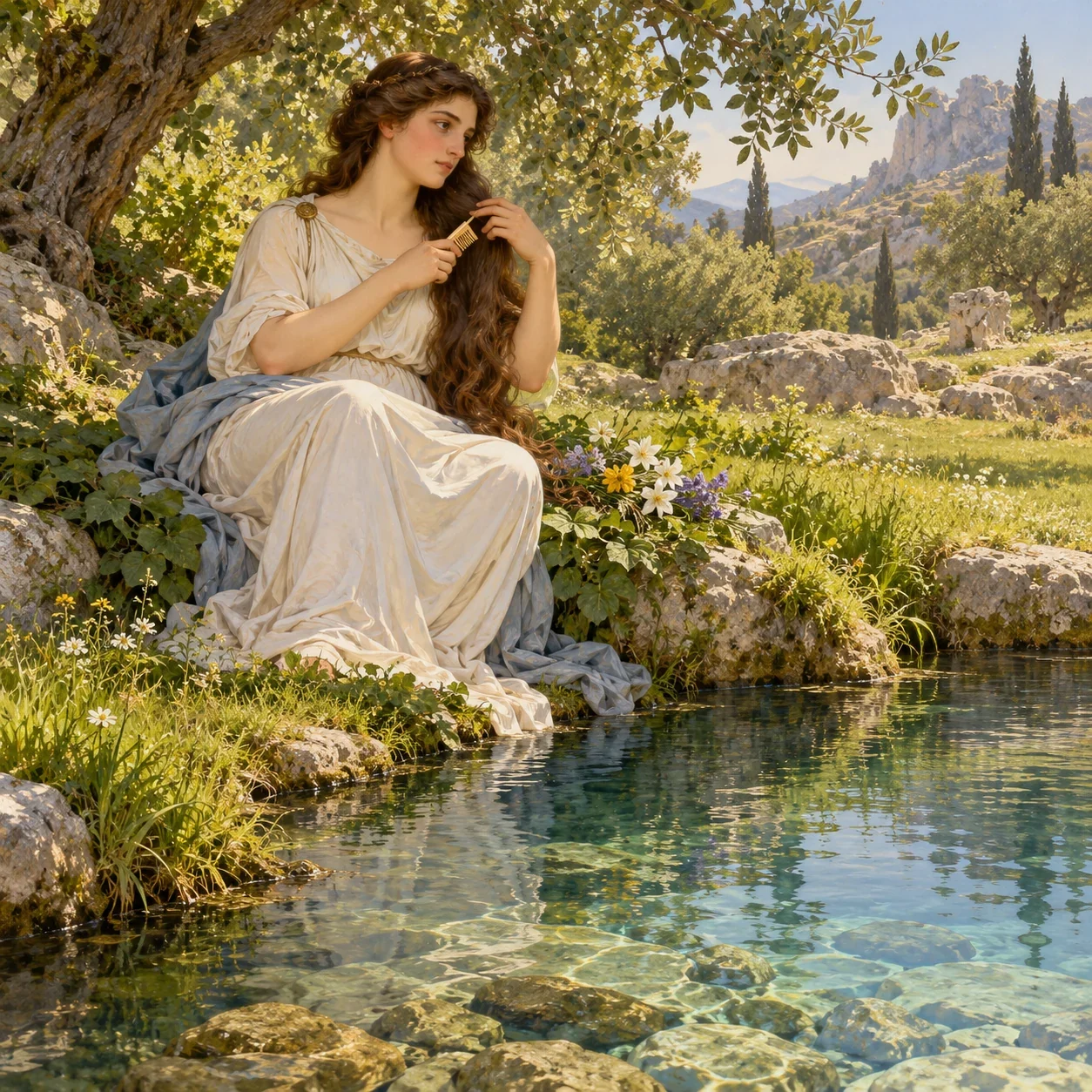
AI-generated interpretation of Salmacis before the encounter in Ovid’s tale. The comb, flowers and clear grassy spring follow the text; her face, gown, landscape arrangement and lighting are artistic choices, not ancient documentary evidence.
AI-generated interpretation of Salmacis before the encounter in Ovid’s tale. The comb, flowers and clear grassy spring follow the text; her face, gown, landscape arrangement and lighting are artistic choices, not ancient documentary evidence.
Overview
Alcithoe tells the Salmacis story while she and her sisters continue weaving during the festival of Bacchus. She introduces it as an explanation of a spring’s notorious effects. The account is therefore a tale within Ovid’s larger narrative of the daughters of Minyas, not a medical description or an assertion that every Naiad possesses the same power. The name Salmacis belongs both to the nymph and to the spring whose reputation the tale explains.
The spring is clear enough for its bottom to be visible and is bordered by soft grass rather than reeds or rushes. Salmacis differs from her hunting companions: she rejects their invitations to carry a javelin and quiver, and the narrator presents her as unknown to Diana’s chase. She instead bathes, arranges her hair with a boxwood comb, studies her reflection, rests on leaves and gathers flowers. These activities establish this particular nymph’s habits; they are not universal attributes of freshwater spirits.
Hermaphroditus, the child of Hermes and Aphrodite, has left Mount Ida after reaching fifteen years of age and travels through Lycia into Caria. Salmacis approaches him, proposes a relationship and persists when he does not welcome her advances. He threatens to leave unless she stops. She pretends to withdraw but watches from concealment. When he enters the spring, she seizes him despite his attempts to escape and asks the gods never to separate them. The text explicitly preserves his resistance; the resulting union is not mutual consent.
The gods answer her prayer by joining their bodies into one form, compared with branches growing beneath a shared bark. Hermaphroditus then asks his divine parents to give the spring a similar effect on later male bathers, and they grant that request. The ending assigns this further change to his prayer and his parents’ assent, rather than making Salmacis alone the author of every property of the water. More’s translation expresses the result through historical ideas of masculinity and bodily mixture. That literary explanation does not define modern intersex people or gender identities.
Origins & earliest records
Ovid places the spring near Caria within Hermaphroditus’s journey. This profile follows BookIV,285–388 in Brookes More’s1922 English translation, as retained in the public text-library cache; the Latin and a physical1922 copy were not independently collated.
Records & interpretation
The complete selected episode, Alcithoe’s introduction, the opening storytelling frame and the sisters’ subsequent transformation were read. No attached explanatory footnotes occur in the inspected hosted passage. This is evidence for a particular literary representation, not for a single pan-Mediterranean biography of Naiads.
Selected bibliography
Documented works and useful reading. This is not a list of every appearance.
- 01
Metamorphoses, BookIV
Complete selected episode285–388; framing1–54,271–284 and389–415. Boston: Cornhill Publishing Co.; edition metadata corroborated by the same-host BookI bibliography.
Family, evolution & connections
Naiad (Narnia)
Ovid names Salmacis a Naiad of a freshwater spring; Narnia uses Naiad for water-associated persons. This is a named-category comparison. Salmacis’s coercive pursuit and bodily-union episode are not attributed to Lewis’s characters, and no consultation of this particular tale is established.
References
Sources supporting this profile. Linked pages have their own scope and editorial standards.
- Historical primary literary translationOvid, Metamorphoses4: More translationResearch access: 2026-10-27
Image credits
AI-generated interpretationAI-generated interpretation of Salmacis before the encounter in Ovid’s tale. The comb, flowers and clear grassy spring follow the text; her face, gown, landscape arrangement and lighting are artistic choices, not ancient documentary evidence.
AI-generated interpretation of Salmacis before the encounter in Ovid’s tale. The comb, flowers and clear grassy spring follow the text; her face, gown, landscape arrangement and lighting are artistic choices, not ancient documentary evidence.