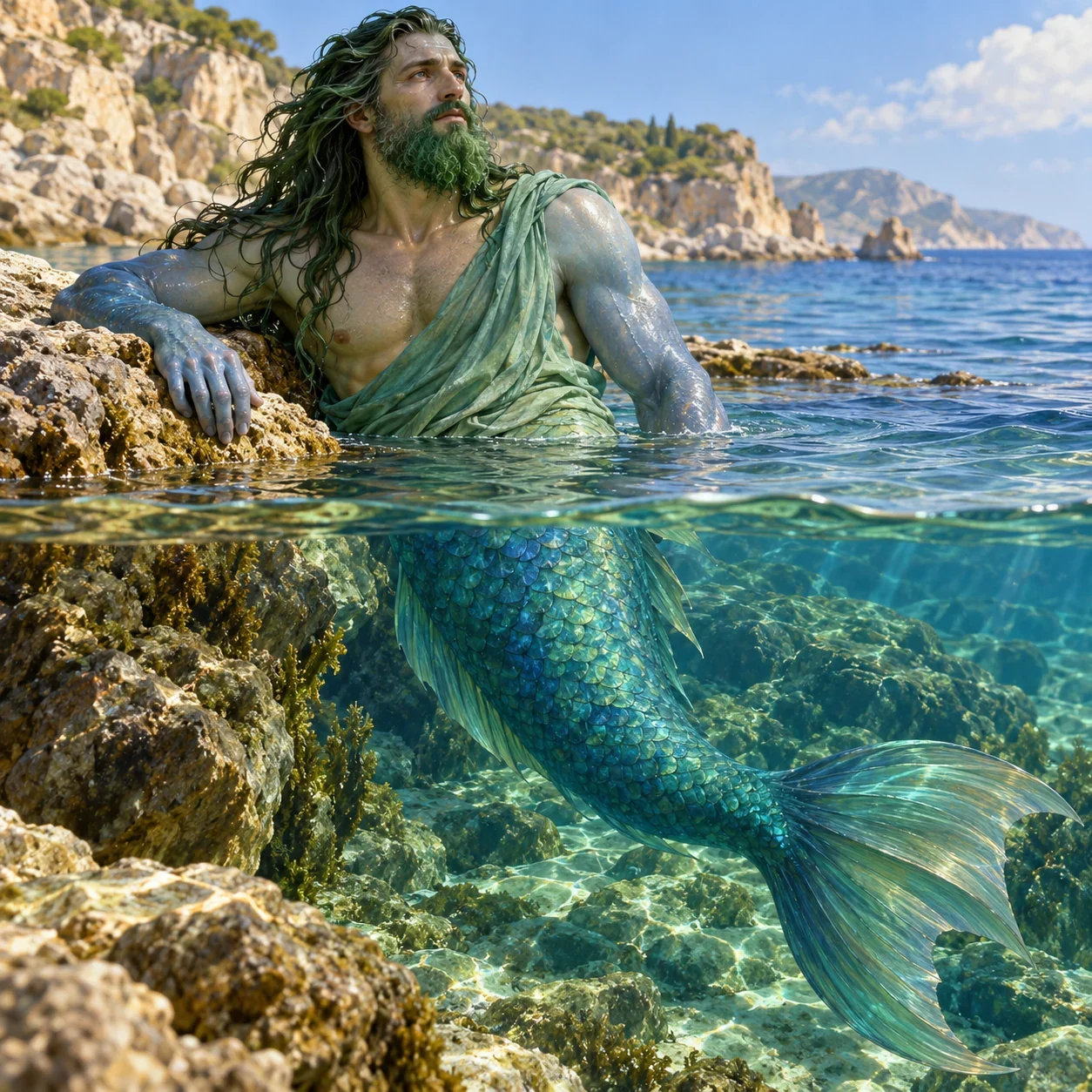
AI-generated interpretation of Glaucus after his transformation in Ovid. Green beard, blue arms, long hair and a fish extremity follow the text; the face, drape, tail design and coast are artistic choices.
AI-generated interpretation of Glaucus after his transformation in Ovid. Green beard, blue arms, long hair and a fish extremity follow the text; the face, drape, tail design and coast are artistic choices.
Overview
Glaucus approaches Scylla after Galatea has finished speaking to her companions. Newly transformed at Anthedon, he follows the frightened nymph and tries to explain himself from beside a rock. Scylla observes his unusual color, flowing hair and fish-shaped lower body, but cannot decide whether he is a monster or a god. His answer is a first-person account of becoming a sea deity, offered in an unsuccessful attempt to persuade her to remain.
Before the change, he earned his living with nets, hooks and a fishing rod. While drying his nets on untouched coastal grass, he laid out his catch to count it. The fish began moving as though they were swimming and escaped into the sea. Wondering whether a deity or the grass had caused this, he tasted the vegetation himself. He immediately felt an unfamiliar inward disturbance and an overwhelming change of inclination, bade farewell to land and plunged into the water.
The sea gods received him and asked Oceanus and Tethys to remove his mortality. His account describes repeated purification and immersion beneath many streams, followed by a lapse of awareness. On recovering, he found himself changed in mind and body: a deeply green beard, long hair trailing through the sea, broad shoulders, blue arms and legs tapering into a fish’s fins. The narrative therefore includes both the herb-triggered plunge and acceptance by marine divinities; it does not describe an ordinary fish merely growing a human torso.
Scylla nevertheless leaves. In the continuation in Book XIV, Glaucus seeks Circe’s assistance to make Scylla return his feelings, rather than asking to be cured of his own desire. He rejects Circe’s advances. When she instead harms Scylla, he laments the result and refuses an alliance with her. His transformation does not grant control over another person’s affection. Riley’s explanation adds speculation that a historical drowning lay behind his divinization, but the profile retains that as commentary, not an event independently established by Ovid’s story.
Origins & earliest records
This profile follows Henry T. Riley’s English translation of Ovid, first published in 1851, in the 1893 George Bell reprint identified by the retained Gutenberg title and transcriber notice. Historical commentary is separated from the translated narrative.
Records & interpretation
Complete XIII fableVIII,898–968 and explanation; notes77–78; complete XIV fableI,1–74, explanation and notes1–4. The Latin and a physical printed copy were not independently collated. Named literary transformation is not zoological evidence.
Selected bibliography
Documented works and useful reading. This is not a list of every appearance.
- 01
Metamorphoses, Books VIII–XV
Complete XIII fableVIII,898–968 and explanation; notes77–78; complete XIV fableI,1–74, explanation and notes1–4. Translation 1851; selected reprint 1893.
Family & connections
A source-supported family tree or inspiration record has not yet been compiled for this profile. Related reading below indicates a connection in subject matter, not a proven lineage or creative influence.
References
Sources supporting this profile. Linked pages have their own scope and editorial standards.
- Historical primary translation with commentaryOvid, Riley translation:1893 reprintResearch access: 2026-10-27
Image credits
AI-generated interpretationAI-generated interpretation of Glaucus after his transformation in Ovid. Green beard, blue arms, long hair and a fish extremity follow the text; the face, drape, tail design and coast are artistic choices.
AI-generated interpretation of Glaucus after his transformation in Ovid. Green beard, blue arms, long hair and a fish extremity follow the text; the face, drape, tail design and coast are artistic choices.