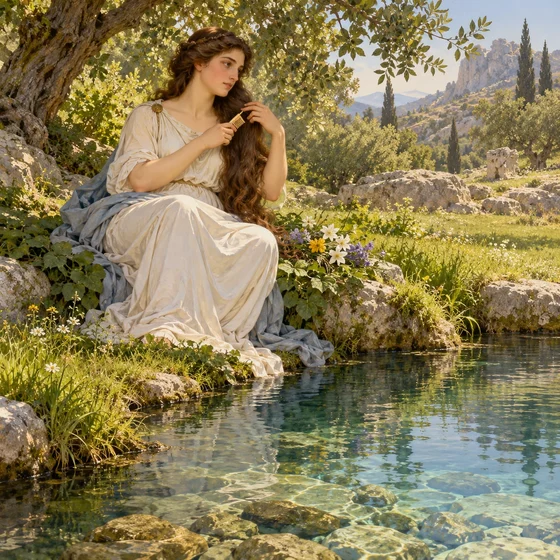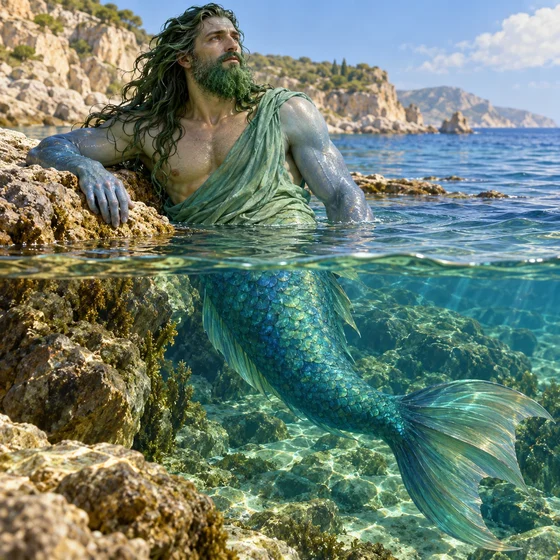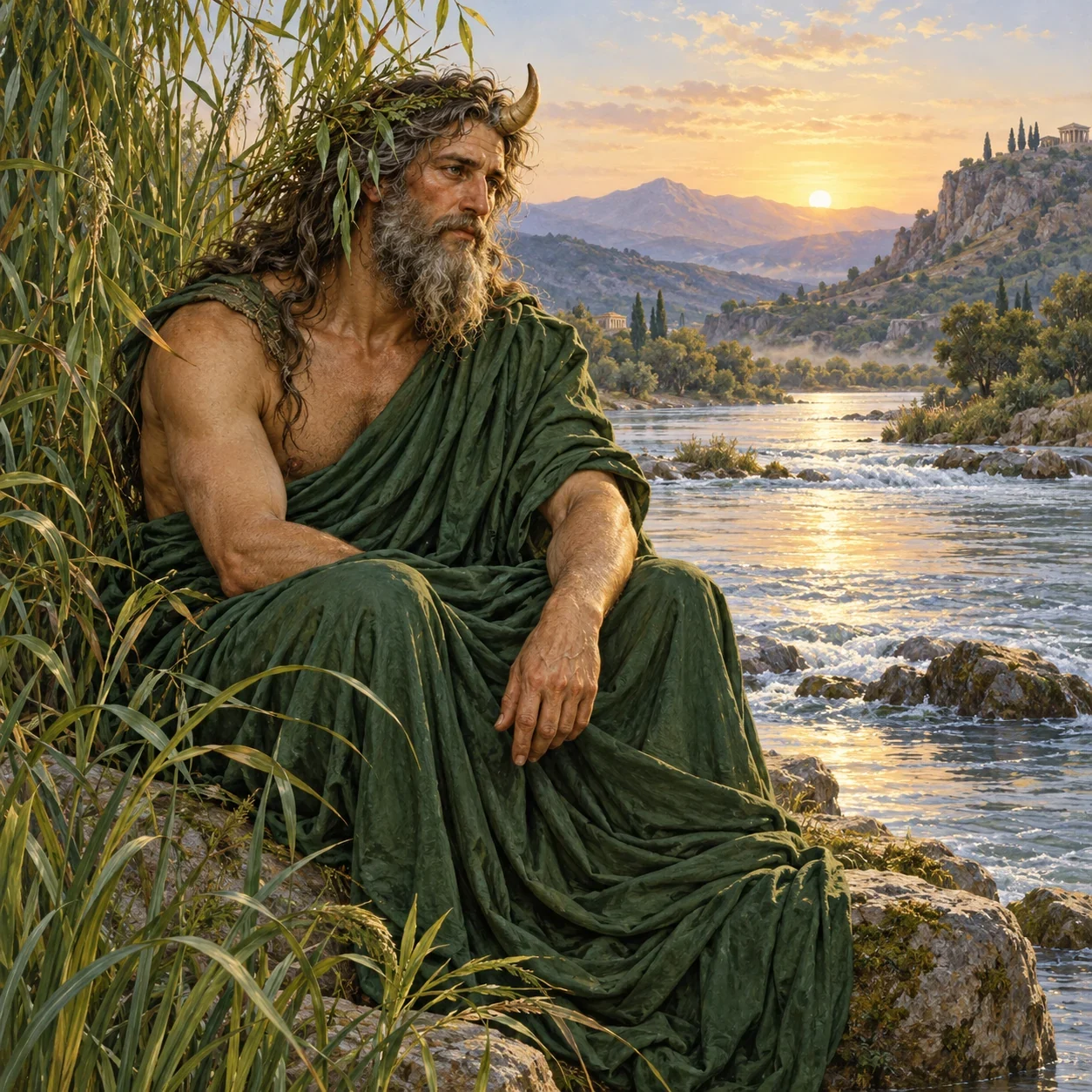
AI-generated interpretation of Achelous after the lost-horn account in Ovid. The green garment, river setting, rustic features and foliage concealment follow selected details; facial anatomy, horn shape and placement, costume arrangement and landscape are artistic choices.
AI-generated interpretation of Achelous after the lost-horn account in Ovid. The green garment, river setting, rustic features and foliage concealment follow selected details; facial anatomy, horn shape and placement, costume arrangement and landscape are artistic choices.
Overview
At the close of Book VIII, Achelous tells his guests that his transformations are limited: he can retain his current form or become a serpent or the leader of a cattle herd. He points to the missing horn on one side of his forehead and sighs. Theseus’s question opens the next book, prompting the river god to recount his defeat rather than letting the reader mistake his shape-changing ability for invulnerability.
Achelous and Hercules remain as rival suitors for Deianira after the other men withdraw. The river god argues that he is a local ruler of waters, part of her father’s country rather than a foreign visitor, and insults Hercules’s claim to divine parentage. Hercules answers with a challenge to physical combat. Achelous removes his green garment and wrestles, initially relying on his great bulk. He admits that Hercules eventually turns him around, bears down on his back and forces him to his knee.
To escape, Achelous becomes a long serpent, twisting and hissing. Hercules mocks that defense by recalling his previous victories over serpents and grips his throat. The river god then changes into a powerful bull and renews the fight. Hercules forces his horns into the sand, throws him down and tears away one horn. Each new body changes the struggle but fails to reverse its outcome. The serpent and bull are successive forms of the same speaking deity, not separate monsters or a pedigree of animal descendants.
The Naiads fill the removed horn with fruit and fragrant flowers, consecrating it as an emblem of abundance. A handmaid subsequently brings the guests autumn produce in the plentiful horn, connecting the narrated loss with the banquet before them. At dawn the guests leave, and Achelous hides his rustic features and mutilated horn in the water. Reeds or willow branches conceal the injury; the narrator says he is otherwise unharmed. Riley’s following explanation interprets the combat as river-control works and fertile land recovered from flooding. That historical rationalization remains the commentator’s interpretation, distinct from the poem’s account of a god defeated in changing bodily forms.
Origins & earliest records
This profile follows Henry T. Riley’s English translation of Ovid, first published in 1851, in the 1893 George Bell reprint identified by the retained Gutenberg title and transcriber notice. Historical commentary is separated from the translated narrative.
Records & interpretation
Complete IX fableI,1–100 and explanation,notes1–10; complete VIII closing transition880–884 with note101. The Latin and a physical printed copy were not independently collated. Named literary transformation is not zoological evidence.
Selected bibliography
Documented works and useful reading. This is not a list of every appearance.
- 01
Metamorphoses, Books VIII–XV
Complete IX fableI,1–100 and explanation,notes1–10; complete VIII closing transition880–884 with note101. Translation 1851; selected reprint 1893.
Family & connections
A source-supported family tree or inspiration record has not yet been compiled for this profile. Related reading below indicates a connection in subject matter, not a proven lineage or creative influence.
References
Sources supporting this profile. Linked pages have their own scope and editorial standards.
- Historical primary translation with commentaryOvid, Riley translation:1893 reprintResearch access: 2026-10-27
Image credits
AI-generated interpretationAI-generated interpretation of Achelous after the lost-horn account in Ovid. The green garment, river setting, rustic features and foliage concealment follow selected details; facial anatomy, horn shape and placement, costume arrangement and landscape are artistic choices.
AI-generated interpretation of Achelous after the lost-horn account in Ovid. The green garment, river setting, rustic features and foliage concealment follow selected details; facial anatomy, horn shape and placement, costume arrangement and landscape are artistic choices.