Juniper-Tree Bird
Image associated with the exact linked encyclopedia article; consult credited file description for its interpretation.
Overview
The bird in Hunt’s Grimm tale 47 emerges from the remains of a murdered boy. Before his birth, his first mother wishes for a child while standing beneath a juniper tree; she dies after the birth and is buried there. His father remarries, and the second wife, concerned that her own daughter should inherit the household wealth, kills the boy and conceals the crime. She deceives her daughter Marlinchen into believing she caused his death, then serves the boy’s flesh to his unsuspecting father. The first mother and the murderous stepmother are different people.
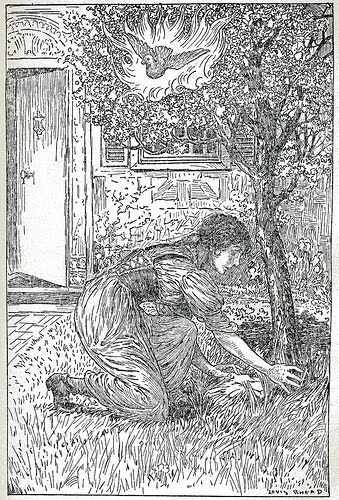
Marlinchen collects the bones in a silk handkerchief and puts them beneath the juniper tree. The branches move as if in delight; a mist and fiery brightness appear, and a beautiful bird flies out. The handkerchief and bones have disappeared. Later descriptions give it red and green feathers, a gleaming neck and eyes like stars. No ordinary bird species is identified. Its song recounts the killing, the father’s unknowing meal and the sister’s act of gathering the bones.
The bird repeats its song in return for three objects. A goldsmith gives a gold chain, which it takes in its right claw. A shoemaker gives red shoes, carried in its left claw. At a mill, twenty millers use a beam to lift a millstone; the bird puts its neck through the opening and wears the stone like a collar. These exchanges connect its remarkable voice with the gifts and punishment at the end. The millstone is carried by the bird after human workers lift it, rather than being described as a stone that flies by itself.
At the family home, the same singing produces different responses: the father feels comfort, Marlinchen grieves, and the stepmother becomes increasingly terrified. The bird drops the gold chain to the father and the shoes to the sister. When the stepmother comes out, it drops the millstone on her and kills her. Smoke and flame then clear to reveal the boy alive. He takes his father and sister by the hand, and the three go indoors to eat together.
The bird is a transformed or restored child within this particular narrative, carrying testimony, gifts and retribution between the household and the wider town. Its emergence in fire can be compared with other renewal stories, but the text does not call it a phoenix or give it a repeating life cycle. The final human return, the sister’s care and the distinction between the two mothers are essential to its identity; a generic description of an avenging magical bird would omit those relationships.
Origins & earliest records
This entry follows tale 47 in the Grimm brothers’ Household Tales, using Margaret Hunt’s 1884 English translation. The collection was repeatedly revised during the nineteenth century and mediates material from storytellers and earlier literature. Its publication and translation dates identify the selected witness, not the beginning of every related oral narrative.
Records & interpretation
Complete tale 47 in Margaret Hunt’s Grimm translation read from opening through ending. The passage supplies this narrative’s events and relationships, not observational evidence for a biological species. The biological mother and stepmother are distinct. Marlinchen’s care, three exchanges, the killing of the stepmother and the boy’s human return are read through the final sentence.
In the literature
“a beautiful bird flew out of the fire singing magnificently,”
Tale 47 The Juniper-Tree; paragraph beginning ““Oh, he wanted to go, and asked me if he might stay…” · Margaret Hunt
The murdered child’s bones beneath the juniper tree are followed by the appearance of the singing bird; prose excerpt, not song lyrics.
Selected bibliography
Documented works and useful reading. This is not a list of every appearance.
- 01
Household Tales, tale 47: The Juniper-Tree
Complete selected English tale read, including the ending and transformation sequence. The translation is a located literary witness, not a claim to the first oral telling.
- 02
Household Tales: 47 The Juniper-Tree
Margaret Hunt’s English translation, London: George Bell and Sons, 1884; Gutenberg e-text identifies Hunt. Translation date corroborated by the Wikisource scanned title page and National Library of New Zealand catalogue.
Family, evolution & connections
The Juniper-Tree family — Hunt’s Grimm translation
Two marriages of the unnamed father and their explicitly distinguished children in tale 47.
Scroll sideways to see all branches. With a keyboard, focus the tree and use the arrow keys.
- Unnamed father
- With first wife (joint parents)
- With second wife (joint parents)
- Marlinchen
Parentage stated in the opening; the ending confirms the bird’s restored identity as the boy. Marriage nodes explain different mothers, not extra ancestors. The boy and bird are one narrative identity. Unnamed parents remain unnamed; no taxonomic bird identification is inferred.
Marlinchen
In Hunt’s translation of The Juniper-Tree, the boy and Marlinchen have the same father but different mothers. Marlinchen preserves his bones beneath the tree, after which a singing bird appears; the ending restores the boy. The bird’s repeated address to his sister preserves that identity rather than introducing a separate avian offspring.
Located primary passages
Specific passages supporting details in this entry, grouped by their published witness.
Household Tales, tale 47: The Juniper-Tree
Margaret Hunt’s English translation, London: George Bell and Sons, 1884; Gutenberg e-text identifies Hunt. Translation date corroborated by the Wikisource scanned title page and National Library of New Zealand catalogue.
- The murdered child’s bones beneath the juniper tree are followed by the appearance of the singing bird; prose excerpt, not song lyrics.
Tale 47 The Juniper-Tree; paragraph beginning ““Oh, he wanted to go, and asked me if he might stay…”
This describes the version printed in Hunt’s translation; German tale origin and other versions require separate evidence.
References
Sources supporting this profile. Linked pages have their own scope and editorial standards.
- Primary textGrimm/Hunt, complete tale 47Research access: 2026-10-05
Image credits
Reference illustrationJuniper-Tree Bird
Image associated with the exact linked encyclopedia article; consult credited file description for its interpretation.