Falada
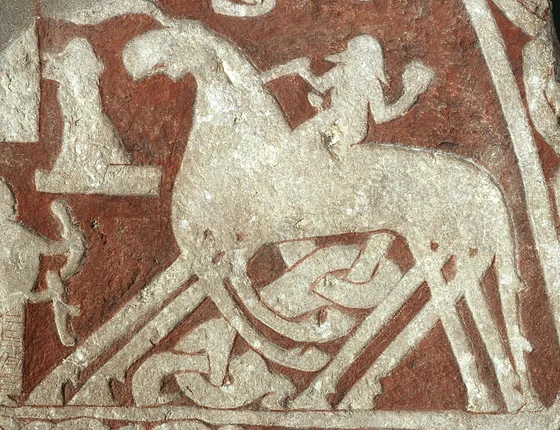
Image associated with the exact linked encyclopedia article; consult credited file description for its interpretation.
Overview
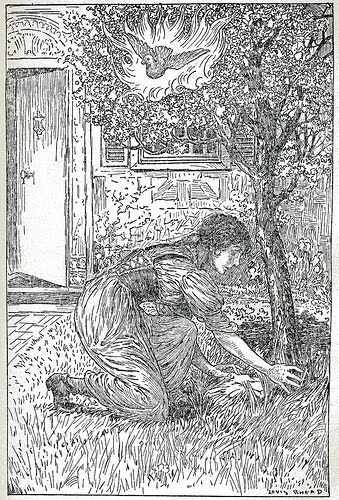
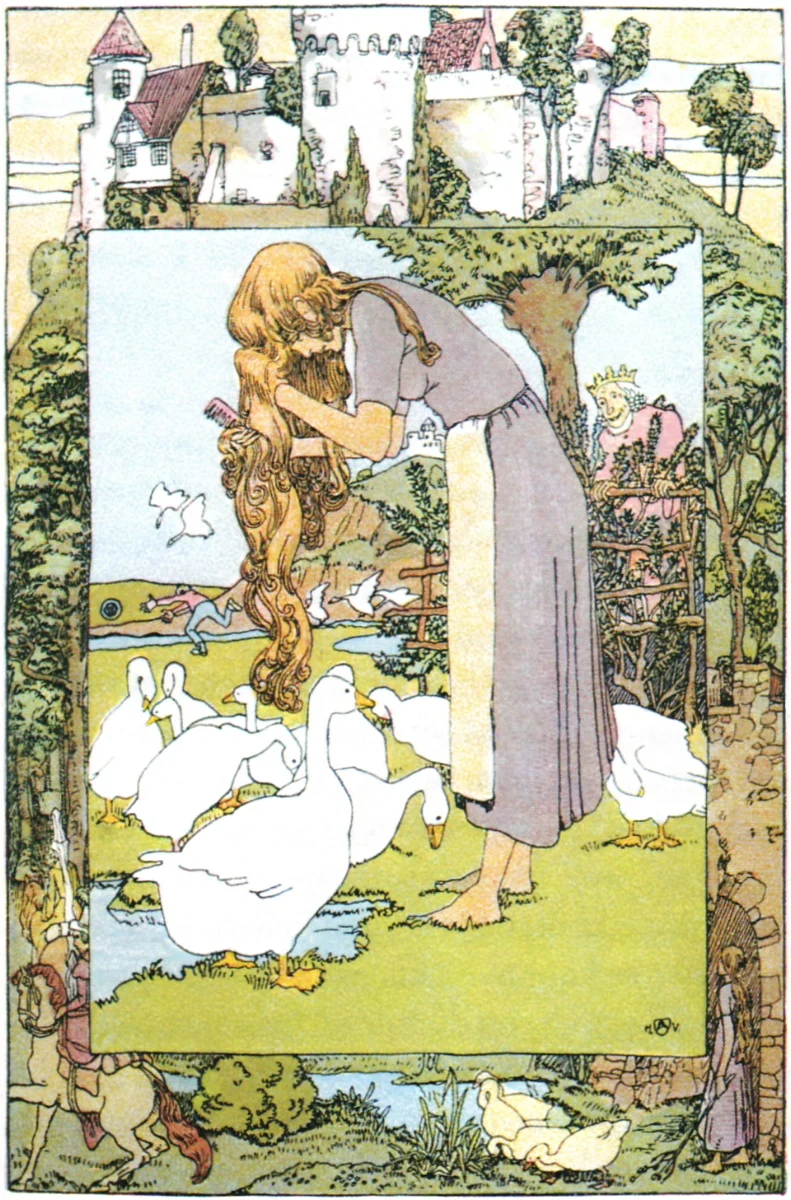
Falada is the princess's speaking horse in The Goose-Girl, rather than an ordinary mount given supernatural powers only after death. The old queen equips her daughter for a distant marriage and sends an attendant on a separate horse. When the attendant refuses to fetch drinking water, the princess must dismount and drink directly from a stream. Three drops of her mother's blood, kept in a handkerchief, answer her distress. Losing this protective cloth allows the attendant to force an exchange of clothes and horses, then demand an oath beneath the open sky forbidding her to tell anyone at the royal court. Falada observes the whole deception. At the destination, the prince welcomes the false bride while the actual princess is assigned to help Conrad tend geese. The impostor asks for Falada's death, pretending the animal annoyed her on the journey; the narrator explicitly explains that she fears his testimony. Thus his capacity to speak creates the danger that leads to his killing.
The princess pays to have his severed head fixed beneath the dark gateway through which she drives the geese each morning and evening. There it answers her lament, addresses her as the young queen and recalls the sorrow her mother would feel. The repeated exchange preserves recognition after the destruction of the horse's body, but does not restore Falada to life. Conrad reports the strange conversation, alongside the girl's ability to command a wind that carries away his hat. The old king then listens at the gateway and watches the meadow, gathering the clues himself. Falada's voice initiates this investigation; the decisive explanation comes when the princess tells her sorrows to an iron stove and the king overhears through its pipe. A restoration of her social identity follows, while the horse's fate remains irreversible in the selected text. No colour, breed, divine ancestry or human identity is assigned to him. His specificity lies in a named witness whose voice survives bodily destruction, rather than a general claim that all horses in Grimm's stories can speak.
Origins & earliest records
This entry follows tale 89 in the Grimm brothers’ Household Tales, using Margaret Hunt’s 1884 English translation. The collection was repeatedly revised during the nineteenth century and mediates material from storytellers and earlier literature. Its publication and translation dates identify the selected witness, not the beginning of every related oral narrative.
Records & interpretation
The numbered tale supplies the being’s appearance, speech and actions in a collected literary narrative. It documents storytelling and editorial transmission, rather than biological existence or actual animal behaviour. Different editions and related oral tales may alter transformations, endings or motives; the selected passage is identified so those differences can be compared.
In the literature
“the horse of the King’s daughter was called Falada, and could speak.”
Tale 89 The Goose-Girl; paragraph beginning “There was once upon a time an old Queen whose husband had…” · Margaret Hunt
The tale introduces Falada as a speaking horse belonging to the princess.
Selected bibliography
Documented works and useful reading. This is not a list of every appearance.
- 01
Household Tales, tale 89: The Goose-Girl
Specific public-domain collected tale inspected. The selected English edition is a literary witness, not a transcript of a universal oral version.
- 02
Household Tales: 89 The Goose-Girl
Margaret Hunt’s English translation, London: George Bell and Sons, 1884; Gutenberg e-text identifies Hunt. Translation date corroborated by the Wikisource scanned title page and National Library of New Zealand catalogue.
Family, evolution & connections
Juniper-Tree Bird
Falada’s severed head continues speaking to the displaced princess, and the old king hears their exchange before learning her story. The Juniper-Tree bird repeatedly sings the boy’s concealed fate and later becomes the boy again. Both narratives preserve testimony through animal speech, but Falada is a horse witness whereas the bird carries the victim’s own identity.
Located primary passages
Specific passages supporting details in this entry, grouped by their published witness.
Household Tales, tale 89: The Goose-Girl
Margaret Hunt’s English translation, London: George Bell and Sons, 1884; Gutenberg e-text identifies Hunt. Translation date corroborated by the Wikisource scanned title page and National Library of New Zealand catalogue.
- The tale introduces Falada as a speaking horse belonging to the princess.
- The false bride seeks Falada’s death to suppress his testimony.
This describes the version printed in Hunt’s translation; German tale origin and other versions require separate evidence.
References
Sources supporting this profile. Linked pages have their own scope and editorial standards.
- Primary textGrimm/Hunt, Household Tales, tale 89Research access: 2026-10-05
Image credits
Reference illustrationFalada
Image associated with the exact linked encyclopedia article; consult credited file description for its interpretation.