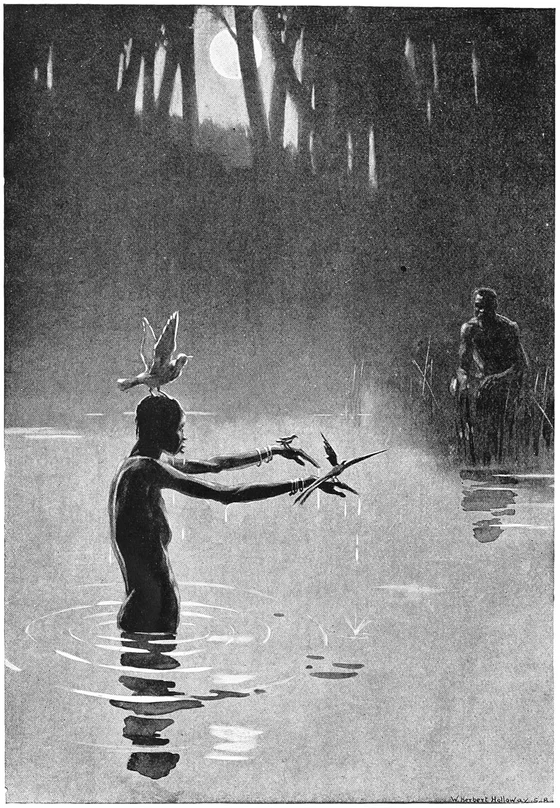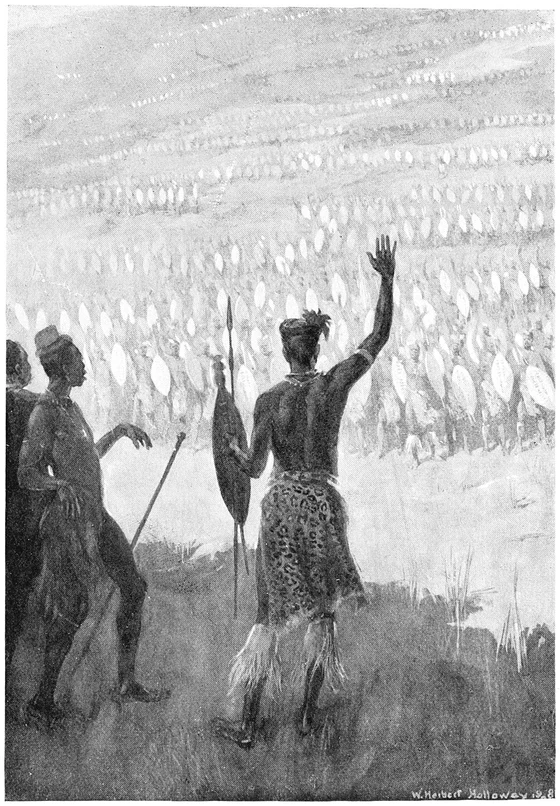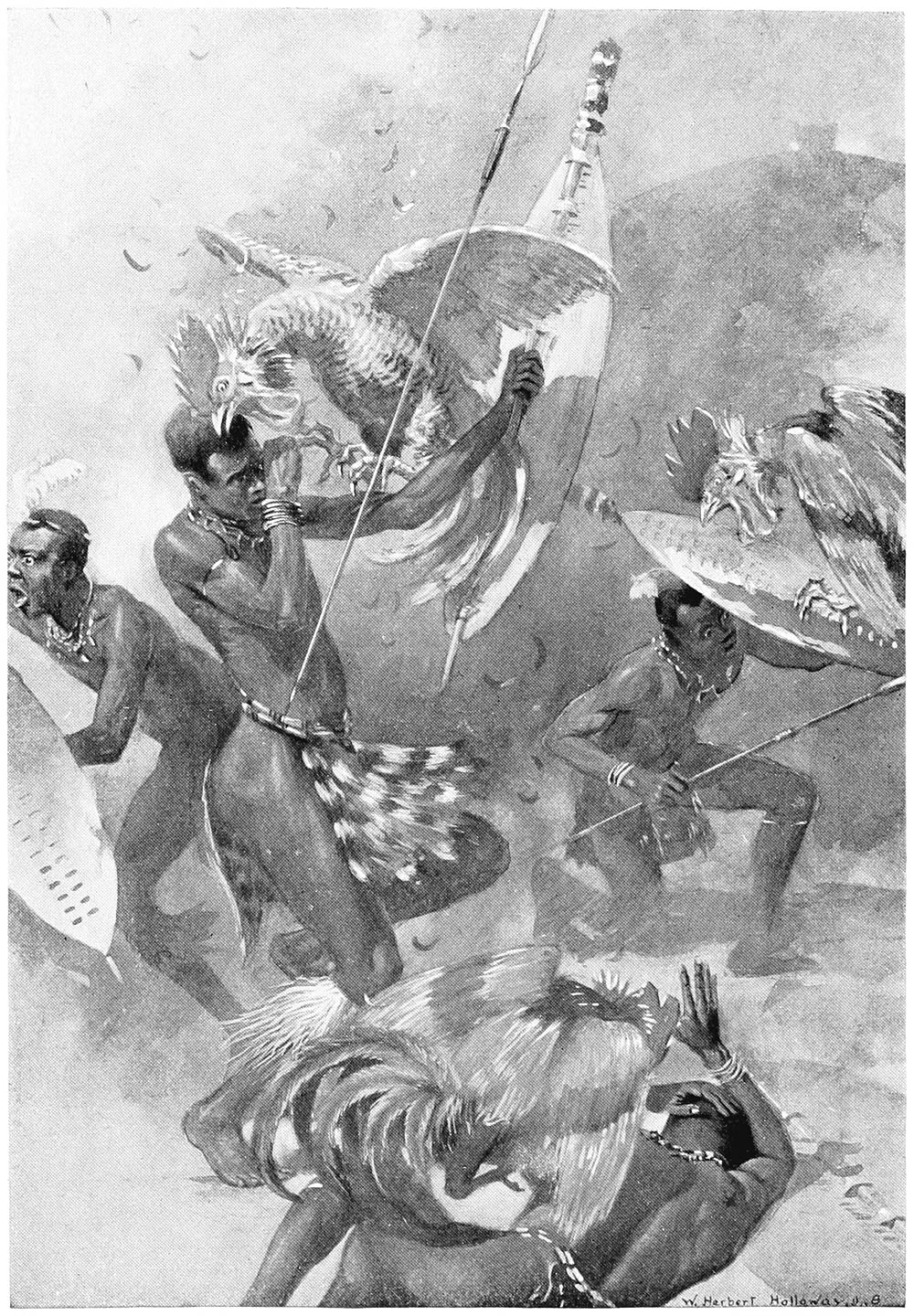
Enchanted fowls defending their settlement against warriors, Holloway 1908
The illustration accompanies the fowl community’s collective defence, as birds attack the invading regiment. It does not distinguish the golden ruler individually, and its monochrome tones do not show his described golden colour.
Overview
Cold, wet hunters seeking fire discover an enormous kraal with livestock and hundreds of huts but no visible human inhabitants. Fowls occupy its houses and go about organized affairs. At the cattle enclosure a magnificent golden cock with bright yellow eyes surveys the city from its fence. He addresses the visitors in a human voice and offers shelter. Explaining his condition, he says that a stronger cannibal king demanded his daughters for that king’s sons. Refusal led hostile magicians to change the ruler and all his people into cocks and hens.
The enchantment can end only if they overcome a chief more powerful than themselves. Nevertheless, the cock houses and feeds the hunters and gives them a slowly smouldering fire-stick for their return. Their own king learns of the rich settlement, condemns them for not stealing its cattle and sends a regiment to seize it. The cock secures his herds, calls the fowl inhabitants to defend their homes and prepares them at their doorways. As the invaders enter, each bird attacks a chosen enemy, overwhelming the regiment through blows of wings and attacks on their eyes.
A second invasion uses the king’s finest bodyguard under his son. It is also defeated, and the cock spares one survivor so that the attackers’ fate will be reported. The king then admits defeat and abandons the attempt to seize the city. At his acknowledgment the cock and his subjects regain human forms, their victory fulfilling the condition of release. This collective profile retains the golden ruler and his enchanted polity together; it does not invent individual biographies for the unnamed fighting fowls.
Origins & earliest records
Sarah F. Bourhill and Beatrice L. Drake present the collected story in an English arrangement for children. The chapter is labelled Swazi, but no individual narrator is named. The narrative contrasts the host’s generosity with the visiting king’s greed.
Records & interpretation
Complete XI. The Cock’s Kraal, printed pp. 132–138, read through the restoration of human forms.
Selected bibliography
Documented works and useful reading. This is not a list of every appearance.
- 01
Fairy Tales from South Africa
XI. The Cock’s Kraal, pp. 132–138; complete English retelling, unnamed individual contributor.
Family, evolution & connections
The enchanted chief’s daughters in The Cock’s Kraal
Bourhill and Drake’s 1908 literary presentation, XI, labelled A Swazi Tale, specifically the chief’s explanation on p. 135.
Scroll sideways to see all branches. With a keyboard, focus the tree and use the arrow keys.
- Unnamed daughters (collective branch)
The speaking Cock explicitly identifies daughters whose proposed marriages he refused. Unnamed daughters remain collective. The rejected suitors are not spouses. All subjects enchanted into fowls are not thereby children of the chief. Human and cock forms are one narrative identity, not separate generations. This is a source-specific historical literary witness, not a universal genealogy or independently verified contemporary oral account.
Unnamed daughters of the enchanted chief in The Cock’s Kraal
The golden Cock calls the women his daughters while explaining his refusal to marry them to a cannibal king’s sons. The rejected proposal does not establish marriages. His bird form is an enchantment of the same human chief, not a bird ancestor.
Located primary passages
Specific passages supporting details in this entry, grouped by their published witness.
Primary source witness
Sarah F. Bourhill (Mrs. E. J. Bourhill) and Beatrice L. Drake (Mrs. J. B. Drake), Fairy Tales from South Africa, London: Macmillan, 1908; selected original title page and complete headed tales in PG75833. Arranged for children; introduction pp.v–xi attributes principally Swazi, also Zulu and border-region contributions, with Shining Princess attributed to Mapoch. Individual narrators for these selected tales unnamed. Historical colonial framing is not current community consensus.
- Travellers find a populated kraal whose inhabitants are fowls rather than people. Its golden cock speaks as a man and explains that a cannibal king’s magicians transformed him and his subjects after he refused to marry his daughters to that king’s sons. The visiting hunting party is treated hospitably.
XI The Cock’s Kraal, pp.133–135; hospitable transformed settlement
- The travellers’ greedy ruler attacks despite the hospitality. Fowls blind the first regiment and later destroy the royal guard; a spared messenger reports the prince’s death. When the attacker admits defeat, the cock and subjects recover human form, fulfilling the condition of overcoming a stronger chief. This release belongs to the whole polity, not only its leader.
Selected historical arrangement, not unmediated original-language oral testimony. Individual contributor not named; no separate manuscript inspected. Original facsimile not visually inspected in this batch.
References
Sources supporting this profile. Linked pages have their own scope and editorial standards.
- Collected historical tale in an English literary retellingBourhill and Drake — The Cock’s KraalResearch access: 2026-10-05
Image credits
Historical illustrationEnchanted fowls defending their settlement against warriors, Holloway 1908
The illustration accompanies the fowl community’s collective defence, as birds attack the invading regiment. It does not distinguish the golden ruler individually, and its monochrome tones do not show his described golden colour.