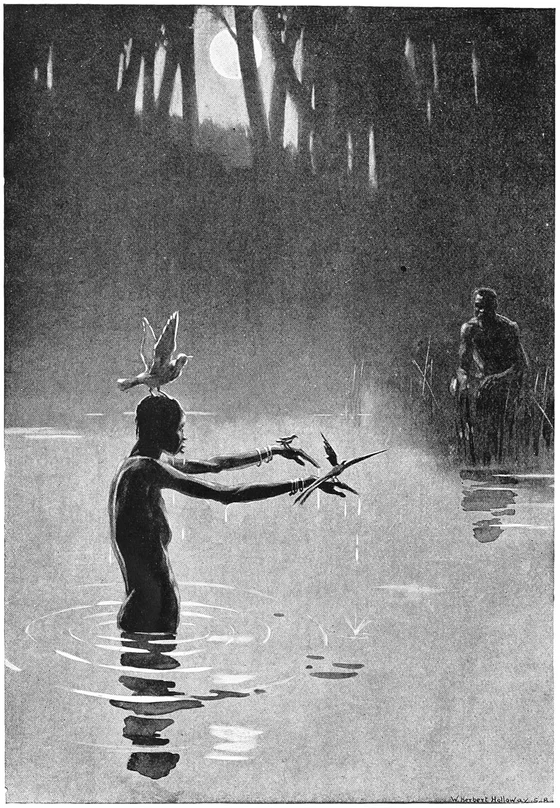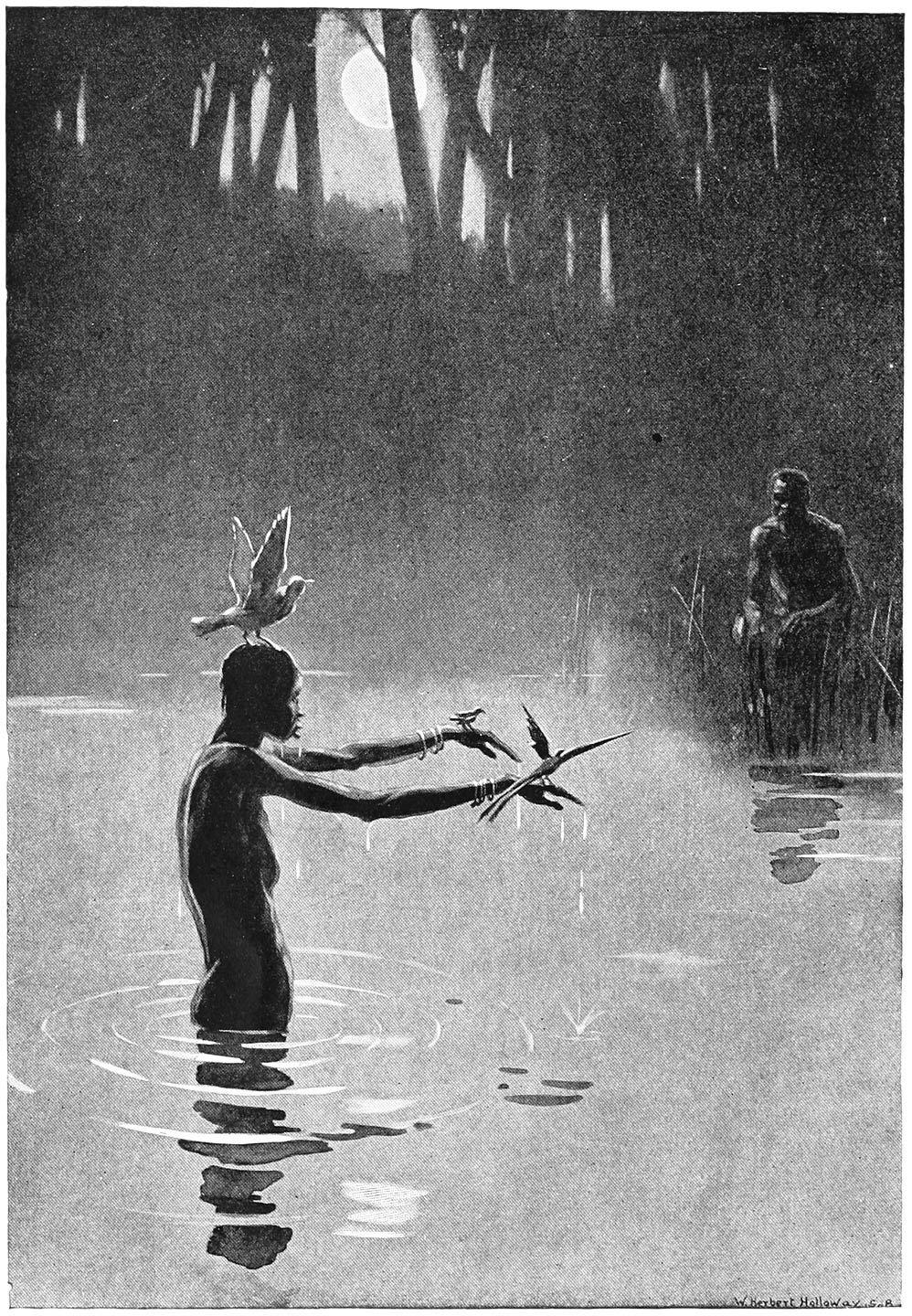
The pool fairy with three birds before Setuli, Holloway 1908
The old woman stands waist-deep in the pool with two birds on her hands and a third above her head. The monochrome illustration does not establish their colours or modern zoological identities.
Overview
The woman appears after golden orioles lead Setuli and his magician brother to a quiet pool. Its instructions require Setuli to wait without fear. First a huge alligator snaps near him; then an ogre covered in eyes roars and springs toward him. Both disappear after he remains motionless. At last a figure described by the arrangers as a Fairy rises and stands waist-deep in the water. She has an old woman’s shape, with a black sakobula on one hand, a rooibekkie on the other and a golden oriole on her head.
She commands him to speak three times. On the third utterance he can speak and understand her. She says she has known both brothers for a long time, directs him back to his brother and promises that future requests will be fulfilled. She vanishes and the three birds depart. Setuli then finds three bird companies, each led by one of those conspicuous birds, and interprets them as supplied for his use.
The later story shows the effects of the aid through shelter, provisions and bird regiments, but gives the woman no personal name or independent later marriage plot. The preceding alligator and many-eyed ogre are retained as apparitions in her testing sequence, not silently identified with the differently described one-legged enemy Setuli subsequently confronts.
Origins & earliest records
Sarah F. Bourhill and Beatrice L. Drake collected and arranged this English children’s retelling. Their preface says most stories came from Swazi contributors, others from Zulu and nearby communities, but gives no individual narrator for this episode. Its colonial generalizations are not adopted as community self-description.
Records & interpretation
Complete I. Setuli; or, the King of the Birds, printed pp. 1–17, read through the ending; collection title page, preface and chapter community label checked.
Selected bibliography
Documented works and useful reading. This is not a list of every appearance.
- 01
Fairy Tales from South Africa
I. Setuli; or, the King of the Birds, pp. 1–17; English literary arrangement for children, unnamed episode contributor.
Family & connections
A source-supported family tree or inspiration record has not yet been compiled for this profile. Related reading below indicates a connection in subject matter, not a proven lineage or creative influence.
Located primary passages
Specific passages supporting details in this entry, grouped by their published witness.
Primary source witness
Sarah F. Bourhill (Mrs. E. J. Bourhill) and Beatrice L. Drake (Mrs. J. B. Drake), Fairy Tales from South Africa, London: Macmillan, 1908, selected original title page and complete headed tales in PG75833. Introduction pp.v–xi says the tales are arranged for children from principally Swazi, also Zulu and border-region sources; individual contributors are not named for these episodes. Its colonial generalisations are attributed historical framing, not present ethnographic fact.
- After an alligator and a many-eyed pool ogre fail to frighten Setuli, a fairy appears as an old woman with three perched birds. Her spoken command grants Setuli speech and understanding. The text does not explicitly identify the earlier visitors as her transformations.
- The fairy offers future help and vanishes with her perched birds. Setuli subsequently recognises the same birds as leaders of three companies and receives their service. This published arrangement does not supply a named underlying narrator or local-language fairy designation.
No individual oral contributor or separate original-language manuscript inspected. Historical framing and translations are not universal current community consensus. Original facsimile not visually inspected in this batch.
References
Sources supporting this profile. Linked pages have their own scope and editorial standards.
- Collected historical tale in an English literary retellingBourhill and Drake — I. Setuli; or, the King of the BirdsResearch access: 2026-10-05
Image credits
Historical illustrationThe pool fairy with three birds before Setuli, Holloway 1908
The old woman stands waist-deep in the pool with two birds on her hands and a third above her head. The monochrome illustration does not establish their colours or modern zoological identities.