A sourced illustration has not yet been added. This gap is included in the coverage record.
Overview
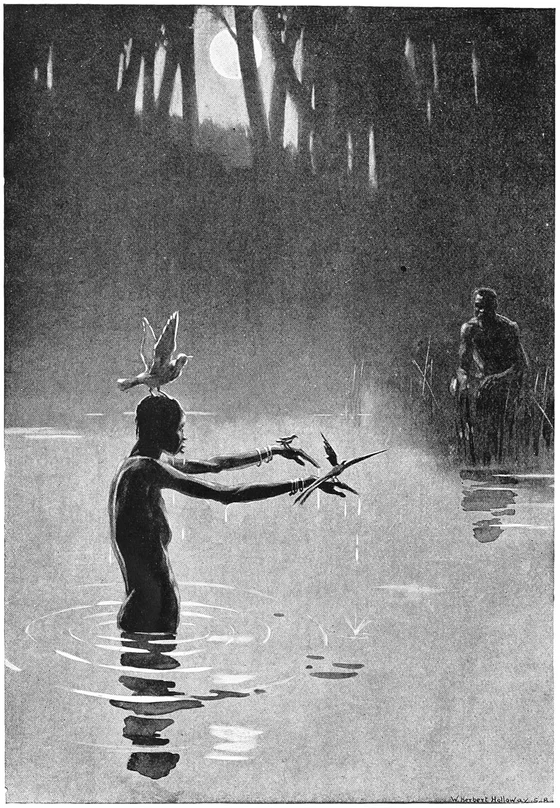
Invisible scouts discover a populous country whose inhabitants have one arm and one leg and cannot hear or speak. Approaching them begins to affect the scouts’ hearing and speech too. Setuli deduces that a powerful enemy governs them. He surrounds his camp with hunted birds and bird heads and hides behind a screen. At night a huge black figure hops into camp, stopping to eat at successive huts. It carries a long spear and has one arm and leg. One eye sits in its forehead and the other behind its head, preventing approach from a blind side.
The creature puts down its spear to eat near Setuli’s hut. Setuli takes the weapon and stabs its neck. It falls apparently dead. The country’s inhabitants regain ordinary two-legged bodies and speech, and leave with Setuli. Yet when he returns for his forgotten feather charm, the ogre is alive, surrounded by hundreds of one-armed, one-legged small ogres playing with the ball. Their disappearance when he touches it distinguishes them from permanent residents or a new independently chronicled species.
The large ogre remains and pursues him swiftly up the mountains. Setuli directs his company to leap an immense ravine and uses the feather ball to send the cattle across too. He crosses last, just as the exhausted pursuer reaches the edge. The episode supplies escape and separation by the ravine, without narrating a second killing. This creature is distinct from the many-eyed pool apparition encountered before Setuli received his powers.
Origins & earliest records
Sarah F. Bourhill and Beatrice L. Drake collected and arranged this English children’s retelling. Their preface says most stories came from Swazi contributors, others from Zulu and nearby communities, but gives no individual narrator for this episode. Its colonial generalizations are not adopted as community self-description.
Records & interpretation
Complete I. Setuli; or, the King of the Birds, printed pp. 1–17, read through the ending; collection title page, preface and chapter community label checked.
In the literature
“His eyes were divided”
I, p.12; two opposed eyes
The hostile ruler has one arm, one leg and two eyes, one on the forehead and one behind the head. Setuli steals the set-down spear and stabs his neck, leaving him apparently dead. This ruler is distinct from the earlier pool ogre covered with eyes.
Selected bibliography
Documented works and useful reading. This is not a list of every appearance.
- 01
Fairy Tales from South Africa
I. Setuli; or, the King of the Birds, pp. 1–17; English literary arrangement for children, unnamed episode contributor.
Family, evolution & connections
The ogre’s offspring in Setuli’s tale
Bourhill and Drake, chapter I, printed p. 14.
Scroll sideways to see all branches. With a keyboard, focus the tree and use the arrow keys.
- Unnamed small ogres (collective stated offspring)
The narrator expressly calls the large ogre father of the surrounding small ogres. The apparent death is reversed in the story. The offspring vanish when the feather-ball is recovered, but the passage does not explain their birth or name a mother. Their collective branch does not fabricate individual names or exact counts.
Unnamed small ogres in Setuli chapter I
After the apparently fatal stabbing, the revived ogre is surrounded by small ogres whom the narrator expressly describes as resembling their father. Their disappearance when Setuli retakes the ball does not establish a birth mechanism.
Located primary passages
Specific passages supporting details in this entry, grouped by their published witness.
Primary source witness
Sarah F. Bourhill (Mrs. E. J. Bourhill) and Beatrice L. Drake (Mrs. J. B. Drake), Fairy Tales from South Africa, London: Macmillan, 1908, selected original title page and complete headed tales in PG75833. Introduction pp.v–xi says the tales are arranged for children from principally Swazi, also Zulu and border-region sources; individual contributors are not named for these episodes. Its colonial generalisations are attributed historical framing, not present ethnographic fact.
- The hostile ruler has one arm, one leg and two eyes, one on the forehead and one behind the head. Setuli steals the set-down spear and stabs his neck, leaving him apparently dead. This ruler is distinct from the earlier pool ogre covered with eyes.
- Setuli finds the ruler alive, surrounded by many small one-armed, one-legged ogres explicitly called his children. The small beings vanish when Setuli recovers his feather-ball. The father pursues to a precipice, while Setuli and his company leap across. No final death or independent identity for the small ogres is supplied.
No individual oral contributor or separate original-language manuscript inspected. Historical framing and translations are not universal current community consensus. Original facsimile not visually inspected in this batch.
References
Sources supporting this profile. Linked pages have their own scope and editorial standards.
- Collected historical tale in an English literary retellingBourhill and Drake — I. Setuli; or, the King of the BirdsResearch access: 2026-10-05
Image credits
A sourced illustration has not yet been added. This gap is included in the coverage record.