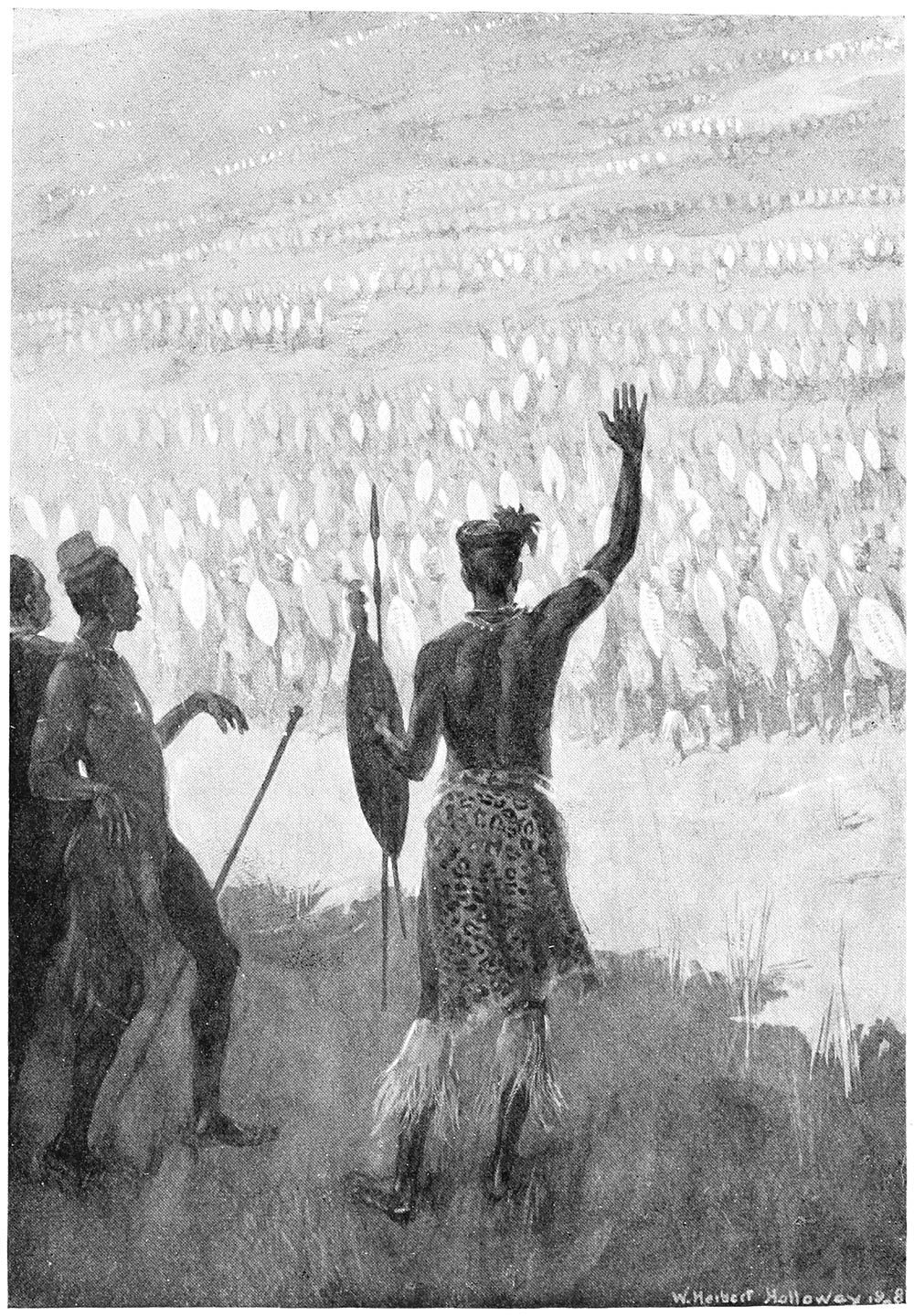
Setuli summons the transformed bird regiments on the hillside, Holloway 1908
The caption identifies Setuli’s command to summon his men; rows of shield-bearing warriors fill the hillside. They are the transformed bird companies of this particular tale, rather than a documentary view of a historical army.
Overview
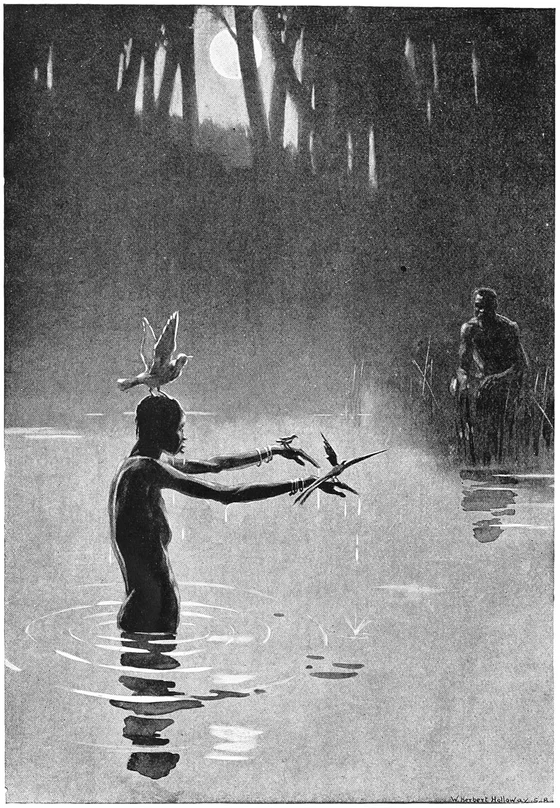
The first company consists of black, long-tailed sakobulas that move among low branches; the second consists of small brown rooibekkies with pink breasts and red bills. A third, golden company with black neck and wing markings leads the brothers toward the supernatural pool. When Setuli returns, each company has an especially beautiful leader matching one of the woman’s perched birds.
During an approaching hailstorm Setuli transforms all three companies with a word. Sakobulas become tall warriors in leopard skins with spears and ox-hide shields, retaining caps of their birds’ long tail feathers. Orioles become a bodyguard clothed in silver-jackal skins, with white ox-tail bracelets and ostrich plumes. Their golden leader becomes the chief general beneath Setuli. Rooibekkies become the small lads carrying baggage and attending the grown warriors.
The companies shelter in magically supplied huts, acclaim their chief and march under the three bird leaders. Later their scouts enter an enemy country using a potion supplied by his magician brother, rather than an innate invisibility assigned to all the birds. This is one army with three branches and named bird types, not a separately invented character for every regiment member. The historical English bird labels are retained as textual descriptions without importing exact zoological species names.
Origins & earliest records
Sarah F. Bourhill and Beatrice L. Drake collected and arranged this English children’s retelling. Their preface says most stories came from Swazi contributors, others from Zulu and nearby communities, but gives no individual narrator for this episode. Its colonial generalizations are not adopted as community self-description.
Records & interpretation
Complete I. Setuli; or, the King of the Birds, printed pp. 1–17, read through the ending; collection title page, preface and chapter community label checked.
In the literature
“changed them all with one word into warriors”
I, p.7; three companies transformed
Three distinct bird companies guide the brothers and later become Setuli’s first regiment, bodyguard and baggage-carrying youths. The transformed first group retains feather caps; the bodyguard has a distinct costume. The perched leaders become generals. No scientific species identification beyond the book’s historical common-name glosses is claimed.
Selected bibliography
Documented works and useful reading. This is not a list of every appearance.
- 01
Fairy Tales from South Africa
I. Setuli; or, the King of the Birds, pp. 1–17; English literary arrangement for children, unnamed episode contributor.
Family & connections
A source-supported family tree or inspiration record has not yet been compiled for this profile. Related reading below indicates a connection in subject matter, not a proven lineage or creative influence.
Located primary passages
Specific passages supporting details in this entry, grouped by their published witness.
Primary source witness
Sarah F. Bourhill (Mrs. E. J. Bourhill) and Beatrice L. Drake (Mrs. J. B. Drake), Fairy Tales from South Africa, London: Macmillan, 1908, selected original title page and complete headed tales in PG75833. Introduction pp.v–xi says the tales are arranged for children from principally Swazi, also Zulu and border-region sources; individual contributors are not named for these episodes. Its colonial generalisations are attributed historical framing, not present ethnographic fact.
- Three distinct bird companies guide the brothers and later become Setuli’s first regiment, bodyguard and baggage-carrying youths. The transformed first group retains feather caps; the bodyguard has a distinct costume. The perched leaders become generals. No scientific species identification beyond the book’s historical common-name glosses is claimed.
- Bird-derived followers accompany Setuli’s campaign and ravine escape. The later warriors summoned onto a hillside are described as another display of his power; the text does not explicitly equate every newly summoned warrior with an individually named member of the first bird companies.
No individual oral contributor or separate original-language manuscript inspected. Historical framing and translations are not universal current community consensus. Original facsimile not visually inspected in this batch.
References
Sources supporting this profile. Linked pages have their own scope and editorial standards.
- Collected historical tale in an English literary retellingBourhill and Drake — I. Setuli; or, the King of the BirdsResearch access: 2026-10-05
Image credits
Historical illustrationSetuli summons the transformed bird regiments on the hillside, Holloway 1908
The caption identifies Setuli’s command to summon his men; rows of shield-bearing warriors fill the hillside. They are the transformed bird companies of this particular tale, rather than a documentary view of a historical army.