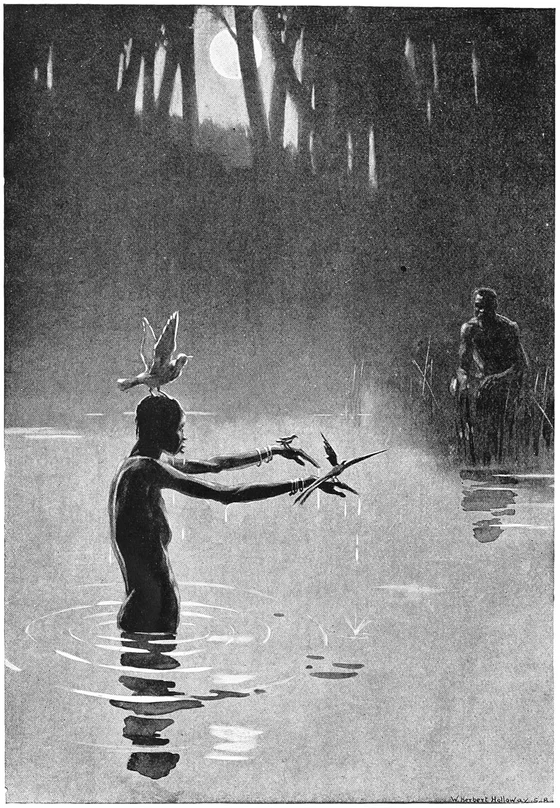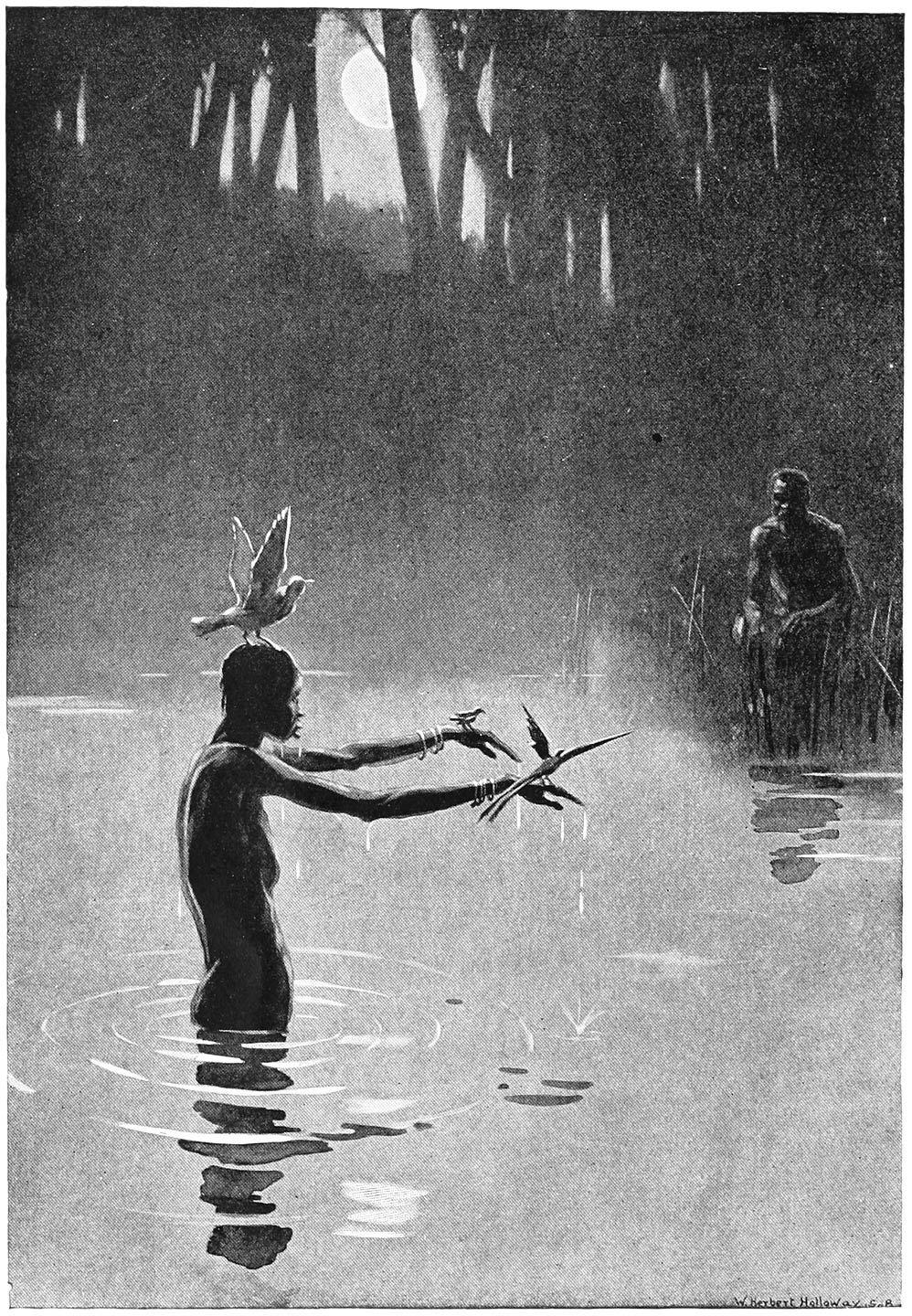
Setuli meets the bird-bearing pool fairy, Holloway 1908
Setuli stands at the right while the pool fairy holds two birds and wears a third on her head. This is the moment at which she restores his speech in Bourhill and Drake’s arranged tale.
Overview
Setuli is a chief’s son who has never heard or spoken and communicates through signs. His household disregards him except for an older brother, a magician who values his sharp sight and deft hands. While they gather roots, successive bird companies appear. Golden orioles lead them over the mountains to a pool, where Setuli remains still despite a snapping alligator and an eye-covered ogre. A supernatural old woman rises with three birds and commands him to speak. On her third command he gains speech and comprehension; she promises further help.
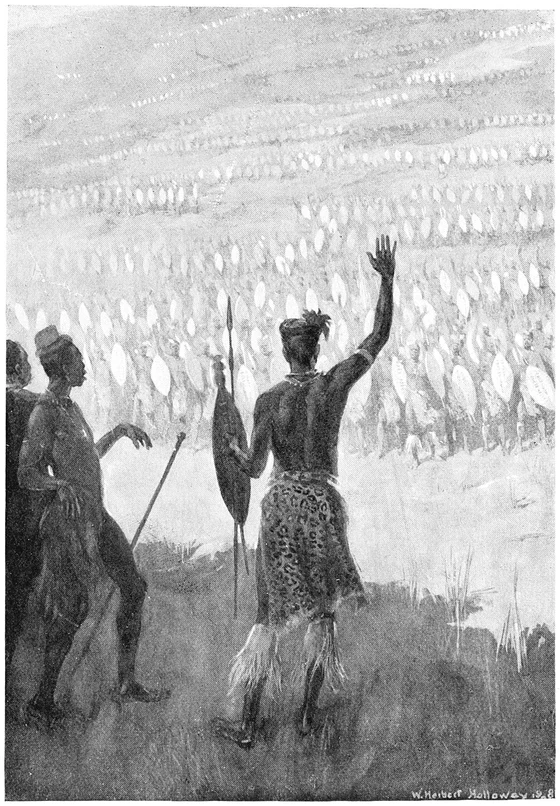
When a hailstorm threatens, he commands a thousand huts to appear and changes the bird companies into warriors and attendants. The sakobulas become a regiment, orioles a bodyguard and rooibekkies baggage-carrying lads. Food is supplied at his request. Later invisible scouts, aided by his brother’s potion, discover a country whose people have one arm and leg and cannot hear or speak; the scouts themselves begin losing those faculties near them. Setuli suspects a hostile ruler and prepares a bird feast as bait.
He takes a protective feather from every captured bird for a ball worn on his head. The arriving one-legged ogre puts down its spear to eat, and Setuli stabs it. Its apparent death releases the people from their enchantment. When he returns for his forgotten feather ball, however, it is alive with small ogres playing around it. His touch on the ball makes the small ones disappear, but the large one pursues. He orders his followers to leap a ravine and touches the cattle with the feather charm so that they leap safely too.
In a new valley he demonstrates power by making his warriors temporarily walk on one leg through spear taps, restoring them and commanding ranks to appear and disappear on a mountainside. Its ruler and people choose him as king. The helpful pool woman, his brother’s invisibility potion and his own granted commands have different narrative roles; the account does not attribute every spell to his deafness or present disability as a monstrous identity.
Origins & earliest records
Sarah F. Bourhill and Beatrice L. Drake collected and arranged this English children’s retelling. Their preface says most stories came from Swazi contributors, others from Zulu and nearby communities, but gives no individual narrator for this episode. Its colonial generalizations are not adopted as community self-description.
Records & interpretation
Complete I. Setuli; or, the King of the Birds, printed pp. 1–17, read through the ending; collection title page, preface and chapter community label checked.
Selected bibliography
Documented works and useful reading. This is not a list of every appearance.
- 01
Fairy Tales from South Africa
I. Setuli; or, the King of the Birds, pp. 1–17; English literary arrangement for children, unnamed episode contributor.
Family, evolution & connections
Setuli’s unnamed chief father
Chapter I identifies Setuli as a chief’s son. This is the protagonist’s stated family, not parentage of the birds or fairy who later aid him.
Setuli’s unnamed elder magician brother
The elder magician is repeatedly called Setuli’s brother. No common mother or precise full-versus-half sibling relationship is specified.
Located primary passages
Specific passages supporting details in this entry, grouped by their published witness.
Primary source witness
Sarah F. Bourhill (Mrs. E. J. Bourhill) and Beatrice L. Drake (Mrs. J. B. Drake), Fairy Tales from South Africa, London: Macmillan, 1908, selected original title page and complete headed tales in PG75833. Introduction pp.v–xi says the tales are arranged for children from principally Swazi, also Zulu and border-region sources; individual contributors are not named for these episodes. Its colonial generalisations are attributed historical framing, not present ethnographic fact.
- A Chief’s son, unsupported by most relatives but cared for by an elder magician brother, follows guiding birds to a pool. After fearlessly enduring threatening visitors, a fairy enables hearing and speech. He then summons shelter, changes three bird companies into differently equipped human units and supplies his followers. His initial disability is part of the arranged narrative, not an account of a medically verified cure.
I Setuli; or, the King of the Birds, pp.1–9; disability, pool encounter and power
- Setuli apparently kills a one-legged ruler, temporarily releases the ruler’s people and takes their cattle. Returning for a lost feather-ball reveals the ruler alive with small ogres. He escapes across a ravine with his followers and later demonstrates temporary one-leg walking and summoned warriors before another chief accepts him as king. The monster is not finally shown dead.
No individual oral contributor or separate original-language manuscript inspected. Historical framing and translations are not universal current community consensus. Original facsimile not visually inspected in this batch.
References
Sources supporting this profile. Linked pages have their own scope and editorial standards.
- Collected historical tale in an English literary retellingBourhill and Drake — I. Setuli; or, the King of the BirdsResearch access: 2026-10-05
Image credits
Historical illustrationSetuli meets the bird-bearing pool fairy, Holloway 1908
Setuli stands at the right while the pool fairy holds two birds and wears a third on her head. This is the moment at which she restores his speech in Bourhill and Drake’s arranged tale.