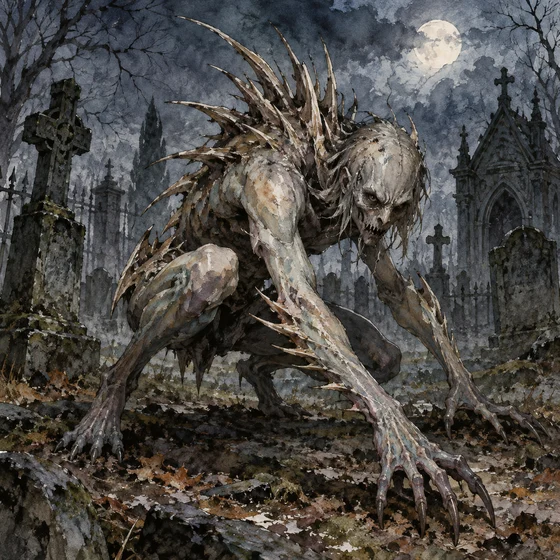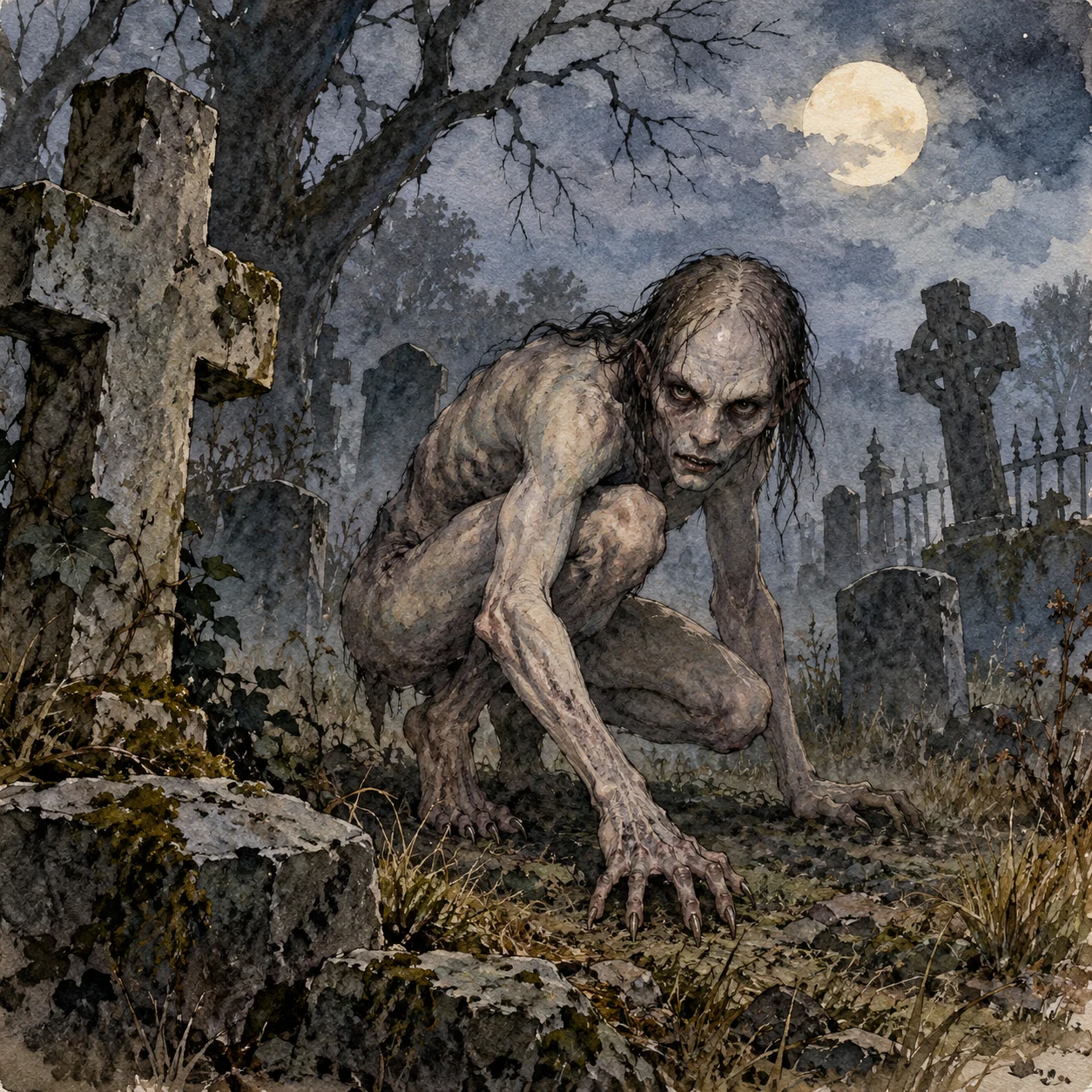
An imagined Ghoul crouching beside empty cemetery stones.
Unofficial AI-generated interpretation; undefined appearance, colours and setting are imagined. Not official artwork.
Overview
Ghouls are necrophages that gather where human remains are available, including graves, crypts and battlefields. Their limbs and faces suggest a disturbing human resemblance, but their low, animal-like movement and hunger define the game encounter. Carrion feeding does not mean they harmlessly wait for bodies: they can attack the living, particularly in groups. The relationship between war and plentiful corpses gives them an ecological place in devastated landscapes.
The Witcher games connect their feeding grounds with a witcher's ordinary cleanup work around settlements and routes. Wild Hunt also describes stronger aggression from wounded individuals, while Alghouls can make a group more dangerous through leadership. This entry separates the broader Ghoul type from that more intelligent relative and does not assume that every traditional ghoul or undead human in another setting shares its anatomy. Exact combat statistics and drop chances are not treated as timeless species facts.
First appearances & development
The selected version is 2007 and 2015 game. CD Projekt RED's games adapt Sapkowski's setting while adding their own creature designs, quest histories and combat classifications. This profile identifies those game treatments, rather than asserting that every detail originates in the novels. Spellings and named variants remain within the same account unless a substantive independent comparison is required.
Canon & continuity
The Witcher Wiki is an independent reference, and its public MediaWiki API supplied the version-labeled bestiary text and relevant quest accounts. Publisher-hosted Prima guide excerpts provide additional context where listed. The bibliography identifies the actual game or reference chapter; it does not imply a complete audit of every novel, expansion, patch, screen adaptation or full guidebook.
Selected bibliography
Documented works and useful reading. This is not a list of every appearance.
- 01
The Witcher
Necrophage encounters and early game bestiary.
- 02
The Witcher 3: Wild Hunt
Bestiary connects group feeding with graves, battlefield remains and living prey.
Family, evolution & connections
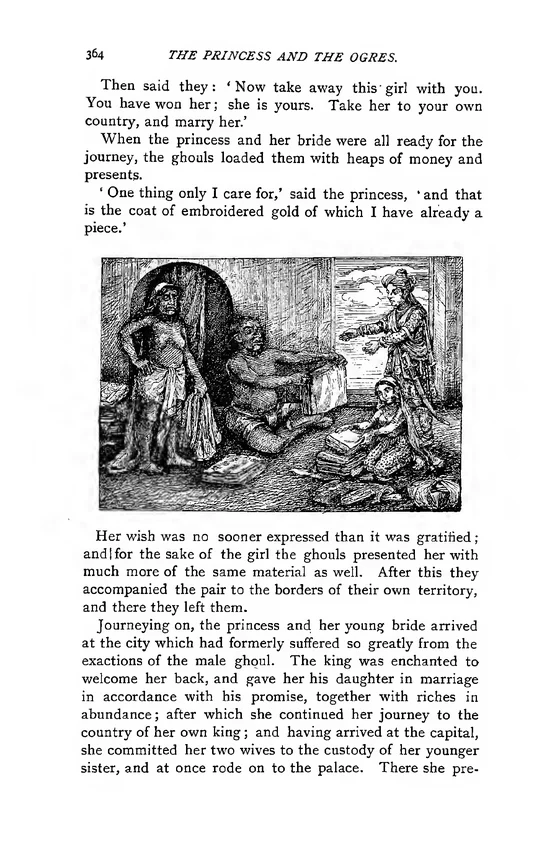
Ghoul spouses in The Princess and the Ogres
Ghouls are necrophages that gather where human remains are available, including graves, crypts and battlefields. Corpse-feeding demon couple reconciled with their conqueror in Swynnerton’s 1892 collection. Comparison only; no creator-source route established.
Female ghoul in Lang’s Sidi-Nouman
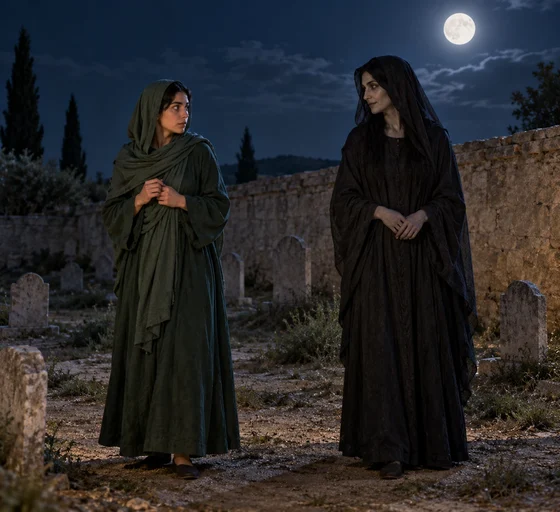
Lang’s selected Sidi-Nouman tale describes an unnamed female ghoul sharing a cemetery meal with Amina. The companion is distinct from the wife who later performs the transformations. This single literary namesake context establishes no shared biology, identical character role or creator-consulted source.
Ghúlah in Burton’s Prince and Ogress tale
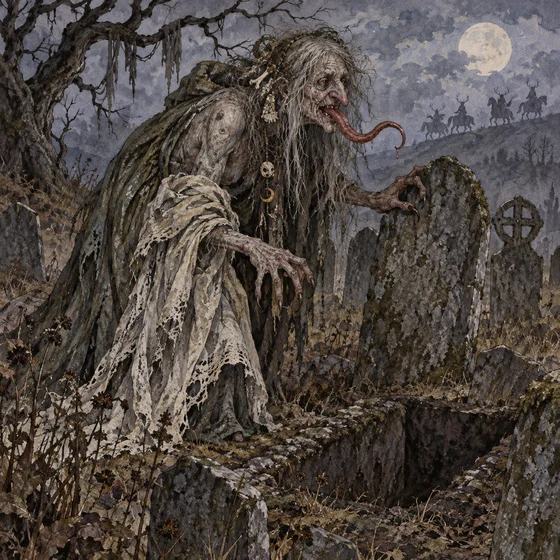
Burton’s tale explicitly names a Ghúlah who pretends to be a stranded princess and offers a living traveller to her brood. This supplies a tale-specific ghoul namesake context, without establishing a creator source, shared identity or equivalent rules in the modern work.
References
Sources supporting this profile. Linked pages have their own scope and editorial standards.
- ReferenceGhoul (The Witcher) — reference guideResearch access: 2026-10-05
Image credits
Modern interpretationAn imagined Ghoul crouching beside empty cemetery stones.
Unofficial AI-generated interpretation; undefined appearance, colours and setting are imagined. Not official artwork.