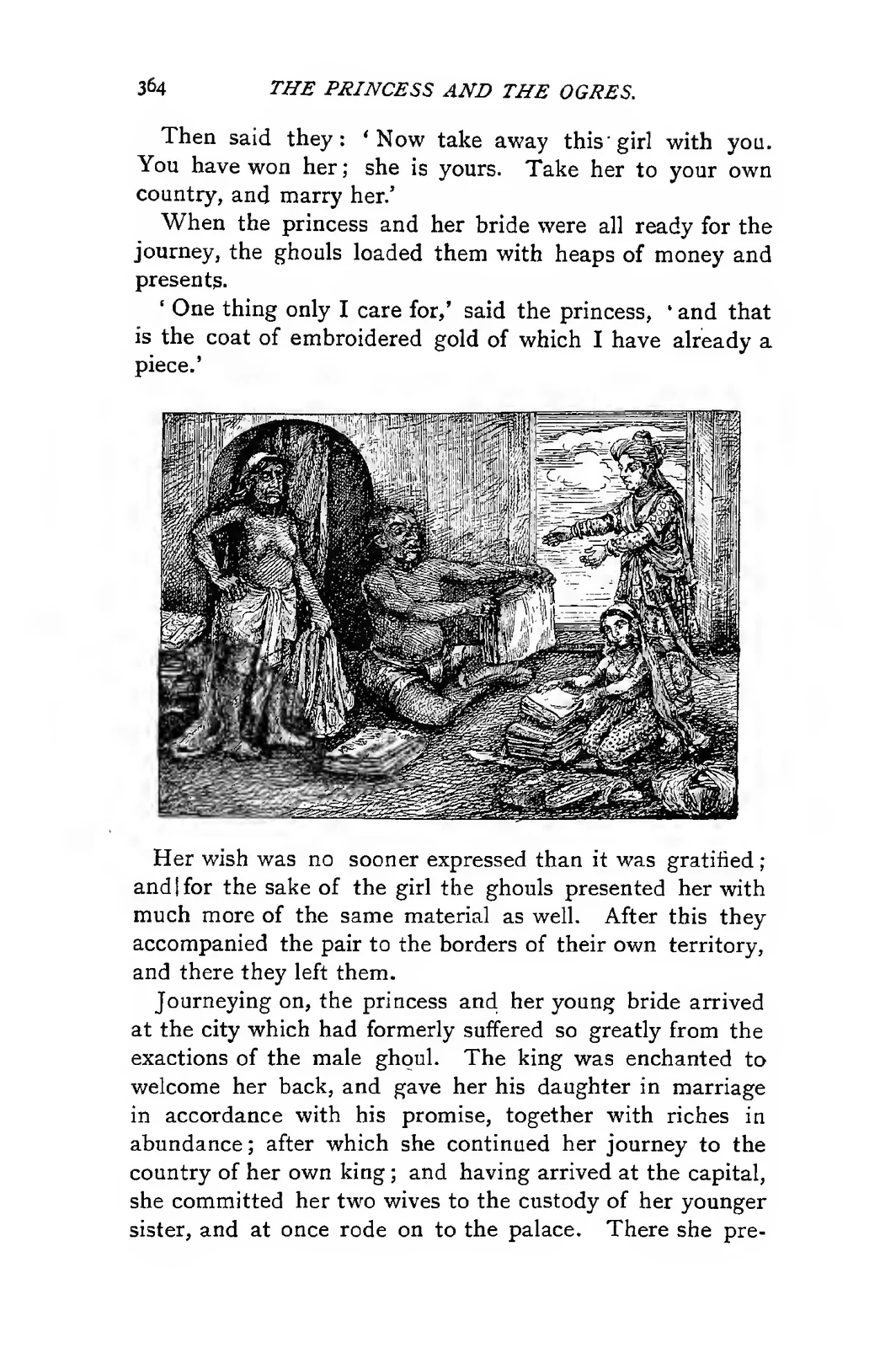
The ghoul spouses give embroidered cloth and gifts to the disguised princess and her bride, original 1892 illustration
The male and female ghouls give cloth and gifts to the princess disguised as a man and the girl they kidnapped. Their appearance belongs to this specific illustration of The Princess and the Ogres; the male’s missing leg is an injury in the story, rather than an original trait of all ghouls.
Overview
An abandoned princess, disguised as a man and employed as a royal guard, follows wailing into a forest and finds a gaunt woman beneath a hanged robber. The narrator identifies her as a female ghoul, a demon in human form. Claiming that the corpse is her son, she asks to be lifted so she may kiss it, then bites its neck and sucks blood. The princess drops her and strikes, cutting only a piece from her richly embroidered coat before she escapes.
Sent to obtain more of the cloth, the princess enters another kingdom where a mountain ghoul exacts a human victim, a buck goat and two hundred pounds of bread every eighth day. She substitutes a dressed log for the victim and hides in a pit. When the gigantic male ghoul seizes the log, she cuts off one leg; he escapes to the hills on the other. His one-legged condition is thus an injury within the story, not an original species trait.
At a distant fortress she meets a girl whom two married ghouls stole as a baby. Their conversation reveals that they are the same female and male she defeated. Each admires the courage of the supposed man responsible and wants him as the girl’s husband. After promising not to kill the visitor, they recognize the princess and honor their word. They give the captive girl, valuable gifts and the desired embroidered cloth, then escort the departing pair to their borders.
The ghouls survive and cease being immediate adversaries. The princess later reveals her disguise, reunites with her own husband and arranges marriages for the two women she had accepted as brides. The kidnapped girl is not called the ghouls’ biological daughter, and the dead robber’s alleged kinship is part of the female’s feeding ruse. Swynnerton’s comparison with a vampire explains her corpse-feeding in English; it does not establish identity with every vampire tradition or with the separate fate-woman at the tale’s beginning.
Origins & earliest records
Upper Indus Panjabi tales in Charles Swynnerton’s English collection
Records & interpretation
Complete tale and footnotes read; key original printed pages visually checked.
Selected bibliography
Documented works and useful reading. This is not a list of every appearance.
- 01
Indian Nights’ Entertainment; or, Folk-Tales from the Upper Indus
LXXXV, The Princess and the Ogres, pp.351–368, including closing footnote
Family, evolution & connections
Male and female ghouls of Swynnerton LXXXV
The captive girl states that one ghoul is the other’s husband on p. 361. Their separate earlier encounters concern this same couple; no common parents, biological children or species-wide one-legged trait are supplied.
Unnamed girl stolen as a baby in Swynnerton LXXXV
The ghouls expressly say they stole the girl as a baby. Their plan to find her a husband establishes control of her household situation, not biological parentage or a narrated adoption ceremony.
Primary records and illustrations
Charles Swynnerton, Indian Nights’ Entertainment (1892)
1892 edition. LXXXV, The Princess and the Ogres, pp.351–368, including closing footnote
Full swynnerton1892-ch85.txt including complete ending/footnote read. Original pages342/344/347/351/355/364 viewed and retained as swynnerton1892-pNNN.png. Distinct actors and transformations not merged.
References
Sources supporting this profile. Linked pages have their own scope and editorial standards.
- Historical primary English translationCornell scan of Swynnerton (1892), LXXXV, The Princess and the Ogres, pp.351–368, including closing footnoteResearch access: 2026-10-05
Image credits
Historical illustrationThe ghoul spouses give embroidered cloth and gifts to the disguised princess and her bride, original 1892 illustration
The male and female ghouls give cloth and gifts to the princess disguised as a man and the girl they kidnapped. Their appearance belongs to this specific illustration of The Princess and the Ogres; the male’s missing leg is an injury in the story, rather than an original trait of all ghouls.