
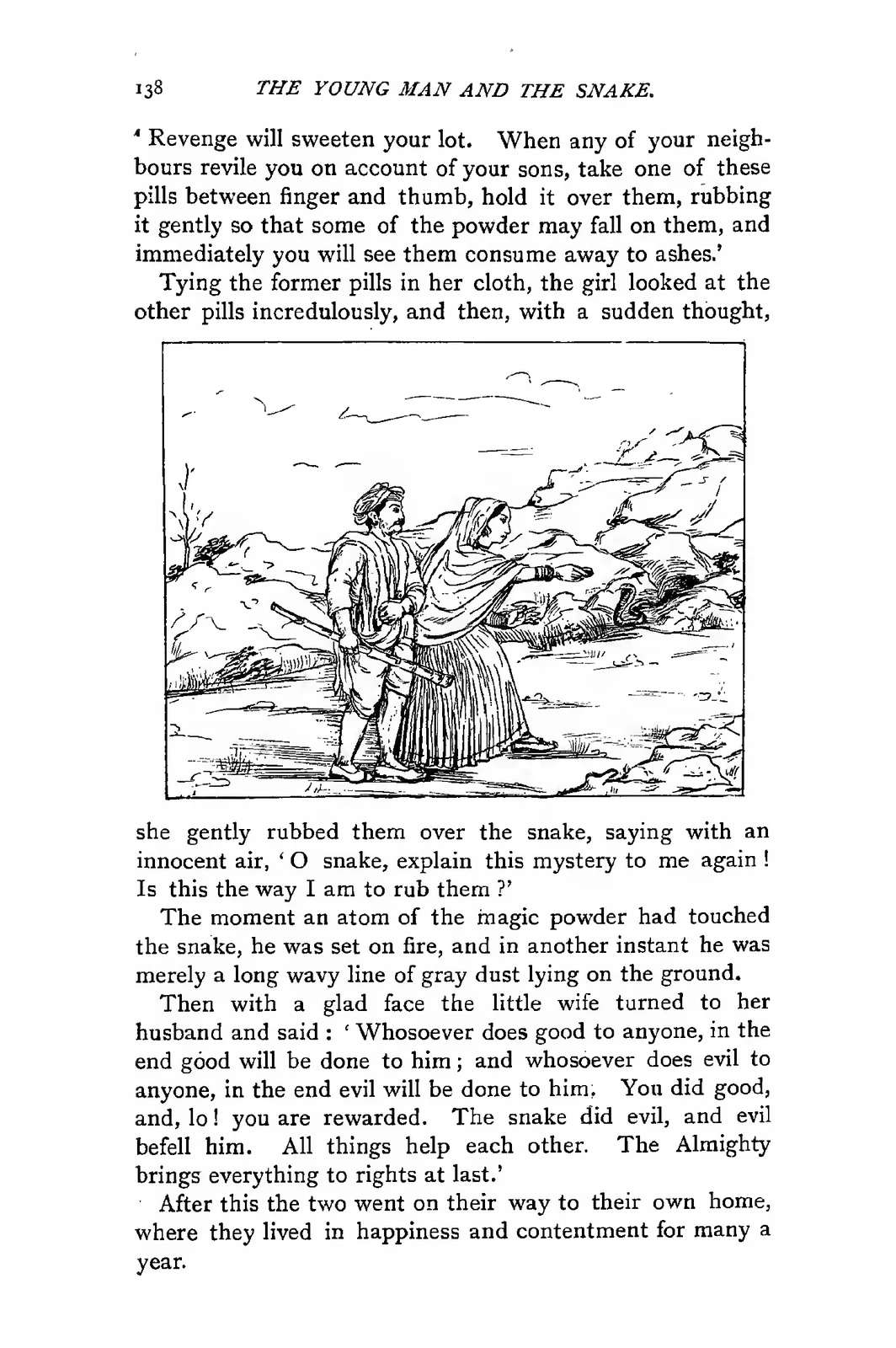
Original 1892 page illustrating the bride sprinkling the enormous serpent with its own destructive powder
The drawing shows the bride testing the snake’s destructive pills on the serpent in The Young Man and the Snake. The whole original page is retained. This is the particular Upper Indus tale published by Swynnerton in 1892, rather than a universal nāga portrait.
Overview
A young man on his way to marry rescues an enormous snake from a mongoose by killing its attacker. The snake responds by coiling around him and announcing that it will eat him: in its forest, it says, good deeds must be repaid with harm. It nevertheless grants eight days for his journey. The youth returns as promised, accompanied by his bride, who refuses to abandon him.
The snake refers her to five talli-trees for an explanation. One tree recounts how a sixth sheltered a thief but was cut down after the rescued man revealed its valuable fragrance. The dying tree decreed the forest’s rule of ingratitude. Having heard this, the bride argues that killing her husband would injure her although she has done the snake neither good nor harm. The snake offers two magical pills, promising that if she swallows them she will have two sons to comfort and support her.
She objects that children without an acknowledged husband would damage her reputation. The snake gives two further pills whose powder, it says, can reduce abusive neighbors to ashes. Pretending to ask how they work, she rubs this second gift over the snake. A particle sets it alight, leaving only a wavy line of gray dust. Husband and wife return safely home. The promised births are never tested; the destructive powder’s effect is actually narrated. Although Swynnerton’s classification calls this a Naga-King type, the story itself supplies no personal name or royal title for the serpent.
Origins & earliest records
Upper Indus Panjabi tales in Charles Swynnerton’s English collection
Records & interpretation
Complete tale read in retained primary OCR; critical printed passages checked against original scan images.
Selected bibliography
Documented works and useful reading. This is not a list of every appearance.
- 01
Indian Nights’ Entertainment; or, Folk-Tales from the Upper Indus
XLII, The Young Man and the Snake, pp.133–138, including p.136 footnote
Family & connections
A source-supported family tree or inspiration record has not yet been compiled for this profile. Related reading below indicates a connection in subject matter, not a proven lineage or creative influence.
Primary records and illustrations
Charles Swynnerton, Indian Nights’ Entertainment (1892)
1892 edition. XLII, The Young Man and the Snake, pp.133–138, including p.136 footnote
Complete swynnerton1892-ch42.txt retained/read; title image leaf8 verified. Critical printed pages9,137–138,301,304 independently viewed in retained PNGs. Native-name equivalents and modern species not supplied.
References
Sources supporting this profile. Linked pages have their own scope and editorial standards.
- Historical primary English translationCornell scan of Swynnerton (1892), XLII, The Young Man and the Snake, pp.133–138, including p.136 footnoteResearch access: 2026-10-05
Image credits
Historical illustrationOriginal 1892 page illustrating the bride sprinkling the enormous serpent with its own destructive powder
The drawing shows the bride testing the snake’s destructive pills on the serpent in The Young Man and the Snake. The whole original page is retained. This is the particular Upper Indus tale published by Swynnerton in 1892, rather than a universal nāga portrait.