A sourced illustration has not yet been added. This gap is included in the coverage record.
Overview
Five talli-trees stand in the forest where a snake intends to devour the young man who rescued it. Asked to explain this reversal of gratitude, the middle tree tells a bride that there were formerly six trees, arranged in three pairs. The missing tree was hollow. When a thief fled into its trunk and begged for protection, it closed its sides around him until his pursuers left, then opened to release him.
The sheltered man carried away a lasting sandalwood fragrance. Threatened by a king who wanted the scent, he disclosed the source and led the king to his refuge. When orders were given to cut it down, the tree lamented that saving a human life would cost its own. It decreed that anyone doing good in that jungle should thereafter receive evil in return. The surviving tree presents this betrayal as the origin of the rule invoked by the snake.
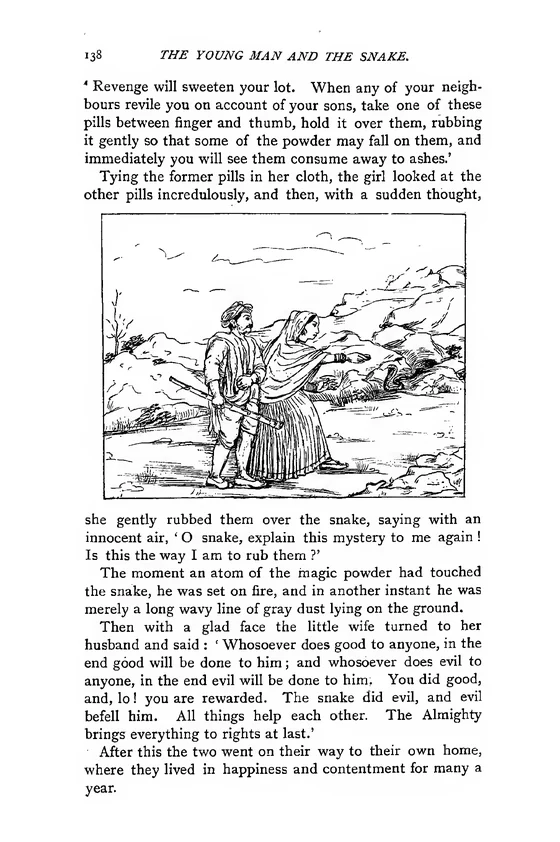
The bride ultimately defeats the snake with its own destructive gift, but the text does not describe the felled tree’s restoration or a formal lifting of its decree. The tree’s enclosing trunk and speech are explicit; a separate resident spirit is not identified. A footnote reports the belief that old talli or sisam trees develop sandalwood, which is part of the collector’s account rather than a botanical fact established here. The surviving speaker and its destroyed companion remain distinct.
Origins & earliest records
Upper Indus Panjabi tales in Charles Swynnerton’s English collection
Records & interpretation
Complete tale read in retained primary OCR; critical printed passages checked against original scan images.
Selected bibliography
Documented works and useful reading. This is not a list of every appearance.
- 01
Indian Nights’ Entertainment; or, Folk-Tales from the Upper Indus
XLII, The Young Man and the Snake, pp.133–138; embedded tree account pp.135–137
Family & connections
A source-supported family tree or inspiration record has not yet been compiled for this profile. Related reading below indicates a connection in subject matter, not a proven lineage or creative influence.
Primary records and illustrations
Charles Swynnerton, Indian Nights’ Entertainment (1892)
1892 edition. XLII, The Young Man and the Snake, pp.133–138; embedded tree account pp.135–137
Complete swynnerton1892-ch42.txt retained/read; title image leaf8 verified. Critical printed pages9,137–138,301,304 independently viewed in retained PNGs. Native-name equivalents and modern species not supplied.
References
Sources supporting this profile. Linked pages have their own scope and editorial standards.
- Historical primary English translationCornell scan of Swynnerton (1892), XLII, The Young Man and the Snake, pp.133–138; embedded tree account pp.135–137Research access: 2026-10-05
Image credits
A sourced illustration has not yet been added. This gap is included in the coverage record.