
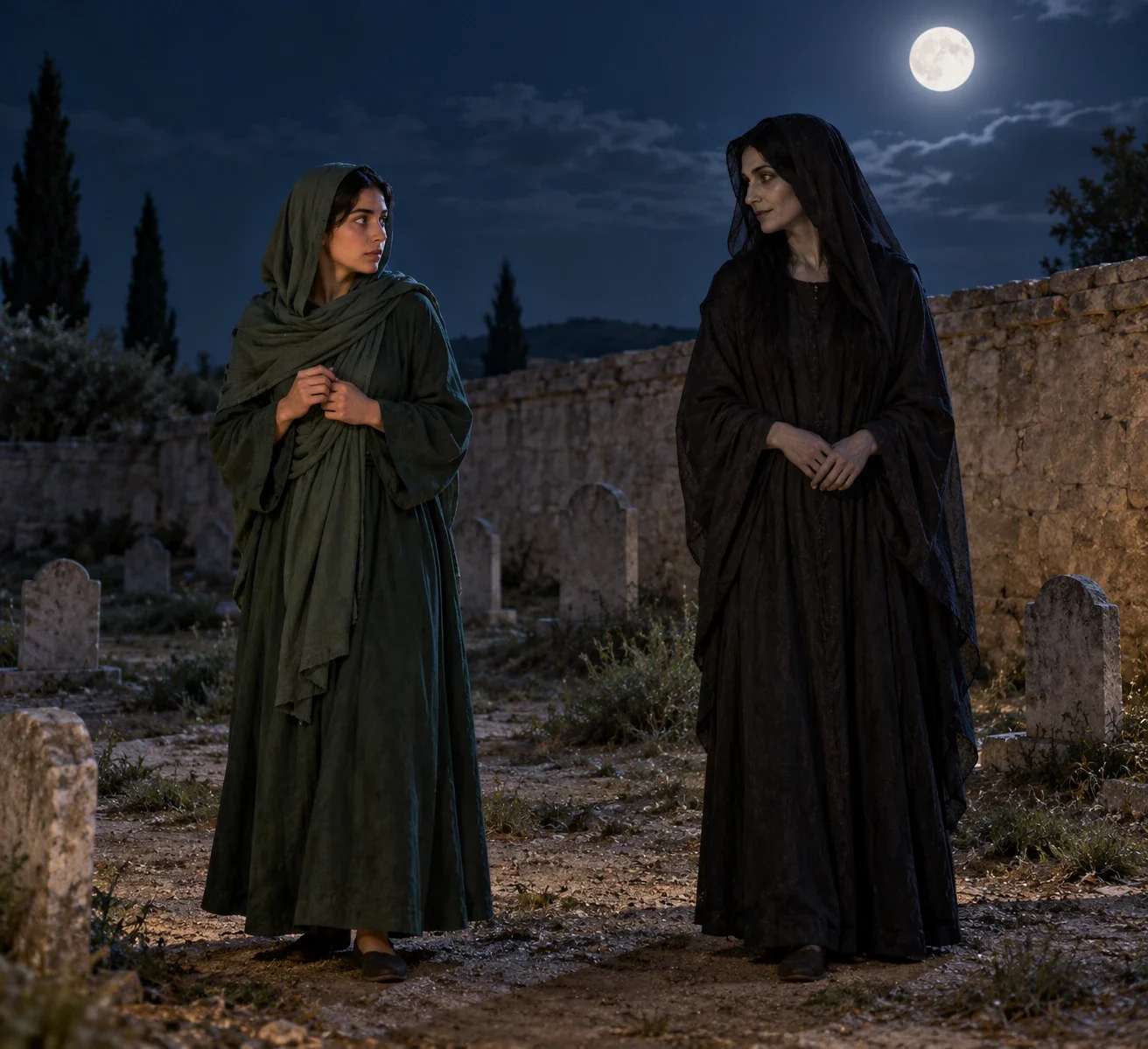
AI-generated interpretation of a calm moment preceding the cemetery encounter in Lang’s selected Sidi-Nouman tale. Amina at left and her unnamed ghoul companion at right remain separate characters. Human-shaped anatomy, faces, skin tones, hair, robes and shoes, wall, grave markers, vegetation, positions and lighting are imagined; no authentic costume, fixed ghoul anatomy or historical portrait is claimed.
No corpse or violence shown. The chosen preceding moment and ordinary human-shaped ghoul are illustrative inventions, not a literal described pose or universal cultural representation.
Overview
In Andrew Lang’s selected English Arabian Nights, an unnamed female ghoul appears during Sidi-Nouman’s account of his marriage to Amina. The story begins before the Caliph, who demands an explanation for the young man’s repeated mistreatment of a horse. Sidi-Nouman’s explanation leads backwards to his wife’s strange refusal to eat ordinary meals. She picks up individual rice grains with a pin and scarcely touches anything else. His uncertainty about her appetite motivates the nocturnal pursuit that reveals her companion.
Sidi-Nouman follows Amina in bright moonlight to a cemetery and hides beneath its wall. He sees her approaching with a female ghoul. His narration interrupts the encounter to explain ghouls as demons that inhabit deserted buildings, ambush travellers and resort to graves when living victims are unavailable. This is the tale’s own generalizing explanation, not an independently established description of Arabic belief. The two companions uncover a recently buried body, eat together and converse. Sidi-Nouman cannot hear their words. They subsequently return the body to the grave and replace the earth; he leaves without confronting them.
The narrative explicitly distinguishes Amina from the ghoul accompanying her. The following day, his indirect reference to corpse flesh exposes his discovery. Amina sprinkles water on him and transforms him into a dog. The chapter attributes that magic to his wife, not to the unnamed companion. His adventures then move through a cookshop and a kinder baker’s household. His ability to distinguish counterfeit coins draws a woman’s attention, and her daughter restores his human form. That daughter identifies Amina as a fellow student of magic.
The ending returns to the horse that prompted the Caliph’s question: Sidi-Nouman uses the helper’s instructions to transform Amina, and the Caliph urges him to regard the transformation itself as sufficient punishment. The ghoul does not return for this resolution, and the chapter supplies neither her later fate nor her physical construction beyond its female designation and the narrator’s expression of horror. Keeping the companion separate from Amina preserves the difference between the graveyard encounter and the tale’s later transformations. It also prevents this single English literary selection from becoming a universal ghoul life cycle.
Origins & earliest records
The Story of Sidi-Nouman, in The Arabian Nights Entertainments, selected and edited by Andrew Lang. The cached electronic title states after the edition of Longmans, Green and Co., 1918 (1898). Lang is credited as selector/editor, not asserted to have translated directly from Arabic.
Records & interpretation
Complete chapter read from Caliph’s opening question through the graveyard, dog transformation, bakery, restoration, Amina’s transformation and final Caliph response. No Arabic original or complete Nights tradition collated. The unnamed ghoul and the wife-magician remain separate characters.
Selected bibliography
Documented works and useful reading. This is not a list of every appearance.
- 01
The Arabian Nights Entertainments, selected and edited by Andrew Lang: The Story of Sidi-Nouman
Complete selected chapter; edition declaration verified in cached header, not original print scan. English selection/adaptation; no direct Arabic translation claim.
Family, evolution & connections
Ghoul (Warcraft)
Lang’s selected Sidi-Nouman tale describes an unnamed female ghoul sharing a cemetery meal with Amina. The companion is distinct from the wife who later performs the transformations. This single literary namesake context establishes no shared biology, identical character role or creator-consulted source.
Ghoul (The Witcher)
Lang’s selected Sidi-Nouman tale describes an unnamed female ghoul sharing a cemetery meal with Amina. The companion is distinct from the wife who later performs the transformations. This single literary namesake context establishes no shared biology, identical character role or creator-consulted source.
References
Sources supporting this profile. Linked pages have their own scope and editorial standards.
- Historical English literary selectionThe Arabian Nights Entertainments, selected and edited by Andrew Lang: The Story of Sidi-NoumanResearch access: 2026-10-24
Image credits
Modern interpretation of one English literary taleAI-generated interpretation of a calm moment preceding the cemetery encounter in Lang’s selected Sidi-Nouman tale. Amina at left and her unnamed ghoul companion at right remain separate characters. Human-shaped anatomy, faces, skin tones, hair, robes and shoes, wall, grave markers, vegetation, positions and lighting are imagined; no authentic costume, fixed ghoul anatomy or historical portrait is claimed.
No corpse or violence shown. The chosen preceding moment and ordinary human-shaped ghoul are illustrative inventions, not a literal described pose or universal cultural representation.