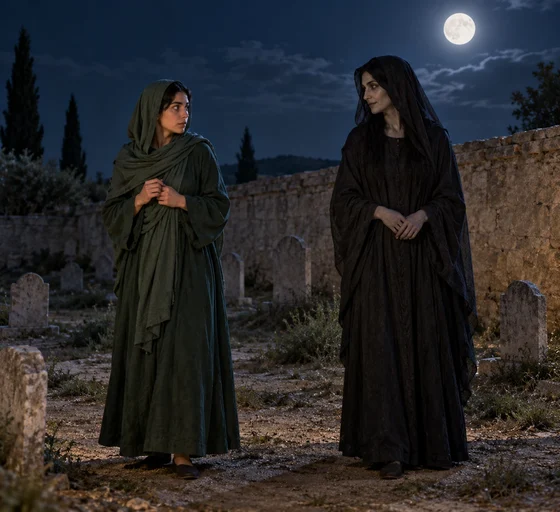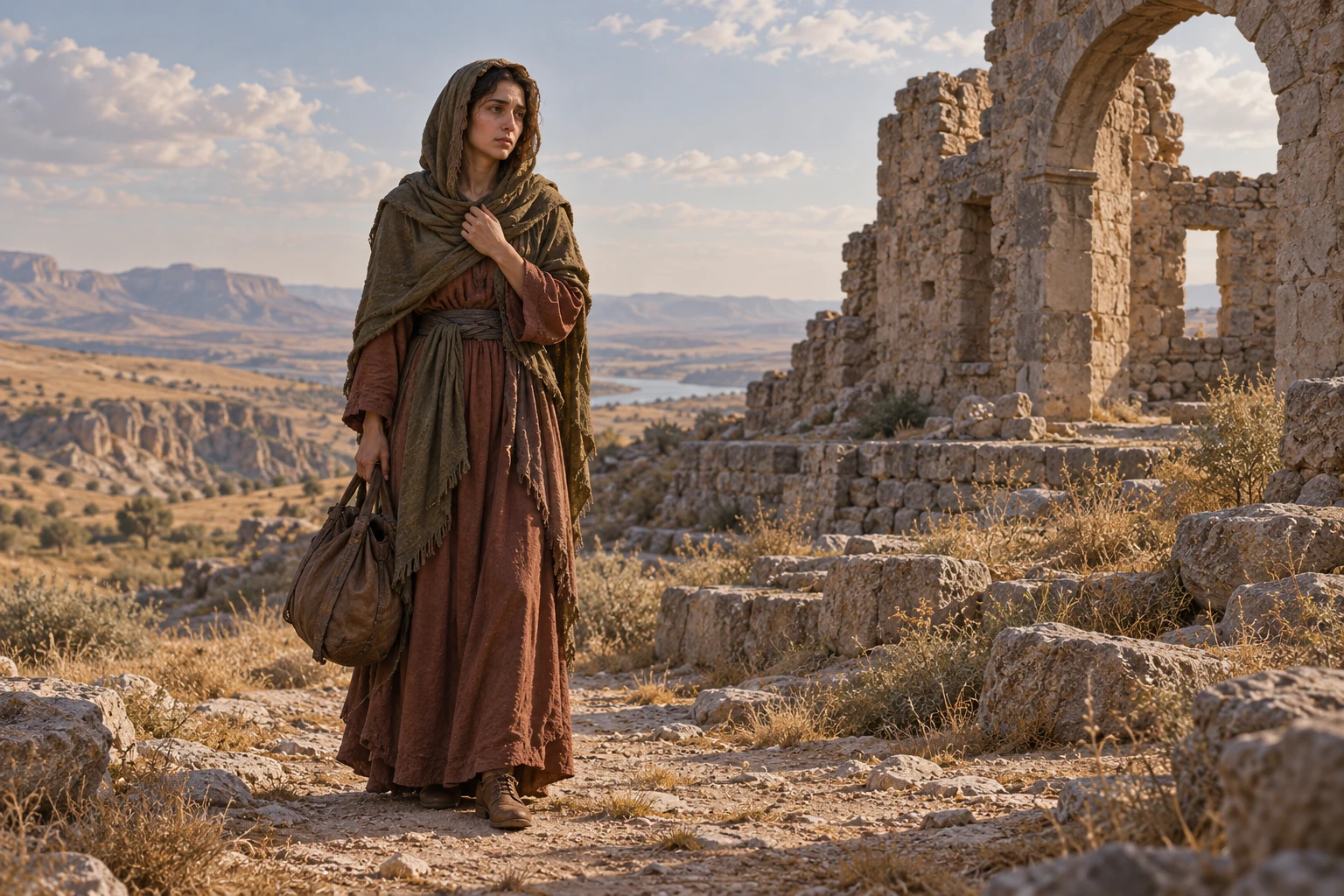
AI-generated interpretation of the Ghúlah in her reported human disguise. Face, clothes, bag, pose, architecture and landscape are imagined. The tale supplies no separate monstrous anatomy; this is neither an ethnographic portrait nor a Witcher design.
Her claimed royal ancestry is a deception within the tale, not an established identity of the depicted woman.
Overview
In Burton’s tale a king orders a minister to accompany his hunting son wherever he goes. The minister urges the prince after a wild animal, but the chase leaves him alone and lost. A crying young woman then claims to be the daughter of a king of Hind. She says that she fell asleep while travelling with a caravan, fell from her mount and became separated from her people. The prince takes pity on her and lets her ride behind him. Her royal identity and account of her misfortune are part of her deception, not the narrator’s confirmation of her origin.
At an old ruin she asks to dismount and goes inside. When her absence becomes suspicious, the prince follows unnoticed and hears her offering him to her hungry children as their meal. The narrator explicitly identifies her as a Ghúlah, translated here as an ogress. The scene establishes a predatory household and a trap for a living traveller. It does not describe a cemetery encounter, feeding on corpses, or a particular monstrous body beneath the woman’s disguise.
The Ghúlah finds the prince trembling and asks what he fears. He answers indirectly that an enemy threatens his life. Her suggestion that he appease the enemy with money is useless, he says, because the enemy wants his life rather than his purse. She then advises him to seek divine protection. The prince prays to Allah for deliverance; on hearing the prayer she turns away, and he returns to his father. The king hears his account and kills the minister. The tale does not say that the prince kills the Ghúlah or her children.
This short narrative is embedded in the Wazir’s warning to King Yunan about the physician Duban. Its ending returns to that warning rather than following the Ghúlah further. Burton’s accompanying note places the name beside numerous beings from other traditions; those comparisons are the translator’s interpretation, not additional characters or acts in this tale. This account remains distinct from the female ghoul in Lang’s Sidi-Nouman and from Swynnerton’s corpse-feeding spouses.
Origins & earliest records
Richard F. Burton, The Book of the Thousand Nights and a Night, Volume I, Shammar edition, The Tale of the Prince and the Ogress, printed pp. 54–55; associated notes 95–97. The consulted title page is undated.
Records & interpretation
Complete inner tale read from the king’s hunting instruction to the minister’s death, together with its immediate transition back to the Wazir and King Yunan and all three attached notes. No full-volume or Arabic-manuscript collation claimed.
Selected bibliography
Documented works and useful reading. This is not a list of every appearance.
- 01
The Book of the Thousand Nights and a Night, Volume I: The Tale of the Prince and the Ogress
Complete inner narrative pp. 54–55, not the entire enclosing Duban and fisherman cycles; notes 95–97 read separately.
Family, evolution & connections
Ghoul (The Witcher)
Burton’s tale explicitly names a Ghúlah who pretends to be a stranded princess and offers a living traveller to her brood. This supplies a tale-specific ghoul namesake context, without establishing a creator source, shared identity or equivalent rules in the modern work.
Female ghoul in Lang’s Sidi-Nouman
Burton’s disguised mother traps a living traveller for her brood, whereas the Sidi-Nouman account presents a cemetery ghoul. They are distinct literary witnesses rather than a single biography or fixed description.
References
Sources supporting this profile. Linked pages have their own scope and editorial standards.
- Historical English literary translationBurton, The Book of the Thousand Nights and a Night I: Tale of the Prince and the Ogress, pp. 54–55; notes 95–97Research access: 2026-10-25
Image credits
Modern interpretation of a literary taleAI-generated interpretation of the Ghúlah in her reported human disguise. Face, clothes, bag, pose, architecture and landscape are imagined. The tale supplies no separate monstrous anatomy; this is neither an ethnographic portrait nor a Witcher design.
Her claimed royal ancestry is a deception within the tale, not an established identity of the depicted woman.