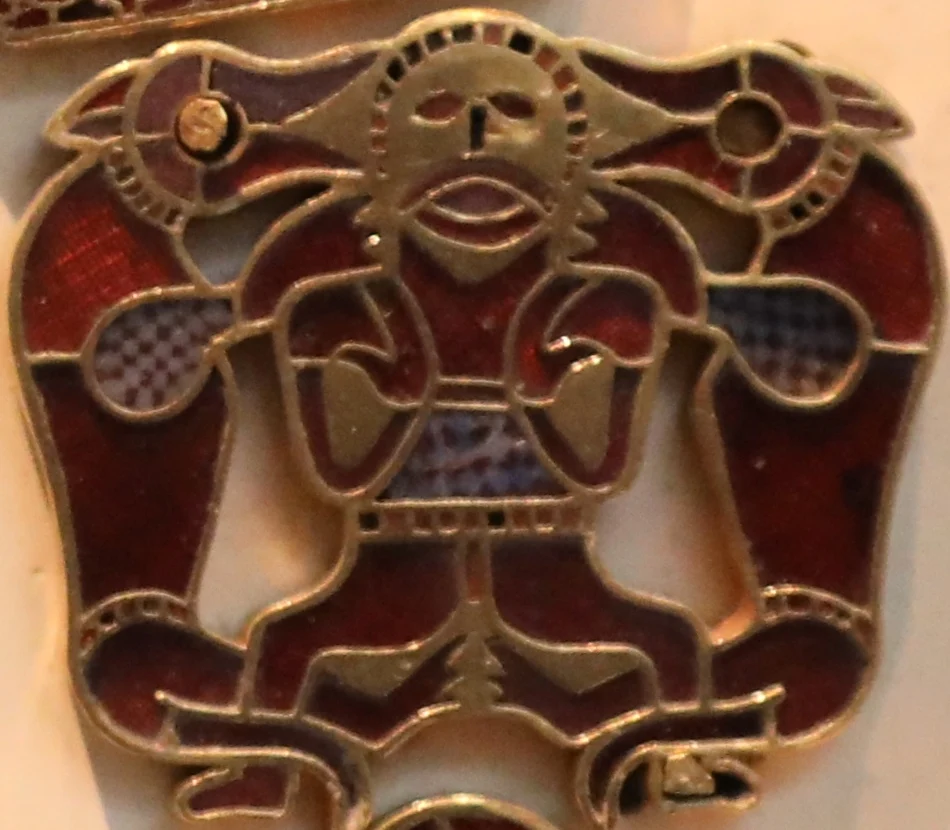
Geri and Freki
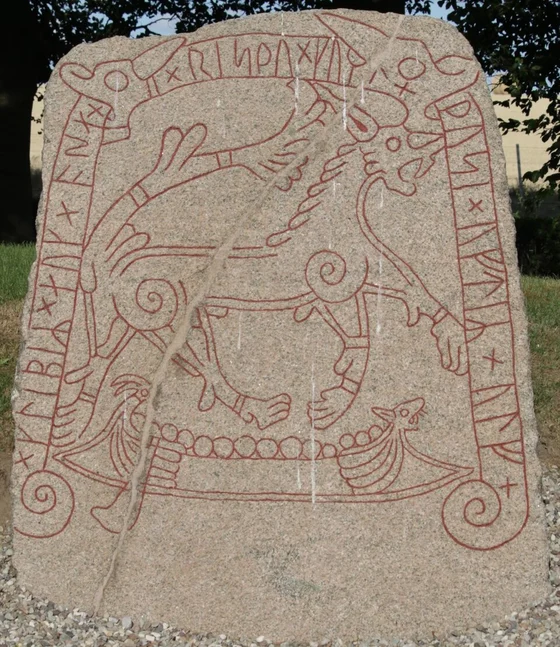
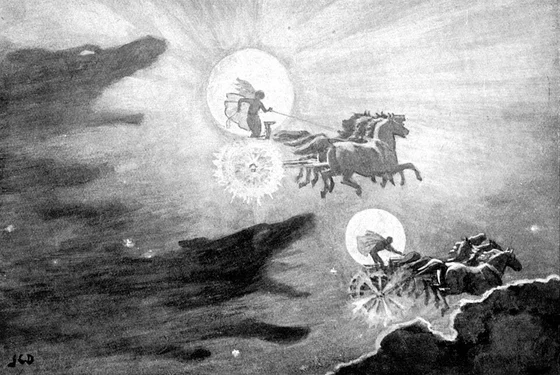
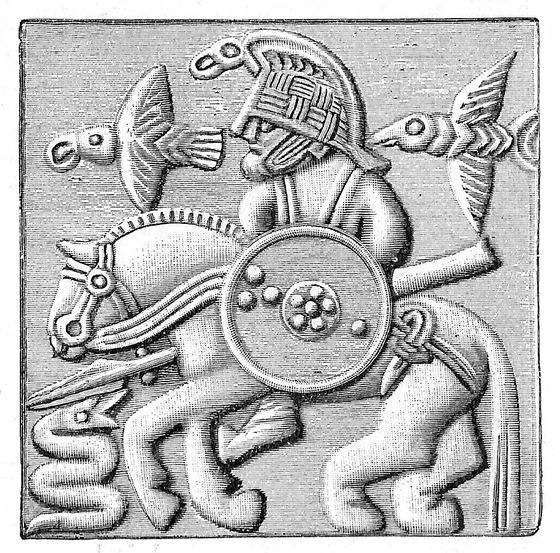
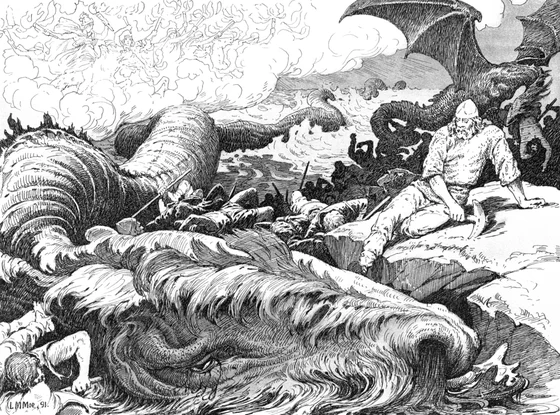
Image associated with the exact linked encyclopedia article; consult credited file description for its interpretation.
Overview
After explaining the warriors’ feast, Snorri turns to Odin’s own nourishment. The god gives the food set before him to two wolves, Geri and Freki, while wine is sufficient for him. Their appearance places recognizable predatory animals within the hall’s ordered relationships of provision rather than making them enemies of its inhabitants.
The pair is presented together because the passage supplies a shared activity and no separate sequence of adventures. Their association with Odin distinguishes them from Fenrir, who is his future adversary, and from the wolves pursuing celestial bodies. Later art or modern interpretation may develop additional symbolism, but those details require independent support. The selected text’s compact account establishes their names, recipient role and place beside the god.
Grimnismal stanza 19 supplies a poetic counterpart: Odin satisfies Geri and Freki while living on wine himself. Stanza 18 immediately before it concerns the warriors’ boiled meat, and stanza 20 moves to his travelling ravens. Brodeur’s prose XXXVIII combines these adjoining topics into a question about Valhall’s provisions. Its footnotes gloss Geri as Ravener and Freki as Glutton or greedy; these are the translator’s explanatory name glosses, not additional adventures or precise bodily descriptions.
Origins & earliest records
This entry follows Gylfaginning, sections XXXVIII, in Snorri Sturluson’s Prose Edda, composed around 1220 and translated here by Arthur Gilchrist Brodeur in 1916. The medieval work incorporates older poetic traditions, but its compilation date does not establish the beginning of a being’s oral history or every earlier attestation.
Records & interpretation
The cited prose describes named wolf pair and situates the named being within an account of the Norse world. This preserved literary witness documents representation and transmission, rather than the biological existence of its subject. Older poetry, archaeological imagery and modern religious interpretation each need distinct evidence and should not be treated as interchangeable.
In the literature
“The food that is placed on his table he gives to his two wolves, which hight Gere and Freke.”
The Fooling of Gylfe, chapter XII, section 39, paragraph following the Andhrimner verse · Rasmus Björn Anderson
Odin gives his table food to his two wolves.
Selected bibliography
Documented works and useful reading. This is not a list of every appearance.
- 01
Prose Edda: Gylfaginning, sections XXXVIII
Selected public-domain prose witness. Numbering follows the linked Brodeur translation; neither a universal canon nor an exhaustive bibliography.
- 02
Grimnismal, The Lay of Grimnir, stanzas 18–20, especially 19
Stanza 19 names both recipients of Odin’s food; adjoining stanzas concern the feast and ravens. Brodeur XXXVIII supplies explicit wolf identification and name glosses.
- 03
The Younger Edda
Chicago: Scott, Foresman and Company, 1901; translation copyright 1879, with translator’s preface dated September 1879.
Family, evolution & connections
Odin
Gylfaginning chapter XXXVIII explains that Odin gives the food on his table to Geri and Freki while sustaining himself with wine. The text establishes a feeding relationship between the god and his two wolves. It does not identify the wolves as his children or treat divine companionship as biological descent.
Located primary passages
Specific passages supporting details in this entry, grouped by their published witness.
Primary source witness
Chicago: Scott, Foresman and Company, 1901; translation copyright 1879, with translator’s preface dated September 1879.
- Odin gives his table food to his two wolves.
The Fooling of Gylfe, chapter XII, section 39, paragraph following the Andhrimner verse
This documents Snorri’s literary account in Anderson’s translation, not zoological existence or a universal account of all Norse traditions.
Encyclopedia background
An additional attributed reference, separate from the editorial profile above.
Read the open encyclopedia overview
In Norse mythology, Geri and Freki (roughly "Greed" and "Glutton") are two wolves which are said to accompany the god Odin. They are attested in the Poetic Edda, a collection of epic poetry compiled in the 13th century from earlier traditional sources, in the Prose Edda, written in the 13th century by Snorri Sturluson, and in the poetry of skalds.
The pair has been compared to similar figures found in Greek, Roman and Vedic mythology, and may also be connected to beliefs surrounding the Germanic "wolf-warrior bands", the Úlfhéðnar.
Text from Wikipedia contributors, “Geri and Freki”. CC BY-SA 4.0. Extracted introduction; formatting changed. Retrieved 5 October 2026. The source article may have changed since retrieval.
References
Sources supporting this profile. Linked pages have their own scope and editorial standards.
- Primary textThe Prose Edda: Gylfaginning XXXVIII (Brodeur translation)Research access: 2026-10-05
- Primary poem in historical translationThe Elder Eddas: Thorpe’s Grimnir translation, 1906 collected editionResearch access: 2026-10-05
Image credits
Reference illustrationGeri and Freki
Image associated with the exact linked encyclopedia article; consult credited file description for its interpretation.