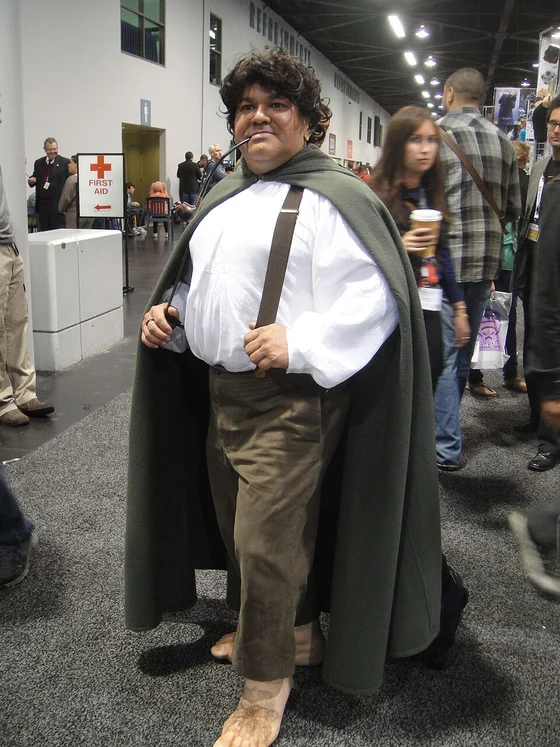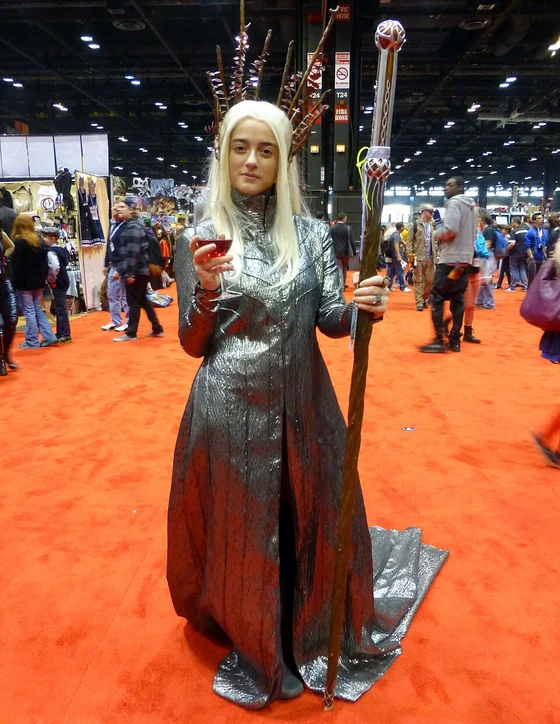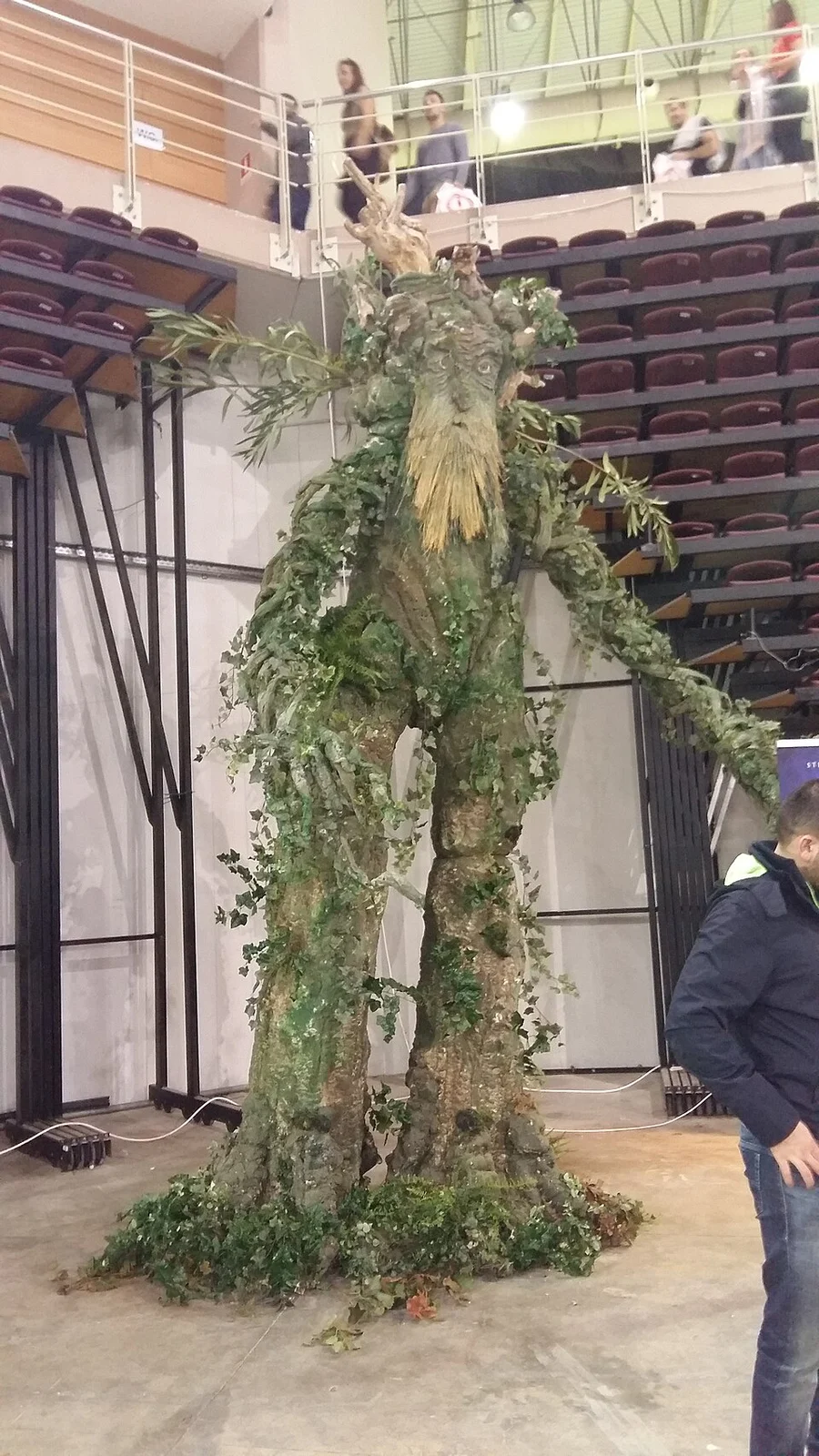
Ent costume at AthensCon 2017
Fan costume photograph.
Overview
Ents are the tree shepherds of Tolkien's Middle-earth, ancient beings whose bodies resemble trees without making every tree an Ent. Treebeard introduces Merry and Pippin to a culture of long names, careful speech and memories extending far beyond the hobbits' experience. Their disappearance and the absence of the Entwives give that antiquity an intimate sadness.
The attack on Isengard makes their relationship with woodland politically consequential: prolonged patience does not prevent decisive anger at destruction. Huorns and ordinary trees require separate identification rather than automatic inclusion in the species. Ents are therefore both inhabitants of a threatened landscape and characters whose deliberation changes the course of the war.
Writing to W. H. Auden in 1955, Tolkien linked the Ent name to Old English and connected their march to war with his disappointment at Shakespeare's treatment of Birnam Wood. He distinguished this later analysis from conscious invention: Treebeard's chapter had emerged with the feeling of discovering someone else's story.
First appearances & development
The Two Towers (1954) gives the principal published narrative treatment. This entry follows the version represented by the primary works listed below, rather than treating the name as a single creature shared by every adaptation. Published Tolkien texts are the baseline; screen adaptations and unfinished textual variants remain distinct.
Canon & continuity
Primary basis: The Two Towers (1954); comparison: The Letters of J. R. R. Tolkien (1981). The bibliography identifies the relevant fictional treatments, while the linked guide supports identification and context. Exact page references, exhaustive first-appearance research and edition-independent mechanics are outside this profile. Published Tolkien texts are the baseline; screen adaptations and unfinished textual variants remain distinct.
Selected bibliography
Documented works and useful reading. This is not a list of every appearance.
- 01
The Two Towers
Ents, Orcs and the destruction of Isengard.
- 02
The Letters of J. R. R. Tolkien
Author correspondence; pagination depends on edition.
Family, evolution & connections
Giant sequoia
Ents are sentient beings associated with trees, whereas a giant sequoia is a living plant described through growth, age and habitat. Their scale and forest associations invite comparison, but no cited author statement identifies sequoias as Tolkien's specific model. The edge preserves the distinction between personified tree imagery and botanical facts about a particular species.
Encyclopedia background
An additional attributed reference, separate from the editorial profile above.
Read the open encyclopedia overview
Ents are giant humanoids in J. R. R. Tolkien's fantasy world of Middle-earth who closely resemble trees; their leader is Treebeard of Fangorn forest. Their name is derived from an Old English word for "giant".
The Ents appear in The Lord of the Rings as ancient shepherds of the forest and allies of the free peoples of Middle-earth during the War of the Ring. The Ent who figures most prominently in the book is Treebeard, who is called the oldest creature in Middle-earth. At that time, there are no young Ents (Entings) because the Entwives (female Ents) were lost. Akin to Ents are Huorns, whom Treebeard describes as a transitional form of trees which become animated or, conversely, as Ents who grow more "treelike" over time.
Tolkien stated that he was disappointed by Shakespeare's handling of the coming of "Great Birnam Wood to High Dunsinane hill"; he wanted a setting in which the trees would actually go to war. Commentators have seen this as wish-fulfilment, as he disliked the damage being done to the English countryside in his lifetime. Scholars have seen his tale of the Ents as a myth, mostly without analysing it. Corey Olsen interprets the song of the Ents and the Entwives as a myth that warns of the dangers of apathetically isolating oneself in nature, whereas the Ents' song "In the willow-meads of Tasarinan" is a lament.
Inspired by Tolkien and similar traditions, animated or anthropomorphic tree creatures appear in a variety of media and works of fantasy.
Text from Wikipedia contributors, “Ent”. CC BY-SA 4.0. Extracted introduction; formatting changed. Retrieved 5 October 2026. The source article may have changed since retrieval.
References
Sources supporting this profile. Linked pages have their own scope and editorial standards.
- ReferenceEnt — reference guideResearch access: 2026-10-05
- Primary workLetter to W. H. Auden, 7 June 1955 — Ent composition and inspirationResearch access: 2026-10-05
Image credits
Cosplay interpretationEnt costume at AthensCon 2017
Fan costume photograph.