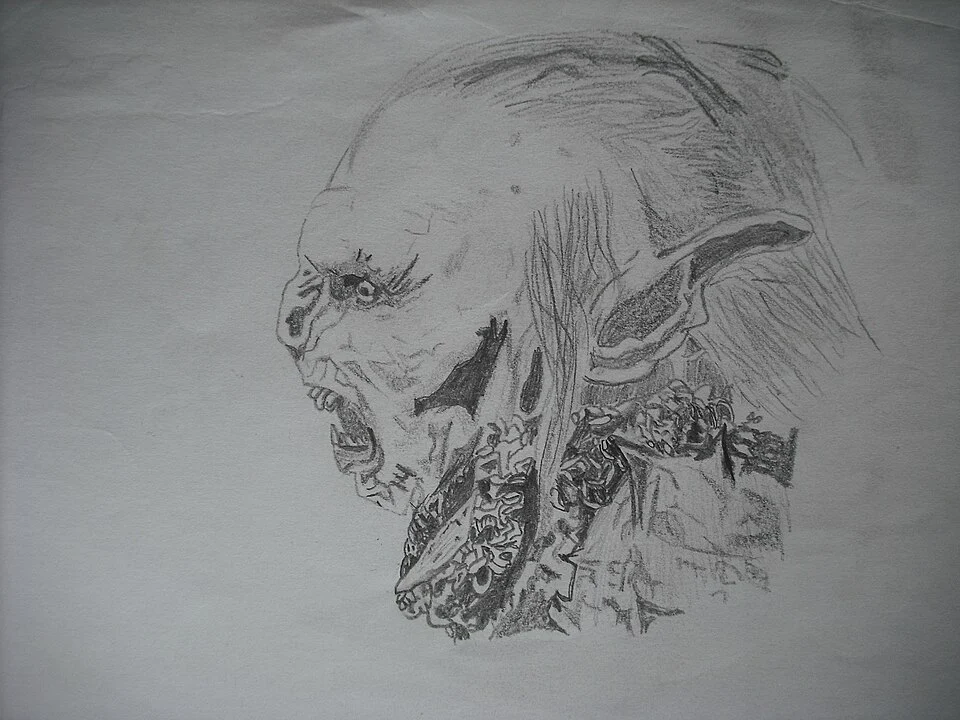
Mordor orc fan artwork
Specific Tolkien subject; original fan artwork.
Overview
Orcs are hostile peoples prominent in the armies and strongholds of Middle-earth's dark powers. The Hobbit frequently calls such beings goblins, while The Lord of the Rings uses Orc across varied groups. They speak, argue, organize and quarrel, so the books depict more than mindless monsters even when their encounters with protagonists are violent.
Tolkien revised and struggled with accounts of their origins, making a single unqualified creation story misleading. The conversation between Orcs in the later narrative also exposes resentment toward commanders. Screen adaptations emphasize particular bodies and military designs; those images should not replace the published texts' more complicated treatment of language, servitude and agency.
First appearances & development
The Hobbit (1937) presents goblins; later published Middle-earth works develop Orc terminology and history. This entry follows the version represented by the primary works listed below, rather than treating the name as a single creature shared by every adaptation. Published Tolkien texts are the baseline; screen adaptations and unfinished textual variants remain distinct.
Canon & continuity
Primary basis: The Hobbit (1937); comparison: The Two Towers (1954). The bibliography identifies the relevant fictional treatments, while the linked guide supports identification and context. Exact page references, exhaustive first-appearance research and edition-independent mechanics are outside this profile. Published Tolkien texts are the baseline; screen adaptations and unfinished textual variants remain distinct.
Selected bibliography
Documented works and useful reading. This is not a list of every appearance.
- 01
The Hobbit
Published novel; later revisions should be identified when quoting.
- 02
The Two Towers
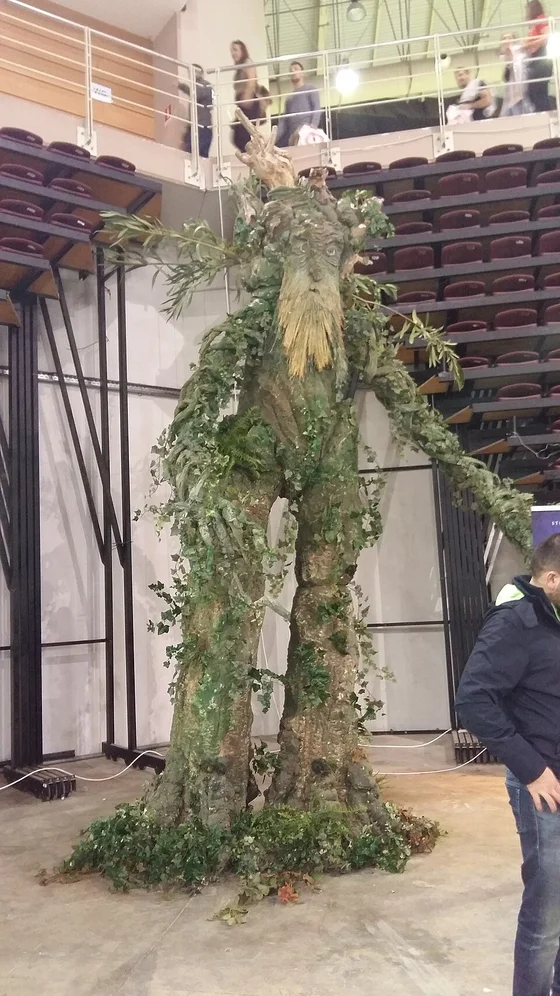
Ents, Orcs and the destruction of Isengard.
Family & connections
A source-supported family tree or inspiration record has not yet been compiled for this profile. Related reading below indicates a connection in subject matter, not a proven lineage or creative influence.
Encyclopedia background
An additional attributed reference, separate from the editorial profile above.
Read the open encyclopedia overview
An orc (sometimes spelt ork; ) is a fictional race of humanoid monsters often found in works of modern fantasy. Originally called "Goblins," the concept of modern orcs can be found in George MacDonald's The Princess and the Goblin, and later adapted into J. R. R. Tolkien's Middle-earth fantasy fiction, where the first uses of the word can be found.
In Tolkien's The Lord of the Rings, orcs appear as a brutish, aggressive, ugly, and malevolent race of monsters, contrasting with the benevolent Elves. He described their origins inconsistently, including as a corrupted race of elves, or bred by the Dark Lord Morgoth, or turned to evil in the wild. Tolkien's orcs serve as a conveniently wholly evil enemy that could be slaughtered without mercy.
The orc was a sort of "hell-devil" in Old English literature, and the orc-né (pl. orc-néas, "demon-corpses") was a race of corrupted beings and descendants of Cain, alongside the elf, according to the poem Beowulf. Tolkien adopted the term orc from these old attestations, which he professed was a choice made purely for "phonetic suitability" reasons.
Tolkien's concept of orcs has been adapted into the fantasy fiction of other authors, and into games of many different genres such as Dungeons & Dragons, Magic: The Gathering, and Warcraft.
Text from Wikipedia contributors, “Orc”. CC BY-SA 4.0. Extracted introduction; formatting changed. Retrieved 5 October 2026. The source article may have changed since retrieval.
References
Sources supporting this profile. Linked pages have their own scope and editorial standards.
- ReferenceOrc (Middle-earth) — reference guideResearch access: 2026-10-05
- Primary workDraft continuation to Rhona Beare, October 1958 (not sent) — one Elven-corruption accountResearch access: 2026-10-05
Image credits
Exact subjectMordor orc fan artwork
Specific Tolkien subject; original fan artwork.