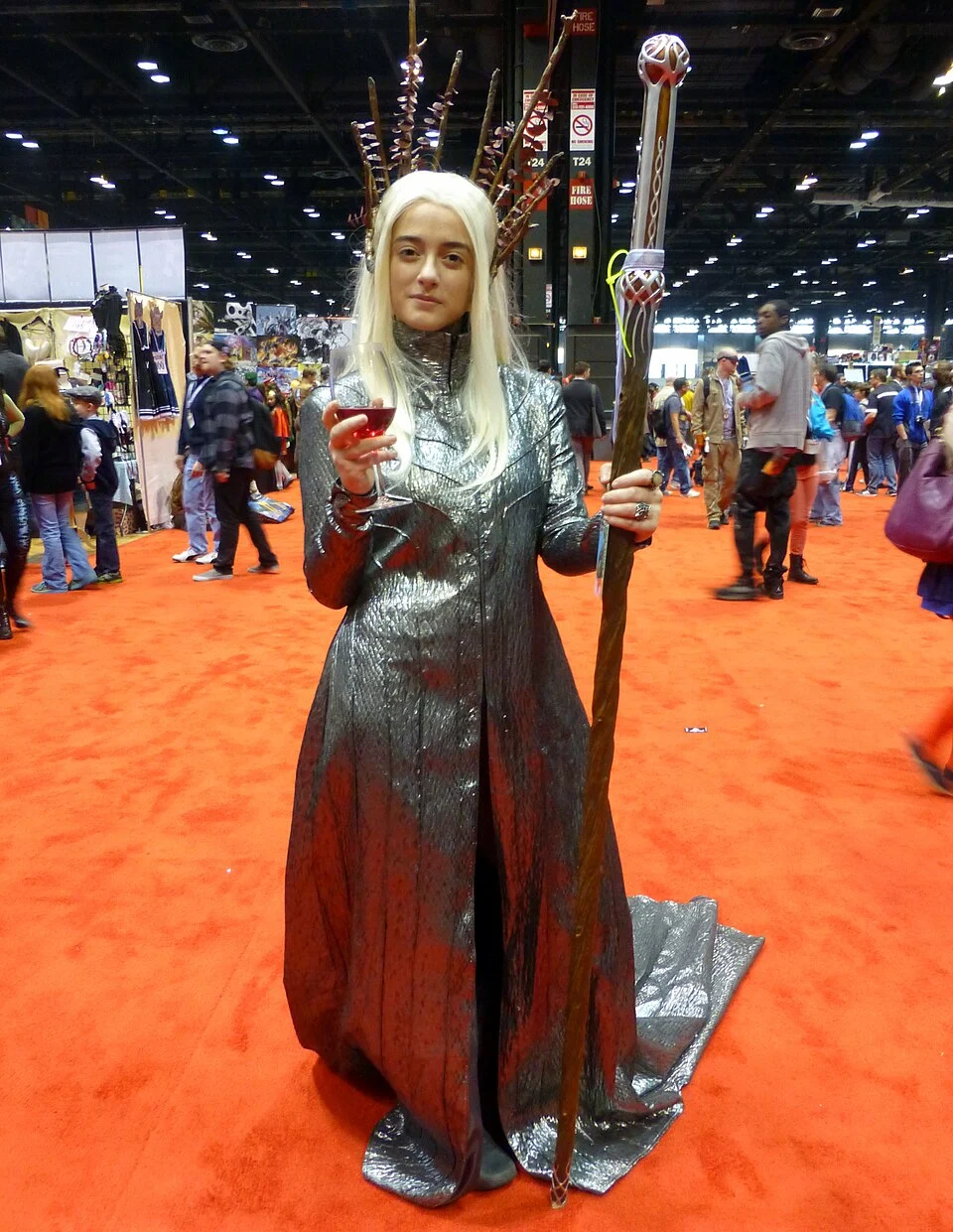
Middle-earth elf: Thranduil cosplay at C2E2 2015
Exact named character costume photograph; contemporary interpretation, not official character artwork or a universal anatomical model. Actual Commons source describes the named character and event. Photographer license verified in returned imageinfo; Visually inspected: silver-robed long-haired Thranduil costume with branch crown and staff; exact named movie-elf interpretation.
Overview
Tolkien's Elves are a people with a deep history of migration, loss, craftsmanship and divided loyalties. Their enduring lives bind them to the world and give their memories a weight unlike ordinary human recollection. The Wood-elves of The Hobbit, the Eldar of older histories and the travellers of The Lord of the Rings are related but not interchangeable groups.
Calling them simply immortal misses the stories' concern with grief, bodily death and the passing of ages. Nor does their beauty make every Elven decision wise or benevolent. Their portrayal belongs to Tolkien's particular cosmology and language traditions; it should remain separate from folkloric elves, Tamriel's Dunmer and playable elves in unrelated games.
First appearances & development
Tolkien's published Middle-earth elves appear in The Hobbit (1937), with earlier composition history beyond this bibliography. This entry follows the version represented by the primary works listed below, rather than treating the name as a single creature shared by every adaptation. Published Tolkien texts are the baseline; screen adaptations and unfinished textual variants remain distinct.
Canon & continuity
Primary basis: The Hobbit (1937); comparison: The Silmarillion (1977). The bibliography identifies the relevant fictional treatments, while the linked guide supports identification and context. Exact page references, exhaustive first-appearance research and edition-independent mechanics are outside this profile. Published Tolkien texts are the baseline; screen adaptations and unfinished textual variants remain distinct.
Selected bibliography
Documented works and useful reading. This is not a list of every appearance.
- 01
The Hobbit
Published novel; later revisions should be identified when quoting.
- 02
The Silmarillion
Posthumously edited First Age narratives.
Family & connections
A source-supported family tree or inspiration record has not yet been compiled for this profile. Related reading below indicates a connection in subject matter, not a proven lineage or creative influence.
Encyclopedia background
An additional attributed reference, separate from the editorial profile above.
Read the open encyclopedia overview
In J. R. R. Tolkien's writings, Elves are the first fictional race to appear in Middle-earth. Unlike Men and Dwarves, Elves do not die of disease or old age. Should they die in battle or of grief, their souls go to the Halls of Mandos in Aman. After a long life in Middle-earth, Elves yearn for the Earthly Paradise of Valinor, and can sail there from the Grey Havens. They are prominent in The Hobbit and The Lord of the Rings, and their history is described in detail in The Silmarillion.
Tolkien derived Elves from mentions in the ancient poetry and languages of Northern Europe, especially Old English. These suggested to him that Elves were large, dangerous, beautiful, lived in wild natural places, and practised archery. He invented languages for the Elves, including Sindarin and Quenya.
Tolkien-style Elves have become a staple of fantasy literature. They have appeared, too, in film and role-playing game adaptations of Tolkien's works.
Text from Wikipedia contributors, “Elves in Middle-earth”. CC BY-SA 4.0. Extracted introduction; formatting changed. Retrieved 5 October 2026. The source article may have changed since retrieval.
References
Sources supporting this profile. Linked pages have their own scope and editorial standards.
- ReferenceElf (Middle-earth) — reference guideResearch access: 2026-10-05
- Primary workDraft continuation to Rhona Beare, October 1958 (not sent) — Elven longevity and bodily deathResearch access: 2026-10-05
Image credits
Cosplay interpretationMiddle-earth elf: Thranduil cosplay at C2E2 2015
Exact named character costume photograph; contemporary interpretation, not official character artwork or a universal anatomical model. Actual Commons source describes the named character and event. Photographer license verified in returned imageinfo; Visually inspected: silver-robed long-haired Thranduil costume with branch crown and staff; exact named movie-elf interpretation.